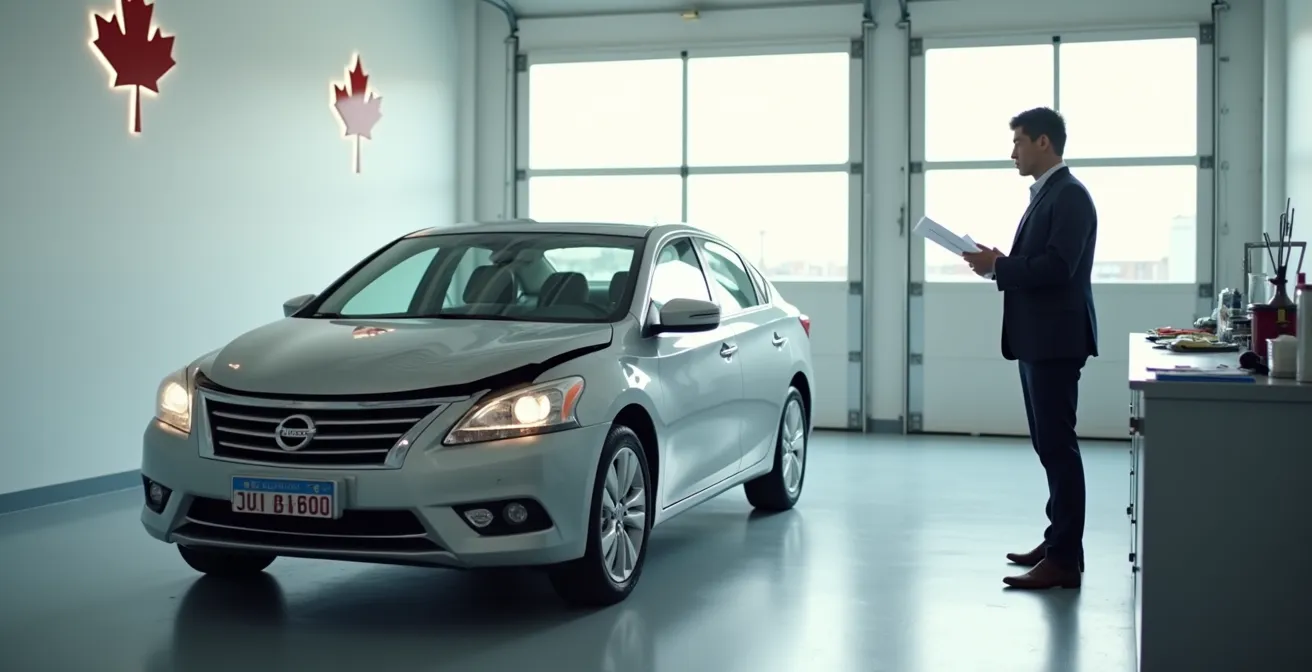
Your insurer’s first offer isn’t a negotiation tactic; it’s a flawed calculation you have the power to dismantle and rebuild.
- Insurers use automated reports that apply hidden « conditioning » deductions and cherry-picked comparable vehicles to lower your car’s Actual Cash Value (ACV).
- The key to a higher payout is not arguing about the final number, but systematically auditing their valuation report and providing superior evidence for your vehicle’s true worth.
Recommendation: Request the insurer’s detailed Comparable Vehicle Report (CVR) immediately. This document is the blueprint for their offer and the starting point for your counter-offer.
The call from your insurance adjuster is a gut punch. Your car isn’t just damaged; it’s a « total loss, » a write-off. The initial shock is quickly replaced by another: the payout offer. It’s thousands of dollars less than what you paid, and nowhere near enough to buy a replacement. You’ve heard the standard advice: « don’t accept the first offer, » « get your own appraisal, » or « show them ads for similar cars. » While not entirely wrong, this advice misses the fundamental truth of the process. It positions you as a haggler in a marketplace when you should be acting as an auditor of a flawed financial report.
As a former claims adjuster, I can tell you the adjuster on the other end of the line isn’t necessarily trying to cheat you. They are following a process, one that relies on third-party valuation software that is systematically designed to minimize payouts. The number they gave you is simply the output of an algorithm. Your job isn’t to emotionally appeal for « more money. » Your job is to surgically dissect their valuation, challenge its weak points with superior data, and force them to manually recalculate a value that reflects reality. This isn’t about arguing; it’s about providing undeniable proof that their inputs are wrong.
This guide will give you the insider playbook. We’ll move beyond generic tips and give you the specific steps to deconstruct the insurer’s offer. We will cover how to find the right evidence to prove your car’s true market value, analyze the financial trap of buying back your written-off vehicle, and leverage the insurer’s own delays to your advantage. You’ll learn to speak the language of adjusters and turn their process against them to secure the fair compensation you’re entitled to.
This article provides a structured approach to your negotiation. The following sections break down each critical stage of the process, equipping you with the knowledge to counter the insurer’s initial offer with confidence and data.
Summary: An Insider’s Guide to Negotiating Your Total Loss Payout in Canada
- Why the insurance offer is thousands less than what you paid?
- How to find comparable listings to prove your car is worth more?
- Is it ever worth buying back your written-off car to repair it?
- Why a « Rebuilt » title destroys 40% of your car’s future resale value?
- How long can you hold a rental car while negotiating the payout?
- How does a carbon fiber chassis impact your collision deductible?
- Why US medical costs make standard Canadian liability limits risky?
- Carbon Fiber and Aluminum: Why Do Repairs Cost 40% More in Canada?
Why the insurance offer is thousands less than what you paid?
The gap between your purchase price and the insurer’s offer is primarily caused by two factors: rapid depreciation and the use of « conditioning » adjustments. The moment you drive a new car off the lot, its value begins to fall. In Canada, it’s not uncommon to see a 20% value loss in the first year alone. This is the starting point for the insurer’s calculation, known as the Actual Cash Value (ACV), which is what your car was worth seconds before the collision, not what you paid for it.
However, depreciation is only half the story. The real issue lies in the Comparable Vehicle Report (CVR) the adjuster uses. This report, generated by a third-party service, finds similar vehicles for sale and then applies « conditioning adjustments » to your car’s value. These are deductions for mileage, prior damage, tire wear, and even minor cosmetic flaws. Often, these deductions are based on assumptions, not a physical inspection. An adjuster might deduct $500 for « worn tires » without ever seeing them. They also often miss or undervalue optional packages and recent upgrades you’ve made.
This is where you fight back. You must demand the full CVR and treat it like an invoice you’re auditing. Your goal is to challenge every unjustified deduction and provide proof for every feature they missed. This systematic deconstruction is far more effective than simply asking for a higher number. For new car owners, investigate if you have the OPCF 43 endorsement (or its equivalent in your province), which waives depreciation for a set period.
Your Action Plan: Challenging Hidden Insurance Deductions
- Request the Report: Demand a complete copy of the Comparable Vehicle Report (CVR) or valuation breakdown showing all adjustments.
- Audit « Conditioning »: Scrutinize every line item for « conditioning » adjustments. Dispute any deductions not supported by evidence from the pre-loss condition of your vehicle.
- Document Options: Provide your original bill of sale or window sticker to prove the existence of higher-value option packages the report may have missed.
- Question Salvage Value: Ask for the written bids from salvage yards (like Copart or IAA in Canada) that were used to determine the salvage value deduction.
- Add the Taxes: Ensure the final settlement offer explicitly includes the applicable GST/HST/PST you would pay to purchase a replacement vehicle. This is legally required.
How to find comparable listings to prove your car is worth more?
Once you have the insurer’s CVR, your primary mission is to prove their « comparable » vehicles are inadequate. The insurer’s software often pulls listings from a wide geographic area, includes vehicles with higher mileage, or omits vehicles from pricier dealership lots. Your task is to build a superior report of truly comparable vehicles, focusing on listings that are as close as possible to your car’s pre-loss state.
Focus your search on reputable Canadian automotive sites like AutoTrader.ca, Clutch.ca, and dealer websites. Define a tight geographic radius around your location (e.g., within 200 km) to reflect your local market. The key is an « apples-to-apples » comparison. Your list of comparables should match your car’s:
- Year, make, and model (exact trim level is crucial)
- Kilometrage (within a 10-15% range)
- Option packages (Sport, Tech, Luxury, etc.)
- Condition (private sales are okay, but dealer listings carry more weight)
This paragraph introduces the concept of gathering evidence. To illustrate this process, the image below shows how you should organize your findings for maximum impact.

As you can see, compiling your evidence in a structured way is critical. Create a spreadsheet or a simple document for 3-5 vehicles. For each one, save a PDF or a screenshot of the full ad, including the date, URL, asking price, and Vehicle Identification Number (VIN). Present this package to the adjuster via email. You are not just sending links; you are delivering a competing valuation report. If the adjuster refuses to consider your data and you are at a stalemate, you can invoke the appraisal clause in your policy, a formal dispute resolution process available in most Canadian provinces.
Is it ever worth buying back your written-off car to repair it?
When your car is written off, the insurer technically buys it from you. The salvage value—what a scrap yard is willing to pay for the wreck—is deducted from your final payout. You have the option to « buy back » your car by forgoing that salvage value portion of the settlement. For instance, if your car’s ACV is $15,000 and the salvage value is $3,000, you can take a cheque for $12,000 and keep the vehicle. While tempting, especially if the damage seems cosmetic, this is a financial minefield.
The decision requires cold, hard math. You must get a detailed, written repair estimate from a trusted body shop. Then, you need to factor in the costs of provincial safety certifications. In provinces like Ontario and Alberta, this includes a mandatory Structural Integrity Inspection, which can cost between $500 and $1,500 alone. This is a rigorous inspection to ensure the frame and key components are sound after the repair.
Most importantly, you must account for the vehicle’s « diminished value. » Once repaired, your car will have a « Rebuilt » or « Salvage » title, which permanently stigmatizes it. This title will make it harder to insure and will slash its future resale value, often by a significant margin. The following table breaks down the financial reality of this decision.
| Calculation Component | Typical Amount (CAD) | Impact on Decision |
|---|---|---|
| Final ACV Payout | $15,000 | Starting point for calculation |
| Salvage Value Deduction | -$3,000 | Negotiable with insurer |
| Cash Received | $12,000 | Actual money in hand |
| Repair Costs | $8,000 | Must get detailed estimate |
| Certification Costs | $500-1,500 | Provincial inspection fees |
| Diminished Value (40%) | -$6,000 | Future resale impact |
As the numbers show, even if the cash received covers the repairs, the future loss in value often makes buying back a poor financial choice. The only exceptions are for rare or classic cars where value is less tied to a clean title, or if you are a licensed mechanic who can perform the repairs and certification at a significantly lower cost. For most people, it’s better to take the full payout and move on.
Why a ‘Rebuilt’ title destroys 40% of your car’s future resale value?
A « Rebuilt » title is a permanent brand on a vehicle’s history, signaling to all future buyers that it was once declared a total loss. This stigma is powerful and directly translates to a massive drop in value. Even if repaired to perfection by a certified facility, a rebuilt car is viewed with suspicion. Buyers worry about hidden structural weaknesses, long-term reliability issues, and the quality of the repairs. This market perception results in a steep discount; an analysis by Clutch.ca found that in North America, rebuilt titles can lead to a 20-50% price reduction compared to their clean-title counterparts.
This financial penalty, known as « inherent diminished value, » is irreversible. When you try to sell or trade in the vehicle later, dealers and private buyers will immediately offer significantly less, regardless of its current condition. Many dealerships have policies against accepting rebuilt vehicles as trade-ins altogether, further shrinking your market of potential buyers.
The process to get a rebuilt title is also arduous. It requires passing stringent safety inspections to prove the vehicle is roadworthy, a process that ensures unsafe vehicles are kept off the road but adds cost and complexity for the owner.
Despite the steep value depreciation, Canadian regulations offer some robust consumer protections that are stricter than in some other jurisdictions. This ensures that the rebuilt cars on the market meet a higher safety standard.
Canadian rebuilt titles come with strict protections. Unlike some jurisdictions, Canada permanently bans flood-damaged vehicles from receiving rebuilt status. This high standard helps protect buyers, while the Interprovincial Record Exchange network ensures the rebuilt status follows vehicles across provincial borders.
– Clutch.ca Research Team, Rebuilt Title Cars in Canada: What You Need to Know in 2025
While these protections make the Canadian market for rebuilt cars safer, they do not erase the financial hit. The 40% average drop in resale value is a very real cost that must be factored into any decision to repair a write-off.
How long can you hold a rental car while negotiating the payout?
Your right to a rental car during a total loss negotiation is one of your most powerful pieces of leverage, but it’s often misunderstood. Most Canadian auto policies include a « Loss of Use » endorsement (like OPCF 20 in Ontario or SEF 20 in Alberta) that covers transportation replacement. However, these endorsements have limits, typically a total dollar amount (e.g., $1,500) or a daily cap (e.g., $50/day).
Adjusters will often pressure you by stating your rental coverage is « running out » to push you into accepting a low offer. Here’s the insider secret: if the delay in settlement is due to the insurer’s failure to provide a fair and timely offer, you can argue that they are responsible for covering the rental beyond your policy limits. This is based on the principle of « unreasonable delay. » If their lowball offer is the reason negotiations are dragging on, they can’t penalize you for it.
The key is to differentiate the cause of the delay. If the hold-up is due to backlogs at the repair shop or parts availability (in a repair scenario), that is not the insurer’s fault. But in a total loss negotiation, the delay is almost always related to the valuation and offer process.
Case Study: Negotiation Delays vs. Repair Delays
In Canadian claims, insurers draw a hard line between delays in settlement negotiations versus repair shop delays. If your rental costs exceed your policy limits because the insurer’s initial offer was demonstrably unfair and forced a lengthy negotiation, you have a strong case to argue for coverage beyond the stated limits. You must document every communication to prove the insurer caused an « unreasonable delay. » Conversely, if your car was being repaired and delays were caused by parts shortages or shop availability, those costs typically fall outside the insurer’s responsibility and your coverage will be capped by your policy limits.
To use this as leverage, you must document everything. Keep a log of all calls and save all emails. If the adjuster is slow to respond or refuses to acknowledge your comparable vehicle evidence, you are building a case for unreasonable delay. Send a formal email stating that their failure to provide a fair offer is extending the claim cycle and that you expect them to cover the ongoing rental costs until a reasonable settlement is reached. If they refuse, you can escalate the matter to the insurer’s internal ombudsman or the General Insurance OmbudService (GIO) for Canada.
How does a carbon fiber chassis impact your collision deductible?
While the material of your car’s chassis doesn’t directly change your collision deductible amount, it has a massive, indirect impact: it dramatically increases the likelihood of your car being declared a total loss. Vehicles constructed with exotic materials like carbon fiber or aluminum monocoques are notoriously expensive and difficult to repair. Insurers in Canada know this and factor it into their risk assessment, which affects both your premiums and the outcome of a claim.
The threshold for writing off a vehicle is typically when repair costs reach a certain percentage of its ACV. In Canada, this is generally when repairs are estimated to cost 70-80% of the vehicle’s pre-accident value. For a standard steel-frame car, this threshold allows for significant damage before a write-off. For a carbon fiber car, even minor-looking damage can require highly specialized technicians and equipment, causing repair bills to skyrocket past that threshold very quickly.
This reality is especially acute in Canada, where certified repair facilities for these materials are concentrated in major metropolitan areas like Toronto, Vancouver, and Montreal. The logistics of transporting a vehicle and the high labour costs create a perfect storm for an early total loss declaration.
The Canadian Reality: Exotic Material Repair Costs
Consider modern vehicles like the BMW i8 or Chevrolet Corvette C8, which feature extensive carbon fiber components. In the Canadian market, even minor structural damage can lead to repair bills that exceed the car’s Canadian ACV. This high risk of total loss significantly impacts insurance premiums. For owners of such vehicles, purchasing a depreciation waiver endorsement like the OPCF 43 in Ontario becomes more valuable than ever, as it can protect their investment from the high probability of a write-off in the first few years of ownership.
So, while your deductible remains the same, owning a carbon fiber vehicle means you are statistically far more likely to face a total loss negotiation rather than a repair process. This makes understanding how to negotiate your ACV—the focus of this guide—absolutely critical from day one of ownership.
Why US medical costs make standard Canadian liability limits risky?
While this guide focuses on your own vehicle’s payout, a total loss accident that occurs in the United States introduces a dangerous new dimension: liability. If you are found at fault for an accident south of the border, you are exposed to the US healthcare and legal systems, where costs can be astronomically higher than in Canada. A standard Canadian auto policy might have a liability limit of $1 million, which can be wiped out by a single serious injury claim in the US.
This is why many experts recommend Canadians carry a minimum of $2 million in third-party liability coverage if they plan to drive in the US. The risk isn’t just financial ruin from a lawsuit; it also complicates your own total loss claim. A cross-border claim involves coordination between Canadian insurers and US-based appraisers, tow yards, and salvage companies like Copart US. This process is inherently slower and more complex, leading to significant delays that can quickly exhaust your standard Loss of Use (rental car) coverage.
Cross-border claims add significant complexity. When a Canadian-insured vehicle is totaled in the US, insurers must coordinate with US-based appraisers and salvage yards, often leading to substantial delays that justify extended rental coverage beyond standard policy limits.
– Canadian Insurance Claims Advisory Board, Cross-Border Insurance Claims Guide 2024
If your car is totaled in the US, you can use this complexity to your advantage. Here are key considerations for a cross-border claim:
- Verify Coverage: Before you travel, confirm you have at least $2 million in liability and consider adding the OPCF 44R Family Protection endorsement to protect you from underinsured US drivers.
- Document Delays: Keep a detailed log of all cross-border communication issues, as these justify your request for extended rental coverage.
- Use Competing Estimates: Get repair estimates from both US and Canadian shops. If the Canadian estimate is higher (which is common), use it to push the insurer towards a total loss designation rather than a complicated cross-border repair.
Key takeaways
- Your insurer’s first offer is an automated calculation, not a final decision. Your goal is to audit their report, not just argue the price.
- Build a superior counter-report with 3-5 truly comparable, local vehicle listings to force a re-evaluation of your car’s Actual Cash Value.
- A « Rebuilt » title permanently slashes a car’s resale value by up to 50% in Canada, making the buy-back option a financial trap for most owners.
Carbon Fiber and Aluminum: Why Do Repairs Cost 40% More in Canada?
The premium you pay for a vehicle with an aluminum or carbon fiber chassis extends deep into its repair costs, especially in Canada. Repairs on these exotic materials can easily cost up to 40% more than identical work done in the United States, even after accounting for the exchange rate. This significant price difference is a result of several factors unique to the Canadian automotive market: import duties, limited technician availability, and parts distribution bottlenecks.
Firstly, the specialized equipment required for carbon fiber or aluminum repair—such as dedicated clean rooms, rivet guns, and bonding stations—is often imported. These imports are subject to Canadian duties and taxes, increasing the initial capital investment for body shops. This cost is inevitably passed on to the consumer or insurer. Secondly, the pool of technicians certified to work on these materials is far smaller in Canada than in the US. This scarcity drives up labour rates, with specialized technicians commanding premium hourly wages.
The following table, based on industry data, highlights the stark cost differences between the two countries for a major repair on a vehicle with exotic materials.
| Cost Factor | US Cost | Canadian Cost | Difference |
|---|---|---|---|
| Specialized Equipment Import | Base price | +15-20% duties/taxes | Higher initial investment |
| Certified Technician Labor | $100-150/hour | $150-225/hour CAD | 50% higher labor rates |
| Parts Availability | Wide distribution | Limited to major centers | Shipping delays/costs |
| Example Repair Total | $25,000 USD | $35,000 CAD | 40% increase after exchange |
This cost inflation is why an endorsement like the OPCF 43 Waiver of Depreciation is so critical for new car owners in Canada. Available from most insurers, this add-on ensures that in the event of a total loss, you receive the full purchase price of your vehicle, not its depreciated value. According to a guide from thinkinsure.ca, you can typically choose to have this protection for a period of 24 to 60 months from the purchase date. Given the high probability that an exotic material car will be written off, this endorsement acts as essential financial protection against both depreciation and Canada’s inflated repair costs.
Empowered with this insider knowledge, your next step is to put it into practice. Stop being a passive recipient of the insurance company’s offer and become an active auditor of their process. Request their full valuation report, build your evidence-based counter-offer, and negotiate from a position of strength, not desperation.
Frequently Asked Questions about Total Loss Claims in Canada
Can I negotiate the salvage value deduction?
Yes. Insurers get bids from salvage yards to determine this value. You are entitled to ask for proof of these bids. If you believe the deduction is too high, you can negotiate it down, which either increases your cash payout or lowers the cost to buy back the vehicle.
Which provinces require a Structural Integrity Inspection?
Ontario and Alberta are two provinces with mandatory Structural Integrity Inspections for vehicles being put back on the road with a « Rebuilt » title. This is a highly detailed and costly inspection, with fees often ranging from $500 to $1,500, and is separate from a standard safety certificate.
When does buying back a written-off car make sense?
It is rarely a good financial decision for the average person. However, it can be viable for rare or classic cars where the value isn’t tied to a clean title, or if you are a licensed mechanic with your own shop who can perform the extensive repairs and navigate the certification process at a significantly reduced cost.