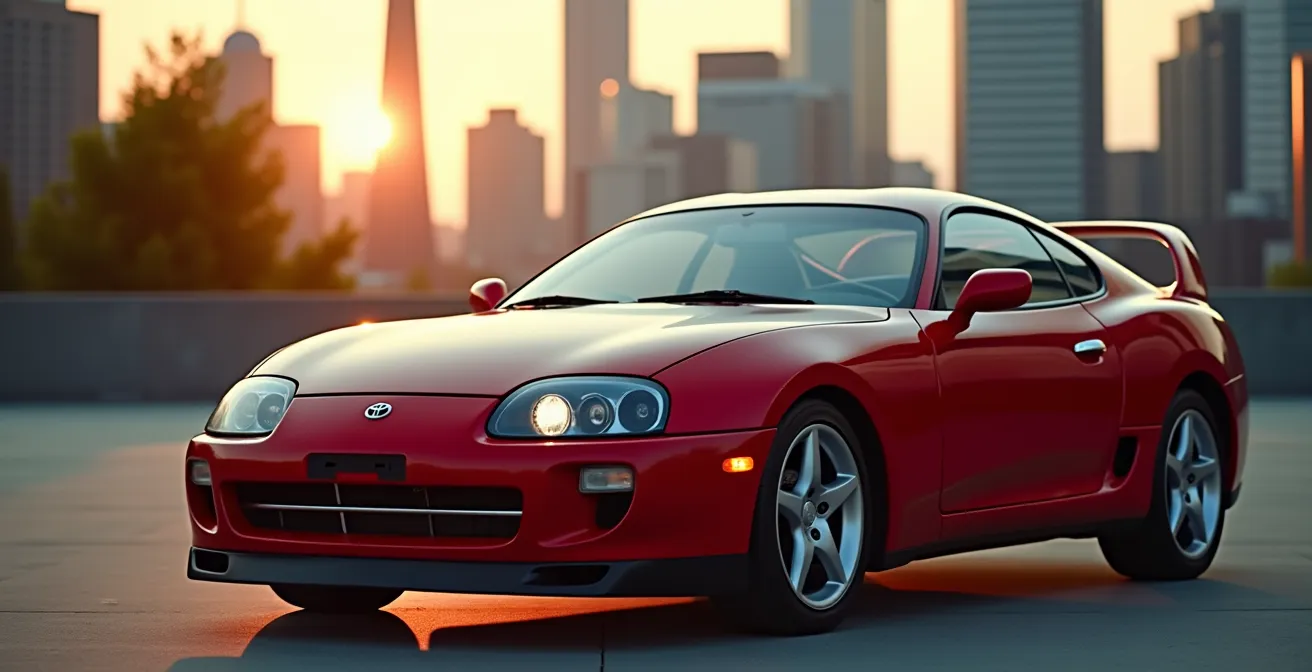
The soaring value of ’90s JDM cars is not a nostalgia-fueled bubble; it’s a predictable market reaction to Canada’s unique position as a 10-year holding zone for future US-bound classics.
- Canada’s 15-year import law creates a crucial « arbitrage window » before these vehicles become legal—and far more valuable—in the American market at 25 years.
- Hidden costs, especially Canada-specific rust issues and high-risk insurance, can completely negate appreciation potential if not expertly managed.
Recommendation: Treat any potential purchase as a financial asset. A professional, pre-purchase inspection focusing on structural integrity and provincial compliance isn’t just wise—it’s essential.
If you’ve spent any time on Canadian auto listings lately, you’ve felt it. A clean, twin-turbo Toyota Supra commands the price of a small condo. A stock Nissan Skyline GT-R is discussed with the reverence once reserved for European exotics. For any enthusiast over 30, it’s a jarring shift from the days when these were simply used, tunable sports cars. The common narrative blames nostalgia and pop culture phenomena like the « Fast & Furious » franchise. While those factors light the match, they don’t explain the financial accelerant that has turned these vehicles into a legitimate, if volatile, asset class specifically within Canada.
As a Vancouver-based appraiser, I see firsthand what separates a six-figure sale from a horror story rusting away in a garage. The conversation has moved beyond 0-60 times and aftermarket potential. Today, it’s about valuation, provincial compliance, and long-term asset protection. Many assume that buying any ’90s Japanese hero car is a guaranteed win, but they overlook the brutal realities of the Canadian market: our road salt, our complex insurance landscape, and our unique role in the larger North American collector ecosystem.
The truth is, the meteoric rise in values is not random. It’s a complex financial phenomenon driven by structural market forces. This isn’t about simply buying a piece of your youth; it’s about understanding a time-sensitive investment opportunity fraught with unique Canadian risks. Forget the generic advice. We’re going to dissect the market mechanics, expose the hidden liabilities, and build a framework for identifying a true asset-grade JDM classic in Canada.
This analysis will guide you through the critical factors defining this market. From the legal loopholes driving demand to the physical threats that can destroy your investment, we’ll cover the essential knowledge needed to navigate this high-stakes environment.
Summary : An Appraiser’s Guide to the JDM Investment Market in Canada
- Why is the 25-year import rule changing the Canadian car market landscape?
- How to import a vehicle into Canada without getting stuck at customs?
- Supra Mk4 vs New Supra: Which one really costs more to own in 2024?
- The hidden rust spots that make 80% of Ontario classics a bad investment
- How to store your investment car for 6 months to prevent depreciation?
- Why do German luxury sedans depreciate faster than Japanese SUVs?
- The subframe failure that can make your car uninspected and illegal
- How Can Young Drivers in Ontario Lower Premiums by $500?
Why is the 25-year import rule changing the Canadian car market landscape?
The core engine driving the JDM investment boom in Canada isn’t just horsepower; it’s a simple calendar arbitrage. While the United States rigidly enforces a 25-year waiting period to import non-conforming vehicles, Canada’s law is significantly more lenient, set at just 15 years. This crucial 10-year difference doesn’t just give Canadian enthusiasts early access; it creates a highly lucrative « Canadian Arbitrage Window. » For a full decade, Canada becomes the exclusive North American holding pen for iconic vehicles that are tantalizingly close to being legal—and massively valuable—to the much larger pool of American buyers.
Think of it as a financial staging ground. A savvy investor can import a 15-year-old R34 Skyline GT-R into Canada, enjoy it, and then, as it approaches its 25th birthday, market it to a legion of American collectors who have been waiting for years. This impending demand from the south acts as a powerful gravitational pull on Canadian prices long before the car is even eligible for US import. It’s no longer just a Canadian valuation; it’s a pre-emptive reflection of future American auction prices.
The numbers confirm this trend. An analysis of recent sales data shows that the most desirable JDM models are already commanding staggering figures. A pristine R34 GT-R can fetch between $148,000 and $226,000, with American buyers demonstrating a willingness to pay significant premiums for well-maintained, Canadian-domiciled examples the moment they become eligible. This dynamic fundamentally changes the nature of these cars from depreciating vehicles to appreciating assets, whose values are directly tied to a predictable, ten-year market cycle.
How to import a vehicle into Canada without getting stuck at customs?
Understanding the « why » of the market is one thing; navigating the « how » of importation is another entirely. Bringing a vehicle from Japan to a Canadian port like Vancouver is a process littered with bureaucratic pitfalls. A single missing document or a miscalculation of age can leave your investment stranded in a container, racking up costly storage fees or, in the worst-case scenario, being denied entry altogether. The process demands meticulous attention to detail, far beyond simply winning an auction and arranging shipping.

The key players in this process are Transport Canada, the Canada Border Services Agency (CBSA), and the Registrar of Imported Vehicles (RIV). Each has its own set of stringent requirements. The vehicle’s age, for instance, is calculated from the month and year of manufacture, not the model year—a mistake that has caught many first-time importers. Furthermore, while most of Canada adheres to the 15-year rule, provinces like Quebec add their own layer of complexity, often requiring a vehicle to be 25 years old for registration, drastically altering its viability depending on your location.
Your 5-Step Audit for a Compliant JDM Import to Canada
- Verify Eligibility & Paperwork: Confirm the car is over 15 years old from its specific month of manufacture. Collect the original Bill of Lading, Japanese Export Certificate (original, not a copy), and a Commercial Invoice.
- Calculate All Landed Costs: Inventory all duties and taxes. This includes the 6.1% duty on passenger vehicles, the 5% federal GST, and a mandatory $100 A/C tax if the system is functional.
- Confirm Provincial Registration Rules: Before shipping, check for provincial-specific hurdles. Confront your vehicle’s specs with local laws, especially the 25-year rule enforced by Quebec’s SAAQ.
- Assess Structural & Safety Compliance: Scrutinize the vehicle for common failure points (rust, unapproved modifications) that would cause it to fail a mandatory provincial safety inspection. This is your biggest financial risk point.
- Schedule Final Inspection & Registration: Once the car clears customs via the RIV Form 1, you have a strict 45-day window to complete the provincial inspection and finalize registration. Plan this timeline in advance.
Supra Mk4 vs New Supra: Which one really costs more to own in 2024?
The comparison between the iconic A80 Supra MK4 and its modern A90 successor is a perfect case study in the new reality of automotive value. On paper, a brand-new GR Supra seems like the more expensive proposition with its showroom sticker price. However, when viewed through the lens of an appraiser focusing on total cost of ownership and asset appreciation, the picture inverts dramatically. The new Supra, like nearly all new cars, begins its life on a steep depreciation curve. The classic MK4, conversely, is well into its depreciation curve inversion, where its value is actively climbing.
A new GR Supra loses thousands of dollars the moment it’s driven off the lot. It comes with a warranty, yes, but its value is guaranteed to decrease for the foreseeable future. The MK4 Turbo is a different beast entirely. While a clean example might have an acquisition cost starting around an average of $50,000 for a turbo model, this figure is a moving target, and the trajectory is upward. Maintenance on the older 2JZ engine can be costly, and parts are becoming rarer, but these expenses are often offset—or dwarfed—by the car’s annual appreciation.
The market has fundamentally shifted, a sentiment captured perfectly by one industry analyst.
Gone are the days when you could buy a functional Nissan Skyline GTS-T for $4,000. Even FC RX-7 prices have doubled or tripled in the past six years.
– Dragos Chitulescu, AutoEvolution Market Analysis
This highlights that the MK4 Supra isn’t an isolated case but part of a market-wide trend. Therefore, while the new Supra costs less in terms of initial maintenance headaches, the MK4 Turbo, if purchased correctly, costs far less in the one area that matters to an investor: net depreciation. One is a depreciating consumer good; the other is an appreciating hard asset. The « cost » of owning the MK4 is increasingly an investment in future equity, not an expense.
The hidden rust spots that make 80% of Ontario classics a bad investment
For any JDM car that has spent time in Central or Eastern Canada, there is one value-destroying enemy that trumps all others: corrosion. The generous use of road salt in provinces like Ontario and Quebec creates an environment that is brutally effective at consuming the untreated steel common on ’90s Japanese vehicles. From an appraiser’s standpoint, rust isn’t a cosmetic issue; it’s a structural integrity risk that can render an otherwise desirable car worthless. I’ve seen countless enthusiasts overpay for a car that looks clean on the surface, only to discover devastating rot in critical, hidden areas.
The common trouble spots are the rear quarter panels, rocker panels, and floor pans. But the real financial killers are the ones you can’t easily see: the frame rails, shock towers, and subframe mounting points. Once corrosion takes hold in these structural areas, a simple « repair » is often not possible. It requires extensive fabrication and skilled bodywork, with costs quickly escalating. According to data from Ontario body shops, even moderate rust repair can range from $600 to over $3,000, and this often doesn’t cover the deep structural work.
Real-world examples from Canadian owners paint an even grimmer picture. It’s not uncommon for a proper rust repair on a single side of a car to be quoted at over $1,000. More alarmingly, many reputable shops will refuse to provide a long-term guarantee for the work, as they know that once rust has permeated the unibody, it is incredibly difficult to stop its return. This makes a car with significant rust a terrible investment. You’re not just paying for the initial repair; you’re buying into a perpetual and costly battle against decay, all while the car’s potential as an asset-grade investment evaporates.
How to store your investment car for 6 months to prevent depreciation?
Acquiring an asset-grade JDM classic is only half the battle; protecting it is the other. In Canada, this means mastering the art of winter storage. The six-month-plus period of hibernation, where the car is exposed to freezing temperatures, humidity fluctuations, and pests, can inflict significant damage if not handled correctly. Improper storage doesn’t just lead to mechanical issues; it actively causes depreciation by degrading the very condition that makes the car valuable.
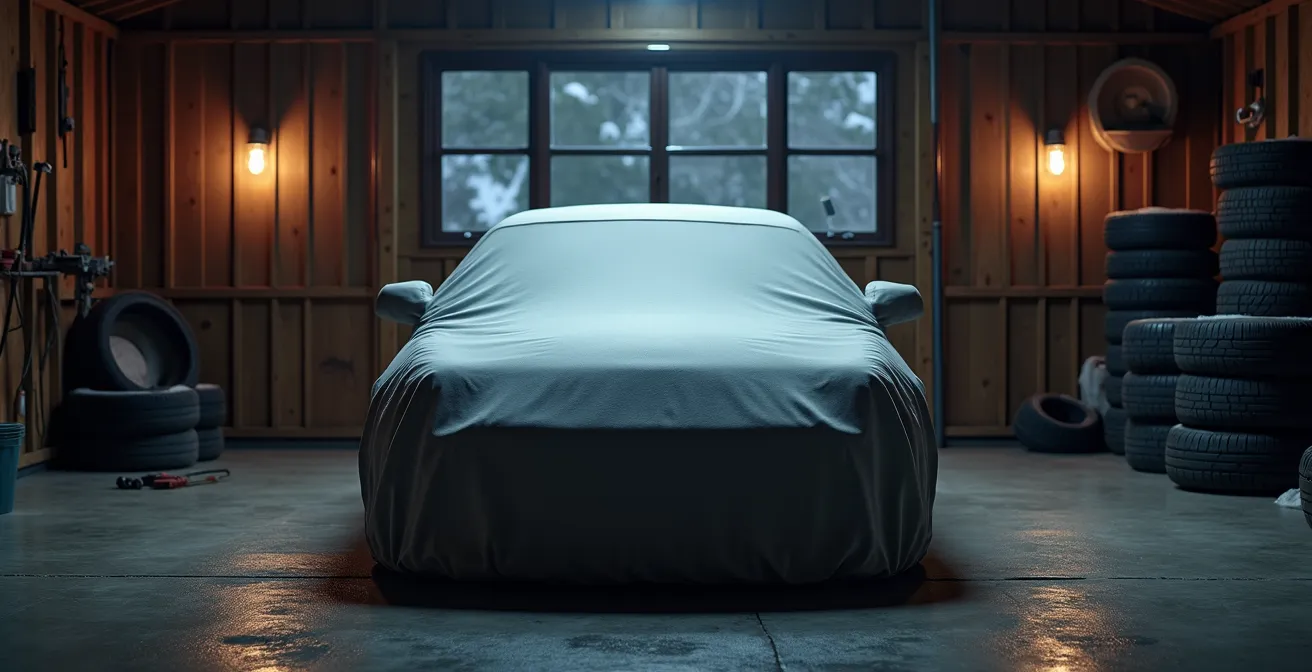
The goal of winter storage is preservation. This goes beyond simply throwing a cover over the car in a cold garage. It involves a systematic process to stabilize its core systems against the harsh Canadian environment. The fuel system is particularly vulnerable. Modern Canadian gasoline often contains ethanol, which can absorb moisture and degrade over several months, leading to clogged injectors and fuel lines. Similarly, batteries can be permanently damaged by deep discharge cycles in sub-zero temperatures, and tires can develop flat spots from sitting under load for extended periods.
A proper storage regimen is a non-negotiable part of ownership for an investment vehicle. It ensures the car emerges in the spring in the same, if not better, condition, preserving its value and preventing a cascade of costly repairs. Here are the essential steps for any Canadian JDM owner:
- Add fuel stabilizer rated specifically for Canadian ethanol-blended gasoline to prevent fuel system degradation and varnish build-up.
- Connect the battery to a smart tender or trickle charger designed for 120V Canadian electrical systems to maintain its charge without overcooking it.
- Over-inflate the tires by 5-10 PSI above the recommended pressure. This compensates for pressure drops in cold weather and helps prevent flat spots.
- Place steel wool in the exhaust tips and air intake snorkel (if accessible). This is a simple but effective deterrent against rodents seeking shelter.
- Switch your insurance policy. Providers like Hagerty Canada offer « lay-up » insurance, which maintains comprehensive coverage against fire and theft but removes collision, significantly lowering your premium during storage.
Why do German luxury sedans depreciate faster than Japanese SUVs?
To truly understand the JDM appreciation phenomenon, it’s useful to contrast it with a segment of the market known for the exact opposite: late-model German luxury sedans. A five-year-old BMW 7 Series or Mercedes-Benz S-Class will have shed a staggering percentage of its original value, often over 60-70%. Meanwhile, a five-year-old Toyota 4Runner or Lexus GX often retains that same percentage. This isn’t an accident; it’s a reflection of fundamentally different value propositions and buyer psychologies.
The German luxury sedan is sold on the promise of cutting-edge technology, prestige, and performance. However, this complexity becomes its greatest liability in the used market. Out-of-warranty repairs on intricate air suspension systems, complex infotainment units, and high-strung turbocharged engines can be ruinously expensive. The target buyer for a used S-Class is not the same person who bought it new; they are more price-sensitive and risk-averse, driving down demand and, consequently, value. The car is perceived as a potential financial time bomb.
Japanese SUVs, and by extension the ’90s JDM sports cars we’re discussing, are built on an entirely different foundation: perceived reliability and durability. A Toyota’s value is anchored in the belief that it will run for hundreds of thousands of kilometers with basic maintenance. This reputation for dependability creates a massive, stable floor for its resale value. The ’90s JDM icons benefit from this same halo effect, amplified by their « over-engineered » reputation from that era (e.g., the 2JZ and RB26 engines). While German cars sell a temporary luxury experience, these Japanese vehicles sell a long-term promise of mechanical integrity, a far more durable store of value in the used market.
The subframe failure that can make your car uninspected and illegal
While surface rust on a quarter panel is a cosmetic and financial headache, corrosion on a vehicle’s subframe is a terminal diagnosis. The subframe is a critical structural component that cradles the engine and holds the suspension and steering systems in place. When this part suffers significant rust perforation, it’s not just a blemish; it’s a catastrophic failure of the car’s core skeleton. For an investor, this is the ultimate structural integrity risk.
In a province like Ontario with strict safety inspection standards (or British Columbia’s out-of-province requirements), a car with a compromised subframe is uninspectable. No licensed mechanic will sign off on a vehicle where the suspension mounting points are threatening to tear away from the chassis. This means the car cannot be legally registered or driven on public roads. Its value as a vehicle is immediately reduced to its part-out value, a tiny fraction of its worth as a running, driving classic. It becomes a static collection of parts, not an asset.
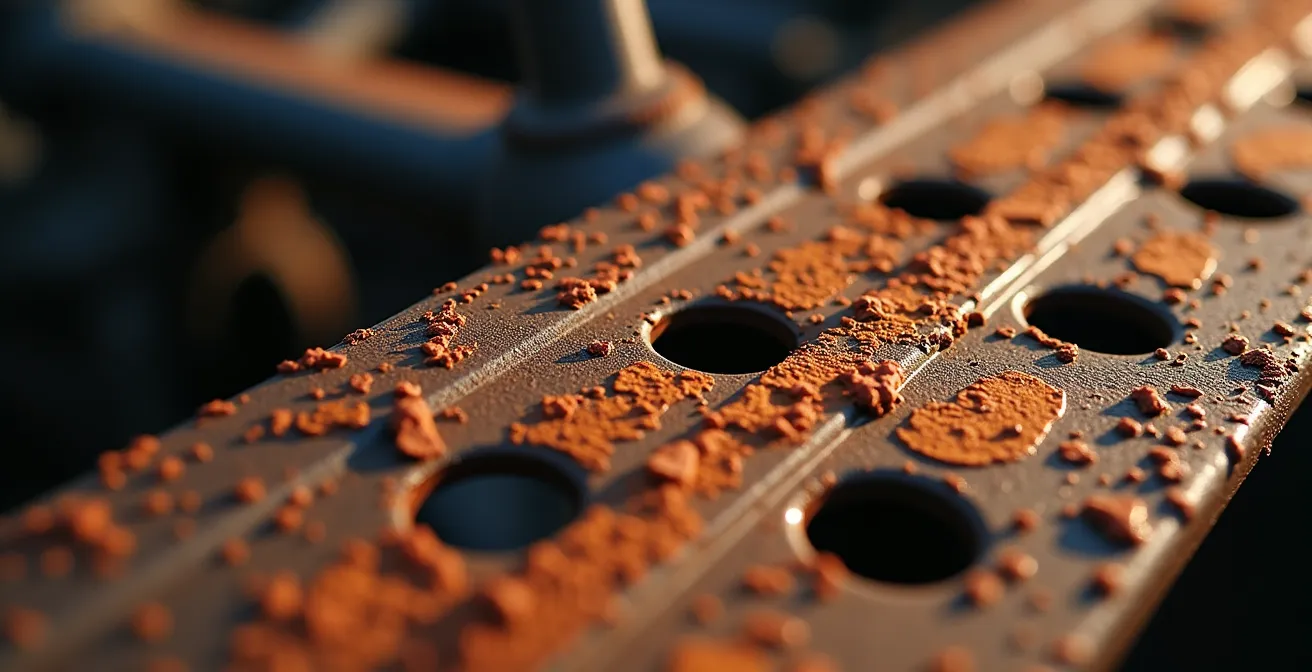
The image above illustrates the terrifying reality of advanced subframe corrosion. This isn’t something that can be fixed with a patch panel and some undercoating. Repairing this level of damage requires either sourcing an increasingly rare, rust-free subframe from a donor car or undertaking thousands of dollars in specialist fabrication and welding—often more than the car’s initial purchase price. Any pre-purchase inspection that does not include putting the car on a hoist and meticulously examining the subframes, frame rails, and suspension mounting points with a sharp tool is fundamentally incomplete. Overlooking this single area is the fastest way to turn a dream investment into a driveway ornament that’s both worthless and illegal to use.
Key Takeaways
- Canada’s 15-year import law is the primary engine creating an « arbitrage window » that drives up JDM car values before they become US-legal at 25 years.
- Hidden costs, particularly Canada-specific rust (subframe rot) and high-risk insurance for RHD vehicles, are the biggest threats to your investment’s profitability.
- A car’s value is a balance of market demand and cost of ownership; classic JDMs are appreciating assets, while many new luxury cars are rapidly depreciating liabilities.
How Can Young Drivers in Ontario Lower Premiums by $500?
For a young enthusiast in a high-cost province like Ontario, the final, and often insurmountable, hurdle to JDM ownership is insurance. The combination of youth, inexperience, and a right-hand-drive (RHD) performance vehicle creates a risk profile that makes standard insurers run for the hills. Many young drivers find themselves forced into high-risk insurance pools, such as the Facility Association, where premiums can be astronomical. It is not an exaggeration to see quotes of $450/month or more for basic liability coverage, a cost that can easily exceed the car payment itself.
This barrier seems impenetrable, but there is a specific, albeit narrow, path to more affordable coverage: specialist classic car insurance. The challenge is that these insurers have their own strict set of requirements designed to ensure the vehicle is a cherished classic, not a daily-driven race car. This is where a strategic approach becomes critical for a young driver aiming to secure reasonable rates.
Case Study: The Path to Affordable Classic Car Insurance in Ontario
Providers like Hagerty Canada offer a lifeline, but only for those who can meet their underwriting criteria. To qualify, a young driver must typically prove they are a responsible custodian of a classic vehicle. This involves having a separate, insured daily driver, access to secure storage (like a locked garage), and a clean driving record. Furthermore, for high-performance vehicles, they often require a minimum of 10 years of licensed driving experience and may impose mileage limitations. While this makes it challenging for a 20-year-old, a 26-year-old with a full license and a clean record who uses a beat-up Civic for their commute could realistically qualify their weekend-only R32 Skyline for a policy that is a fraction of the Facility Association rate.
The key takeaway is that lowering premiums isn’t about finding a « deal » with a standard insurer. It’s about fundamentally changing your risk profile to fit the specific mold of a classic car collector. By demonstrating responsibility with a daily driver and secure storage, a young enthusiast can transition from being seen as a high-risk youth in a sports car to a responsible custodian of a classic, unlocking access to premiums that make the dream of ownership a financial reality.
Ultimately, investing in a ’90s JDM classic in Canada is a venture that demands the diligence of a stock analyst combined with the passion of an enthusiast. To capitalize on the opportunity, you must look beyond the gleaming paint and embrace the role of a risk manager. The next logical step is to move from theory to practice by securing a professional, unbiased appraisal of any potential acquisition. This is the single most effective way to protect your capital and ensure your investment is built on a solid, rust-free foundation.