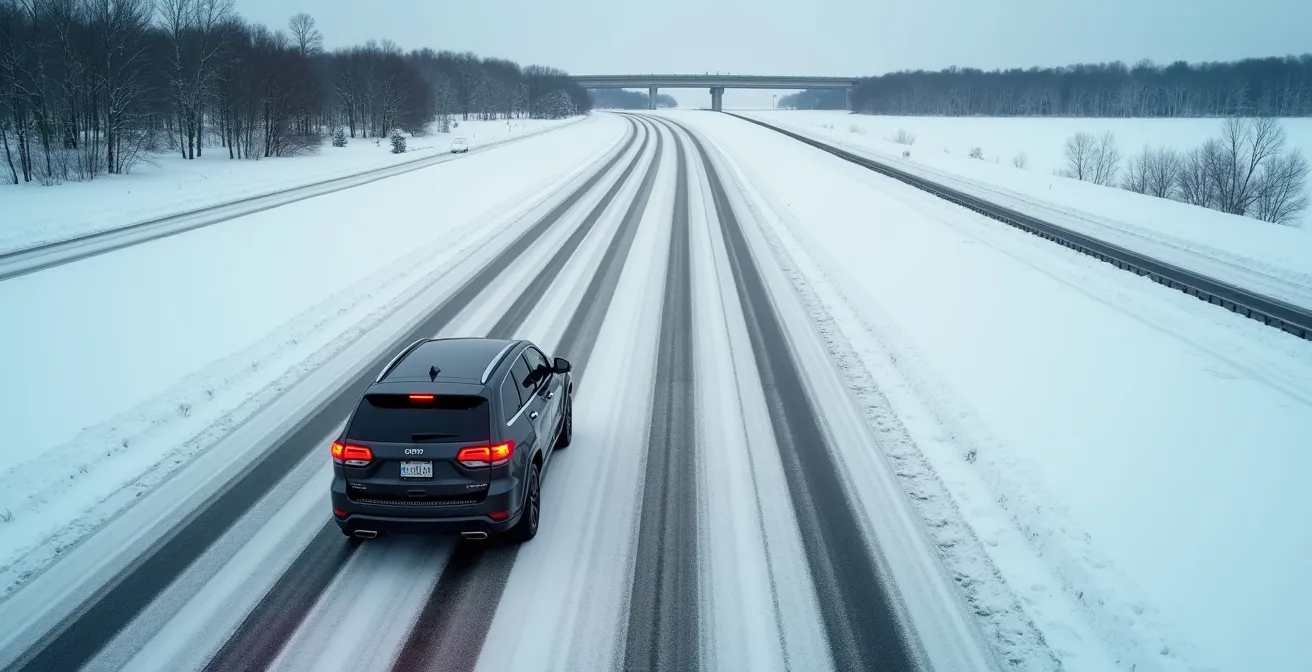
Phantom braking isn’t a random glitch; it’s a predictable outcome of how Automatic Emergency Braking (AEB) sensors interpret ambiguous data, especially in unique Canadian conditions.
- Environmental factors like low sun angles, car wash spray, and dried road salt can physically block or confuse the radar and camera sensors that guide the system.
- AEB logic has inherent blind spots, often struggling to reliably detect pedestrians in the dark or correctly classify the unique shape of large North American wildlife like moose.
Recommendation: Understanding these limitations is the key to safety. Learn to anticipate high-risk scenarios, know when to manually override the system, and practice proactive sensor maintenance to maintain confident control of your vehicle.
It’s a gut-wrenching feeling familiar to many modern drivers: the sudden, violent lurch of your car’s brakes engaging for no apparent reason. You’re driving on a clear road, but the vehicle has decided an impact is imminent. This phenomenon, often called « phantom braking, » can be unnerving and dangerous. While Automatic Emergency Braking (AEB) is a revolutionary safety technology, these false positives are becoming a common concern for drivers, prompting hundreds of thousands of reports to safety authorities.
The common explanation points to generic issues like bad weather or dirty sensors. While true, this advice barely scratches the surface. As vehicle dynamics engineers, we understand these aren’t random « ghosts » in the machine. They are logical, predictable failures that occur when the system’s sensors and its object classification algorithms encounter situations they weren’t perfectly programmed for. The system isn’t truly ‘seeing’ the world; it is interpreting data, and that interpretation can be flawed.
The key to mastering your vehicle is to move beyond the frustration and understand the ‘why’ behind these events. This article demystifies AEB’s limitations from an engineering perspective. We will dissect the precise interplay of sensor physics and software logic that leads to these false activations in specific Canadian scenarios. By understanding why your car misinterprets shadows, car washes, or even wildlife, you gain the power to anticipate these moments, manage them safely, and reclaim your confidence behind the wheel.
This guide breaks down the most common and confusing AEB scenarios encountered by Canadian drivers. By exploring each case, you’ll learn to think like your car’s safety system, recognize its weaknesses, and become a safer, more informed operator.
Summary: When the Car Brakes for Ghosts: Understanding AEB Limitations
- Why do shadows under bridges trigger your emergency brakes?
- Why you must disable AEB before entering an automatic car wash?
- Does your AEB actually see pedestrians wearing dark clothes?
- Will your car stop for a child running behind you in a driveway?
- Should you trust emergency braking on an icy road?
- How to calculate the « 6-second rule » for safe winter following?
- Why a thin layer of dried salt disables your emergency braking?
- Why you should brake for a moose but never swerve for a deer?
Why do shadows under bridges trigger your emergency brakes?
One of the most common phantom braking scenarios involves driving under a bridge or overpass on a bright, sunny day. The sudden transition from bright light to deep shadow can trick your car’s AEB system. This isn’t a malfunction in the traditional sense; it’s a limitation of the sensor fusion process, where the vehicle’s camera and radar systems provide conflicting information.
The camera, a primary input for AEB, can be momentarily « blinded. » The stark contrast may be interpreted by the image processing software as a large, dark, static object directly in your path—like the back of a stopped truck. Simultaneously, the radar system, which uses radio waves, correctly reports a clear path ahead. When the object classification algorithm receives this contradictory data, it may default to the most cautious interpretation: brake now to avoid a potential collision. The low sun angles during Canadian autumn and spring mornings and evenings exacerbate this effect, casting long, sharp shadows that are prime triggers.
Understanding this phenomenon allows you to anticipate it. When approaching a dark shadow under an overpass on a sunny day, maintaining a steady throttle position can signal your intent to the system, sometimes reducing the likelihood of a false positive. If the system does engage, a firm and deliberate press of the accelerator is the manufacturer-designed method to override the braking command and maintain control.
While unnerving, these events highlight the system’s inherent bias toward safety, even when its perception of reality is momentarily flawed.
Why you must disable AEB before entering an automatic car wash?
An automatic car wash is a sensory overload for an AEB system. The combination of moving brushes, high-pressure water jets, steam, and shifting curtains creates a perfect storm of false-positive triggers. From the perspective of your car’s sensors, you are driving into a chaotic environment filled with multiple, unpredictable, and fast-approaching objects.
Your vehicle’s radar can interpret the dense spray of water or the large, rotating brushes as solid obstacles. The camera system, meanwhile, sees large, dark shapes (the washing equipment) moving directly toward it. This creates a high-confidence « imminent collision » scenario for the sensor fusion algorithm. The system does exactly what it’s designed to do in this situation: it slams on the brakes to prevent a crash. This can not only be startling but can also cause your vehicle to misalign on the track, potentially leading to damage from the car wash equipment.
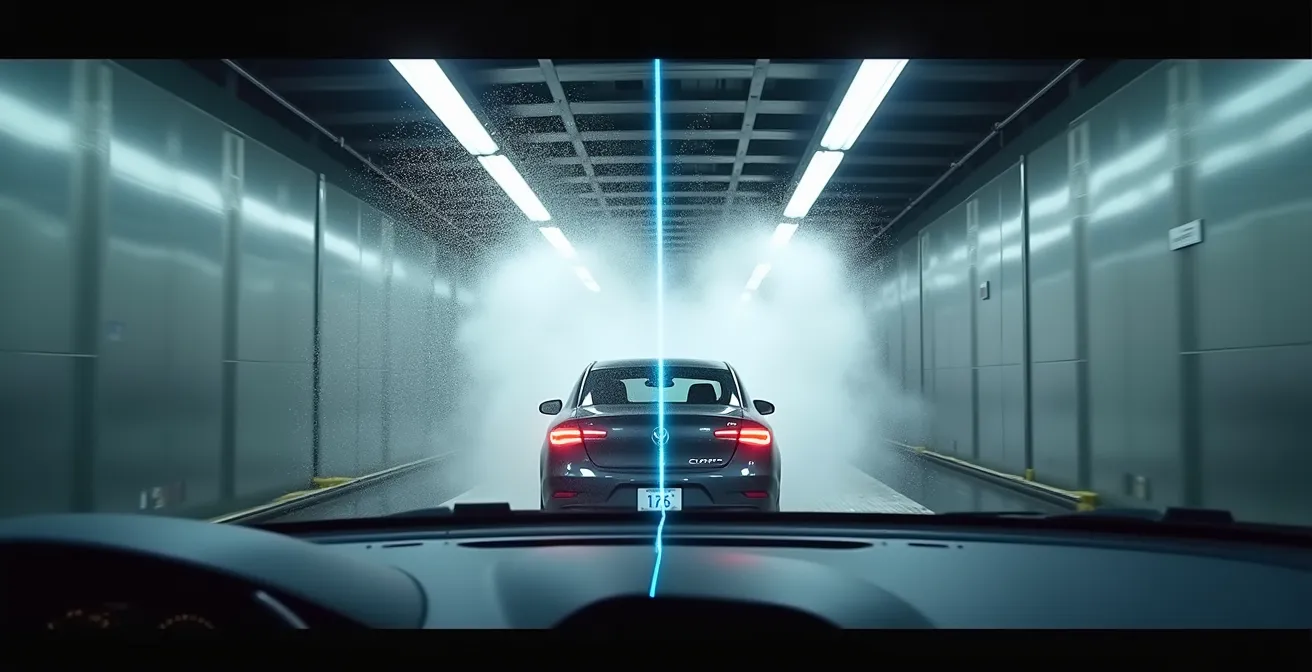
As the visualization shows, what is a clear path to a human driver is a field of threatening obstacles to a sensor array. This is why virtually every vehicle manufacturer and car wash operator in Canada recommends temporarily disabling your AEB and other related features like automatic wipers before entering the wash tunnel. It’s a critical step in preventing an unnecessary and potentially damaging emergency stop. The deactivation process is typically straightforward and accessed through the vehicle’s infotainment screen.
- GM Vehicles (Chevrolet/GMC/Cadillac): Navigate to Settings > Vehicle > Collision/Detection Systems > Front Pedestrian Braking OFF.
- Ford/Lincoln: Go to Settings > Driver Assistance > Pre-Collision Assist > OFF.
- Toyota/Lexus: Find Settings > Vehicle Settings > PCS (Pre-Collision System) > OFF.
- Nissan/Infiniti: Select Settings > Driver Assistance > Emergency Brake > OFF.
Remembering to disable the system beforehand is crucial, but just as important is reactivating it immediately after you exit the car wash to ensure you have full safety protection back on the road.
Treating AEB deactivation as a standard part of your car wash routine is the best practice for any modern vehicle owner.
Does your AEB actually see pedestrians wearing dark clothes?
The effectiveness of AEB in preventing pedestrian collisions is one of its most lauded benefits. However, its performance is not uniform across all conditions, and darkness is its greatest adversary. The system relies heavily on its camera to identify the shape and movement patterns of a person. At night, especially on roads without streetlights, this capability diminishes dramatically.
Research is starkly clear on this point. Testing by the Insurance Institute for Highway Safety (IIHS) found that while pedestrian AEB systems reduce crashes in daylight, that benefit disappears in the dark. In fact, their studies show that on unlit roads at night, AEB provides a 0% crash reduction. The camera simply cannot gather enough light to reliably distinguish a pedestrian from the dark background, and radar alone often struggles to classify a pedestrian-sized object with enough confidence to trigger an emergency brake.
This limitation highlights a dangerous gap between driver expectations and technological reality. A driver might feel an extra layer of security from their AEB system at night, when in reality, its effectiveness has plummeted. This is especially critical during Canada’s long winter nights. As a driver, you must operate under the assumption that you are the primary detection system in low-light conditions.
Case Study: The High-Visibility Clothing Paradox
Counter-intuitively, simply wearing reflective clothing may not be the silver bullet. A separate IIHS study found that some retroreflective safety gear worn by road workers actually confused the AEB sensors on several 2023 models. The systems, trained on the walking motion of limbs, were perplexed by the bright, disjointed reflective strips. Test vehicles often failed to brake or only slowed marginally for dummies in safety gear, while they more consistently detected those in plain black clothing. This shows that the object classification algorithm is trained for specific scenarios and can be thrown off by unexpected visual data, even when that data makes the pedestrian more visible to the human eye.
Ultimately, while AEB adds a valuable layer of protection, it is no substitute for vigilant driving, appropriate speed, and the use of high beams when conditions permit.
Will your car stop for a child running behind you in a driveway?
This is a critical question for any parent or resident in a family-oriented neighbourhood. While forward-facing AEB is becoming a standard feature, the same cannot be said for its rear-facing counterpart, often called Reverse AEB or Rear Cross-Traffic Braking. The assumption that your car protects you equally in both directions is a dangerous one.
While Transport Canada research confirms pedestrian AEB reduces injury crashes by 30% overall, this statistic primarily reflects the performance of forward-facing systems. Reverse AEB is often an optional extra, bundled into higher trim levels or technology packages, and is sometimes not available at all, even on popular models. This creates a significant and often misunderstood gap in a vehicle’s safety net, particularly in low-speed environments like parking lots and driveways where backover incidents are common.
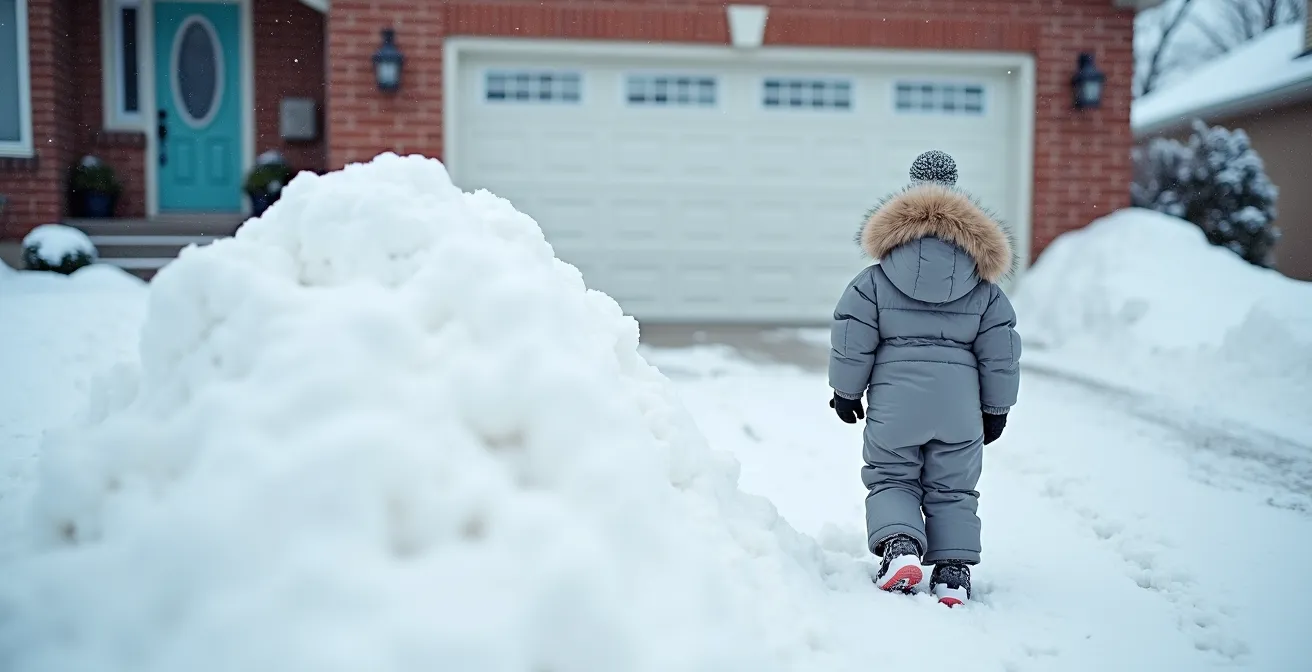
In Canada, winter adds another layer of risk. Towering snowbanks at the edge of driveways can easily hide a small child from a driver’s view and from the vehicle’s sensors until it is too late. The effectiveness of even a top-tier Reverse AEB system is contingent on its ability to see the hazard, and a physical obstruction like a snowbank creates a significant blind spot. Drivers must not rely on technology to see through these obstacles.
| Vehicle Model | Forward AEB | Reverse AEB | Snow Obstruction Warning |
|---|---|---|---|
| Ford F-150 | Standard | Optional | No |
| Toyota RAV4 | Standard | Standard 2024+ | Yes |
| Honda CR-V | Standard | Not Available | No |
| Chevrolet Silverado | Standard | Optional HD models | Yes |
The only foolproof strategy is to combine technology with timeless safety practices: perform a physical walk-around of your vehicle before reversing and proceed with extreme caution, regardless of the beeps and warnings from your dashboard.
Should you trust emergency braking on an icy road?
Trusting AEB on ice is a misplaced faith. An AEB system’s primary function is to detect a potential collision and apply the brakes faster than a human can react. However, it cannot change the laws of physics. The system has a fundamental knowledge gap when it comes to the road surface itself.
As an engineering principle, it’s crucial to understand what the system does and does not know. In a consultation document, Transport Canada puts it perfectly:
AEB has no a priori knowledge of ice; it can only react to wheel slip detected by ABS after braking has already begun.
– Transport Canada, Background on Automatic Emergency Braking Systems consultation
This means the AEB system assumes it is braking on dry pavement until proven otherwise. It will command maximum braking force, and only when the ABS (Anti-lock Braking System) sensors report that the wheels have locked up and are skidding does the system understand it’s on a low-grip surface. By then, precious stopping distance has already been lost. An experienced Canadian driver, on the other hand, anticipates ice, reduces speed preemptively, and applies the brakes with a finesse that the computer cannot replicate.
| Surface Condition | AEB Stopping (from 50 km/h) | Experienced Driver | Advantage |
|---|---|---|---|
| Dry Pavement | 12.5 meters | 18 meters | AEB (-30%) |
| Packed Snow | 31 meters | 28 meters | Human (+10%) |
| Black Ice | 85 meters | 65 meters | Human (+24%) |
| Reaction Time | 0.3 seconds | 1.5 seconds | AEB (5x faster) |
The data is clear: while AEB has a massive reaction time advantage, that benefit is completely negated and even reversed on slick surfaces where a human driver’s foresight and gentle inputs are superior. On black ice, an experienced driver can stop significantly shorter than a car relying solely on AEB. Relying on AEB in winter conditions is a recipe for a rear-end collision.
In winter, the driver’s brain remains the most important safety feature.
How to calculate the « 6-second rule » for safe winter following?
The standard « 2-second rule » taught in driving schools is designed for ideal, dry conditions. In Canadian winter, it is dangerously inadequate. On surfaces with compromised grip like packed snow or potential ice, you need to multiply that following distance by at least three, leading to the « 6-second rule » as a bare minimum for safe winter driving.
Calculating this distance while driving is easier than it sounds. The method is to watch the vehicle in front of you pass a fixed object on the side of the road (like a sign, a tree, or a hydro pole). Then, start counting « one-one-thousand, two-one-thousand, three-one-thousand… » until your own vehicle passes that same fixed object. If you don’t reach at least « six-one-thousand, » you are following too closely for winter conditions.
This increased gap gives you the two things you need most in a low-grip situation: time and space. It provides the time to react to sudden slowdowns and the space to brake gently and maintain control, avoiding the kind of panic braking that can easily induce a skid. For drivers who frequently travel on specific Canadian routes, there are even more localized methods for judging this critical distance.
Your Action Plan: Canadian Highway Distance Calculation Methods
- Highway 401 Method: On Ontario’s 401, use the green kilometre markers. In winter conditions, strive to maintain a distance of at least six of these markers between you and the vehicle ahead.
- Hydro Pole Technique: In many rural parts of Ontario and Quebec, hydro poles are spaced at regular intervals. Count a minimum of six poles between your car and the one you’re following.
- Trans-Canada Highway Rule: The 6-second rule is the standard for clear winter days. In active light snow or slushy conditions, increase this to 8 seconds to account for reduced visibility.
- Coquihalla Pass Protocol: On challenging mountain passes like BC’s Coquihalla Highway during a snowstorm, a 10-second gap is often considered mandatory by professional drivers for maximum safety.
- Adaptive Cruise Control Setting: If your vehicle has adaptive cruise control, set it to the maximum following distance. Then, manually add what feels like two more car lengths by adjusting your speed with the throttle for an extra buffer.
Mastering the 6-second rule isn’t just about following a guideline; it’s about fundamentally re-calibrating your perception of a safe space on the road to match winter’s harsh reality.
Why a thin layer of dried salt disables your emergency braking?
During a Canadian winter, a car’s front end is constantly blasted with a mixture of snow, slush, and road salt. While drivers diligently clear their windshields, the vehicle’s most important « eyes »—the radar and camera sensors—are often neglected. A thin, seemingly harmless layer of dried salt film is all it takes to effectively blind your AEB system.
This isn’t just a matter of being ‘dirty’. The crystalline structure of dried salt creates a multifaceted surface that dramatically scatters the radio waves emitted by the radar sensor. This severely degrades the signal-to-noise ratio (SNR), meaning the faint signal reflecting off a distant car is lost in the ‘noise’ created by the salt crystals right on the sensor’s surface. To the system, the road ahead simply disappears into a fog of nonsensical data. Similarly, the salt film creates a hazy, opaque layer over the camera lens, preventing the image processor from identifying any recognizable shapes.
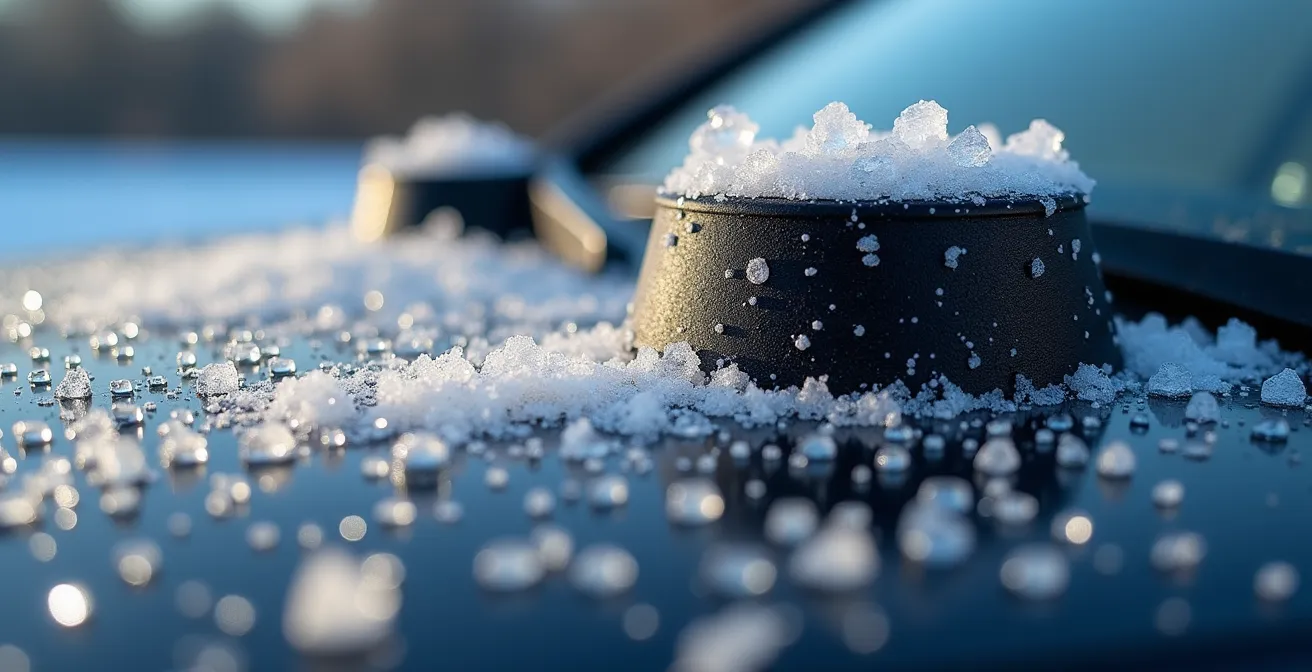
Most modern vehicles will display a warning message like « Front Sensor Blocked » or « AEB Unavailable » in this situation, but drivers may not understand the critical safety implication. This isn’t a minor glitch; your primary active collision avoidance system is completely offline. Keeping these sensors clean during the salt season (typically November to April in most provinces) is as crucial as clearing your windows.
A proper cleaning routine requires more than a quick wipe with a glove. To avoid scratching the sensitive surfaces, a specific kit and technique are recommended:
- Premium microfiber cloth (minimum 300 GSM) designed for optical surfaces.
- A small spray bottle with -40°C windshield washer fluid (methanol-based is effective).
- A soft-bristle brush (like a detailing brush) to gently clear packed snow from radar sensor grilles without scratching.
- Isopropyl alcohol wipes (70%) for carefully removing stubborn, bonded salt crystals.
Making sensor cleaning a weekly—or even daily—habit during salty conditions is a non-negotiable part of responsible winter driving in Canada.
Key Takeaways
- AEB systems are not ‘seeing’ the world; they interpret data from sensors which can be easily confused by environmental factors like light, water, and dirt.
- Performance degrades significantly in low-grip (ice, snow) and low-visibility (night) conditions, where a driver’s judgment remains superior.
- Proactive maintenance (cleaning sensors) and situational awareness (knowing when to disable or override AEB) are non-negotiable for safe operation in Canada.
Why you should brake for a moose but never swerve for a deer?
The long-standing advice for wildlife encounters on Canadian roads is to brake firmly for a moose but to avoid swerving for a deer. The introduction of AEB adds a complex new layer to this critical driving decision, as the system’s capabilities and limitations for wildlife detection are often misunderstood.
Most AEB systems are primarily trained on standardized pedestrian dummies and common vehicle shapes, as defined by testing protocols from organizations like the IIHS. Large North American wildlife is often an edge case—an unusual scenario not central to the core design. This is particularly true for moose.
Case Study: The Moose Detection Gap
A moose’s unique body profile presents a major challenge. Its long legs create a large open space beneath its torso. A vehicle’s radar, often mounted low in the grille, may see this gap and interpret the path as clear, failing to detect the massive body above it. While some European manufacturers test for moose in Scandinavian markets, these specific algorithms are not always transferred to their North American models. An AEB system might therefore fail to brake for a moose, an animal whose high center of mass means it’s likely to come through the windshield in a collision, posing an extreme danger to vehicle occupants.
For a deer, the risk calculation is different. A collision is less likely to be fatal for the occupants, whereas swerving to avoid it can easily lead to a much more dangerous loss of control, a rollover, or a head-on collision with oncoming traffic. This is where AEB can conflict with driver instincts.
Swerving is even more dangerous with AEB, as it can conflict with the system’s own stability control interventions during an emergency brake.
– Phil Koopman, Carnegie Mellon University autonomous vehicle safety research
If you swerve while the AEB system is simultaneously commanding a full-force straight-line stop, you are sending conflicting instructions to the vehicle’s dynamics controller, potentially making a skid or loss of control even more likely.
Your best course of action is to brake hard and in a straight line, letting the AEB and ABS systems do their work, while preparing for an impact rather than risking a more catastrophic loss of control.