
Hands-free driving systems promise a relaxed commute, but the reality is they operate on a knife’s edge of ‘sensor brittleness’, especially on Canadian roads.
- These systems are easily confused by unpredictable scenarios like human construction flaggers and can be rendered blind by snow-covered lanes.
- Despite the advanced technology, the driver is—and will remain for the foreseeable future—100% legally liable for the vehicle’s actions under all provincial traffic laws.
Recommendation: Treat these systems as an advanced, attentive co-pilot, not a fully autonomous chauffeur. Your situational awareness remains the vehicle’s ultimate safety feature.
The allure of hands-free driving is undeniable. Systems like Ford’s BlueCruise, GM’s Super Cruise, and Tesla’s FSD promise to take the stress out of long highway drives and tedious traffic jams. They represent a significant leap in automotive technology, offering a glimpse into a future of autonomous mobility. For many Canadian drivers interested in this technology, the primary question is one of trust: how safe are these systems, and what are their true capabilities?
The common refrain is that « hands-free isn’t minds-free, » a warning that drivers must always remain vigilant. While true, this advice often fails to explain the fundamental reasons *why* this vigilance is so critical. The limitations of these systems are not random; they are predictable consequences of the current state of sensor technology and artificial intelligence, exacerbated by the unique challenges of the Canadian driving environment. These systems are not just « less advanced »; they are fundamentally brittle, performing flawlessly in 99% of situations but failing abruptly when faced with specific « edge cases. »
This article moves beyond the marketing hype to provide a clear-eyed, objective analysis from a systems research perspective. We will dissect the « why » behind common failure modes. Instead of simply stating the rules, we will explore the engineering and environmental realities that dictate them. Understanding this brittle reality is not about fearing the technology, but about respecting its boundaries. It is the key to using these powerful tools safely and effectively, transforming you from a passive passenger into an informed, supervising operator who knows when, and why, to trust—and when to verify.
This guide breaks down the critical aspects of Level 2 autonomous systems that every Canadian driver should understand. We will examine the core reasons behind system limitations, from legal responsibilities to real-world performance in uniquely Canadian conditions.
Summary: The Reality of Hands-Free Driving in Canada
- Why you are still legally responsible even if the car is driving itself?
- Why does hands-free driving disengage in construction zones?
- How does the car know if you are looking at your phone?
- Why self-driving features fail when lane markings are covered in snow?
- How to safely take back control when the system panics?
- Can hackers inject malware into your car during a wireless update?
- Why a speeding motorcycle might not trigger your blind spot light in time?
- Why do shadows under bridges trigger your emergency brakes?
Why You Are Still Legally Responsible Even if the Car Is Driving Itself?
The single most important fact about today’s hands-free systems is that they operate under Society of Automotive Engineers (SAE) Level 2 or Level 2+ autonomy. This classification means that while the vehicle can manage steering, acceleration, and braking under specific conditions, the human driver is required to supervise the technology at all times and is the sole party responsible for the vehicle’s operation. Legally, you are not a passenger; you are an active supervisor.
In Canada, all provincial and territorial Highway Traffic Acts were written with a human operator in mind. There is no current legal framework that transfers liability from the driver to the manufacturer for a Level 2 system. Legal experts highlight this clarity, noting that according to an analysis of Canadian autonomous vehicle laws, there are currently 0 established legal precedents for Level 2 ADAS accident liability in Canada. This legal vacuum means any incident will, by default, be adjudicated under existing laws that presume human control.
This point is reinforced by legal analysis from major firms specializing in technology and automotive law. As the law firm BLG states in its comprehensive review of the Canadian regulatory landscape:
Broadly speaking, these laws favour a finding of individual driver liability in automobile accidents, rather than finding liability in an automobile manufacturer or software developer
– BLG Law Firm, Autonomous vehicle laws in Canada: Provincial & territorial regulatory review
Until legislation evolves to address Level 3+ systems (where the car is responsible under certain conditions), the person in the driver’s seat bears full legal responsibility for any traffic violations or collisions, regardless of whether their hands were on the wheel. The system is merely a tool, and you are the one wielding it.
Why Does Hands-Free Driving Disengage in Construction Zones?
Construction zones are a prime example of the « sensor brittleness » inherent in current ADAS technology. These systems are trained on vast datasets of predictable road environments: clearly marked lanes, standardized signs, and consistent traffic flow. A Canadian construction zone, however, is a chaotic and unpredictable edge case that shatters these assumptions. The system disengages not because it is faulty, but as a pre-programmed safety measure when its confidence level drops below a critical threshold.
The primary failure point is the system’s reliance on computer vision. Cameras and software are excellent at identifying fixed, uniform objects like a 60 km/h speed limit sign. However, they are fundamentally challenged by temporary, non-standardized elements. Shifting lane markers, temporary concrete barriers common on 400-series highways, and the erratic movement of construction vehicles create a visual scene that doesn’t match the system’s training data, forcing it to hand control back to the human driver.
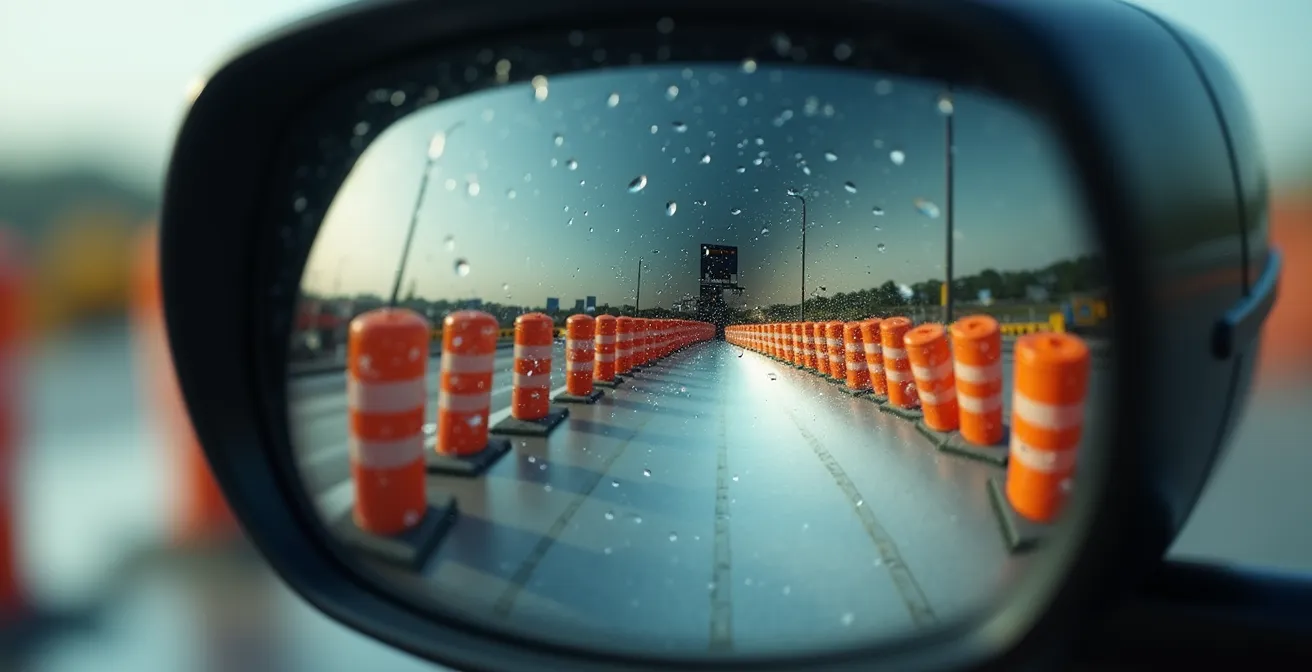
The most significant challenge, particularly in Canada, involves human workers. An ADAS system can’t interpret the nuanced hand signals of a traffic flagger, a scenario detailed in analyses of AI recognition failures.
Case Study: The Human Flagger Problem
Canadian construction zones frequently employ human flaggers whose non-standardized hand signals cannot be reliably interpreted by current AI models trained primarily on fixed signage. Unlike traffic lights or stop signs with consistent visual patterns, each flagger’s gestures vary, creating a recognition challenge that forces ADAS disengagement. The system cannot distinguish between a flagger waving traffic through and one signalling to stop, making a handover to the human driver the only safe option.
Ultimately, a construction zone is a high-stakes environment where context and human interaction are paramount. Since today’s AI lacks true contextual understanding, it correctly identifies its own limitations and defers to the one processor that can navigate the chaos: the human brain.
How Does the Car Know if You Are Looking at Your Phone?
The « trust but verify » relationship between you and your car is a two-way street. While you are trusting the car to steer, the car is constantly verifying that you are ready to take over. This is accomplished through a sophisticated Driver Monitoring System (DMS), a critical safety component of any hands-free driving feature. The system’s primary job is to measure your level of attentiveness, and looking at your phone is a clear sign of distraction.
Most modern DMS use a small, inward-facing infrared (IR) camera, often mounted on the steering column or integrated near the rearview mirror. Using infrared light allows the system to work reliably in all lighting conditions, including at night or when the driver is wearing sunglasses (though some polarized lenses can still pose a challenge). This camera is not recording video for posterity; it is feeding a real-time data stream to an onboard processor.
The software uses advanced algorithms to track two key metrics:
- Head Position: The system identifies the driver’s head and tracks its orientation. If your head is turned to the side or tilted down for an extended period—the classic posture of someone texting—it will trigger a warning.
- Eye Gaze: More advanced systems perform eye-tracking, or gaze detection. The software locates your pupils and determines the precise direction you are looking. If your gaze is consistently directed away from the road ahead (e.g., down at your lap where a phone would be), the system will conclude you are not situationally aware.
When the DMS detects a sustained period of inattention, it initiates a series of escalating alerts. This typically starts with a visual warning on the dashboard, followed by an audible chime, and in some systems, a vibration in the steering wheel or seat. If the driver does not return their attention to the road, the system will ultimately disengage hands-free mode as a final safety measure, forcing the driver to resume full manual control.
Why Self-Driving Features Fail When Lane Markings Are Covered in Snow?
For any hands-free driving system, visible lane markings are the foundational data source for positioning the vehicle. The primary sensor for this task is a forward-facing camera. When a Canadian winter buries those markings under a blanket of snow, the system’s most critical dataset is effectively erased. This isn’t a minor glitch; it’s a fundamental sensor failure known as occlusion, where the object the sensor needs to see is physically hidden.
The problem is magnified by the fact that nearly 30% of all vehicle collisions in Canada happen on wet, snowy, or icy roads, according to the National Collision Database. This highlights the critical need for systems to perform in adverse weather, yet it is precisely where they are most brittle. The system’s computer vision algorithm is trained to identify the high-contrast signature of a white or yellow painted line against dark pavement. When the entire scene becomes a uniform field of white, the algorithm has no reliable reference points to track.
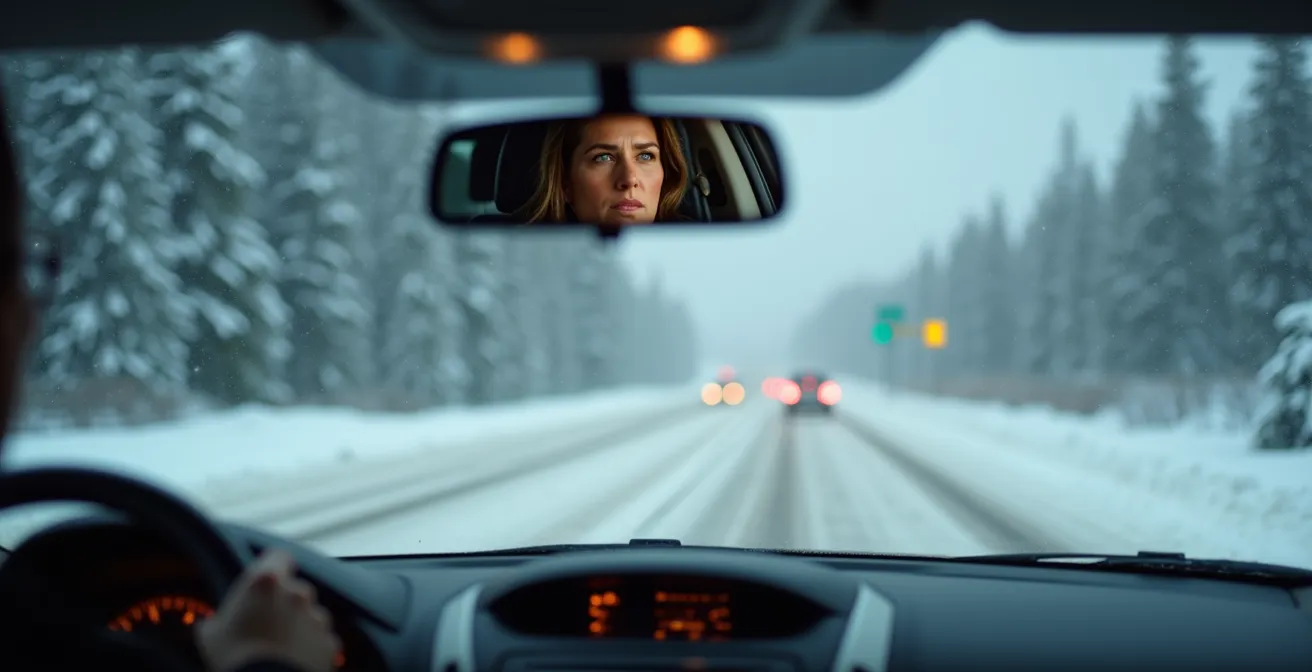
While some systems attempt to use secondary data, such as following the tracks of the vehicle ahead or relying on high-definition GPS maps, these methods have their own weaknesses. The tracks of a preceding vehicle may not be accurate, and even slight GPS drift on a high-definition map can place the car precariously close to an unseen road edge or curb. This is a classic example of sensor fusion failing; when the primary sensor (the camera) is compromised, the secondary sensors (radar, GPS) may not have high-enough-fidelity data to compensate safely.
The system is programmed to recognize this high-uncertainty state. Rather than risk a dangerous deviation, it will alert the driver and disengage hands-free mode, handing control back to the human operator who can use a much wider range of subtle cues—like the texture of the snow, the curve of the snowbank, or experience—to navigate.
How to Safely Take Back Control When the System Panics?
A system « panic, » or an unexpected disengagement, is a designed-in feature, not a bug. It occurs when the system encounters a scenario it cannot safely navigate. However, the transition from automated to manual control is a critical moment that can be jarring if you’re unprepared. The challenge is not just physical but cognitive. As one expert notes, the real task is rapidly re-engaging your mind with the driving environment.
The issue isn’t just physically grabbing the wheel, but mentally rebuilding a situational awareness model in the 1-3 seconds the system gives you
– Aaron Gold, MotorTrend Best Tech 2025 Analysis
Rebuilding this situational awareness model means quickly understanding your vehicle’s position, speed, and the status of surrounding traffic. The key to a safe takeover is a smooth, deliberate process that prioritizes stability and awareness over abrupt reactions. Panicking in response to the system’s alert is the most dangerous thing a driver can do. Instead, having a practiced, methodical response is essential.
Your Action Plan for ADAS Takeover
- Immediate Hand Placement: The moment you receive a takeover alert (visual, audible, or haptic), place both hands firmly on the steering wheel at the 9 and 3 o’clock positions.
- Confirm Manual Control: Apply gentle but deliberate steering input. This action confirms to both you and the vehicle that you have resumed manual control. Avoid jerking the wheel.
- Rebuild Situational Awareness: Immediately check your rearview mirror, side mirrors, and blind spots. Your first priority is to know what is around you before making any adjustments.
- Smooth Speed Adjustment: Once you have regained awareness, smoothly apply the accelerator or brake as needed to match traffic flow or respond to the situation that caused the disengagement.
- Practice in a Safe Environment: The best way to prepare for a real-world takeover is to practice. Use an empty parking lot to intentionally trigger and handle disengagements to build muscle memory.
This procedure turns a potentially stressful event into a controlled, manageable transition. By staying calm and following a plan, you ensure that you, the human supervisor, remain the ultimate authority in the vehicle.
Can Hackers Inject Malware into Your Car During a Wireless Update?
As vehicles become more connected, their vulnerability to cyber threats increases. The prospect of a hacker injecting malware during an Over-the-Air (OTA) update is a valid concern for many drivers. However, automotive manufacturers and government bodies like Transport Canada are acutely aware of these risks and have implemented robust security frameworks to prevent such attacks. While no system is impenetrable, the risk to a consumer during a standard OTA update is exceptionally low due to multiple layers of security.
The core defense mechanism involves cryptographic verification. Every OTA update file is protected by a digital signature. Think of this as a tamper-proof seal. Before the vehicle’s system will even consider installing an update, it verifies this signature against a secure key stored within the car’s hardware. If the signature is invalid or missing—as it would be on a malicious file—the update is immediately rejected. This prevents an attacker from simply pushing their own software to your vehicle.
Case Study: Transport Canada’s Cyber Security Framework
To standardize security, Transport Canada’s Vehicle Cyber Security Guidance outlines a multi-layered defence strategy for manufacturers. This framework mandates end-to-end encryption for all data transmitted during an OTA update, the use of digital signatures for authentication, secure boot processes that prevent unauthorized software from running at startup, and the implementation of intrusion detection systems to monitor for anomalous activity. This creates a defensive depth that makes remote exploitation extremely difficult.
While manufacturers have secured the pipeline, the driver still plays a role in maintaining security. The most significant vulnerability often comes from the driver’s own network habits. Following basic cyber hygiene, as recommended by the Canadian Centre for Cyber Security, is crucial. This includes performing updates only on a secured home Wi-Fi network or the vehicle’s built-in cellular connection, and strictly avoiding unsecured public Wi-Fi networks at locations like Tim Hortons or Canadian Tire. By using secure connections, you close the most likely door a hacker might try to open.
Why a Speeding Motorcycle Might Not Trigger Your Blind Spot Light in Time?
Blind Spot Warning (BSW) is one of the most common and effective ADAS features, and studies show that Blind Spot Warning (BSW) systems significantly reduce the rate of lane-change crashes. However, like all sensor-based systems, they have operational limits. A common edge case where BSW can fail is with a small, fast-moving vehicle like a motorcycle, especially one that is lane filtering or accelerating rapidly into the blind spot. The failure is not arbitrary; it’s rooted in the physics of how the primary sensor—usually a rear-facing radar—operates.
Radar systems work by bouncing radio waves off objects and measuring the return signal. The system’s ability to « see » an object depends on its Radar Cross-Section (RCS)—a measure of how large and reflective it appears to the radar. A large, metal-sided van has a massive RCS and is easily detected. A motorcycle, by contrast, presents a much smaller and more complex target.
Case Study: The Radar Cross-Section Challenge
Motorcycles present a significantly smaller radar cross-section compared to cars, especially when they are built with composite fairings instead of metal. This small RCS, combined with a high-speed differential (i.e., the motorcycle is approaching much faster than surrounding traffic), creates a difficult detection scenario. The radar system’s software may filter out this fast-approaching, low-RCS object as « noise » or may not detect it until it is already alongside the vehicle, too late for the BSW light to provide a timely warning to the driver.
This is a classic false negative error: the sensor fails to detect a real object that is present. The system is calibrated to avoid false positives (like triggering for a guardrail or a car in the next lane over), and this calibration can sometimes make it less sensitive to small, fast-moving targets. This limitation is precisely why BSW is a driver *aid*, not a replacement for a physical shoulder check. The human eye and brain, capable of spotting the movement and shape of a motorcycle, remain the ultimate blind spot detection system.
Key Takeaways
- The driver is always 100% legally responsible for a Level 2 vehicle’s actions in Canada.
- System disengagements are a safety feature, occurring when sensor confidence drops in unpredictable environments like construction zones or heavy snow.
- Safe takeover requires a calm, practiced procedure focused on rebuilding situational awareness, not just grabbing the wheel.
Why Do Shadows Under Bridges Trigger Your Emergency Brakes?
One of the most unsettling experiences with an ADAS-equipped vehicle is « phantom braking, » an event where the Automatic Emergency Braking (AEB) system engages for no apparent reason. Drivers have reported more than 400,000 phantom braking incidents to U.S. regulators alone, and a frequent culprit is a seemingly harmless shadow under a bridge or overpass. This is a classic false positive error, where the system « sees » an obstacle that isn’t actually there.
The root cause lies in the limitations of the camera-based computer vision systems that are a key part of sensor fusion for AEB. The algorithm is trained to identify large, dark, solid shapes in the road ahead as potential collision threats. A dark shadow cast across a bright, sunlit highway creates an area of extreme high contrast. To the camera’s software, this sudden, dark, road-sized patch can look remarkably similar to the signature of a stopped vehicle, a piece of road debris, or another solid obstacle.
This problem is particularly pronounced in Canada due to specific environmental factors. The low angle of the sun during the long winter months creates exceptionally long and dark shadows. When these deep shadows are combined with the high reflectivity of a wet road surface, the contrast becomes even more extreme for the vehicle’s camera sensor.
When the camera flags this « obstacle, » the AEB system must make a split-second decision. If the radar sensor (which is not fooled by shadows) doesn’t provide a strong conflicting signal confirming the path is clear, the system’s safety-first programming may err on the side of caution and apply the brakes. It’s choosing a potential false alarm over the risk of a high-speed collision. While unnerving for the driver, from the system’s perspective, it’s executing its core safety directive based on the imperfect data it received.
Understanding these technical realities is the first step toward becoming a competent and safe supervisor of this emerging technology. The final step is to never forget that the ultimate responsibility rests with you. By treating hands-free driving as a powerful co-pilot rather than an infallible chauffeur, you can leverage its benefits while mitigating its inherent risks. Evaluate your driving habits and environment to determine if this technology is the right fit for you.