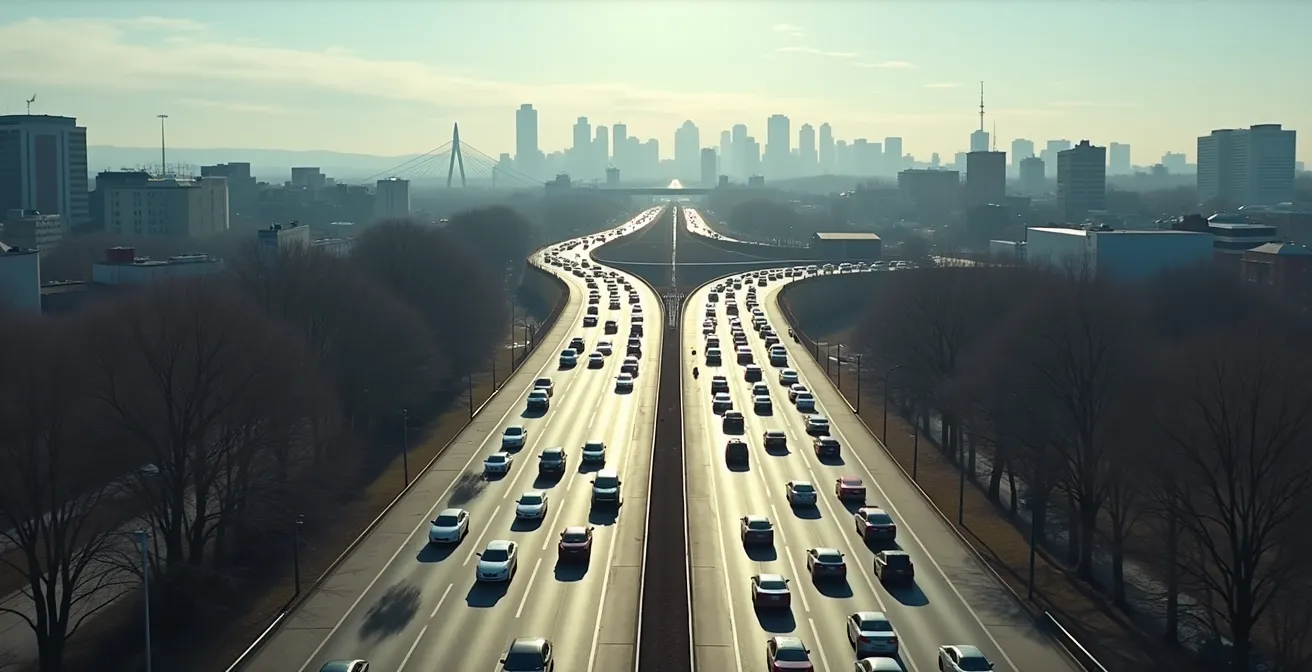
Driving in Toronto and Montreal is less about the car and more about mastering a complex system; this guide is the strategic playbook to win the game.
- Uncover and eliminate thousands in hidden « financial leakage » from your commute, beyond just gas and insurance.
- Learn to decode the urban environment, from chaotic parking signs to predicting road closures before apps do.
Recommendation: Shift from being a reactive driver to a strategic operator by focusing on proactive planning and understanding the true cost of every trip.
The daily grind of driving in downtown Toronto or Montreal feels less like a commute and more like a battle. You’re fighting for every inch of pavement against a backdrop of endless construction, a sea of cyclists, and parking spots that seem to vanish into thin air. The frustration is palpable, a shared experience for any urban dweller behind the wheel. The common advice is to simply use public transit or pay the exorbitant parking fees, but that ignores the reality for those who need or want their vehicle.
Most guides will tell you the obvious: check signs carefully, use a navigation app, be patient. But this is like telling a chess player to simply « move the pieces. » It misses the entire strategic layer of the game. What if the key to survival wasn’t just enduring the chaos, but outsmarting it? What if you could transform from a stressed driver into a calculated urban mobility operator who anticipates problems and sidesteps the financial traps laid at every corner?
This guide provides that strategic playbook. We will move beyond the surface-level complaints to dissect the real challenges of the urban jungle. We will analyze the true cost-benefit calculus of car ownership versus sharing, provide a system for decoding the seemingly impossible language of parking regulations, and reveal how to predict traffic jams before they even appear on Waze. It’s time to stop surviving your commute and start mastering it.
To help you navigate this complex environment, this article breaks down the essential strategies into clear, actionable sections. Explore the topics below to build your personal playbook for mastering the streets of Montreal and Toronto.
Summary: A Driver’s Playbook for Montreal & Toronto
- Is it cheaper to use Communauto than to own a car downtown?
- How to decode complex orange signs to avoid towing during snow clearing?
- Does the engine turning off at every light actually save gas in gridlock?
- SpotAngels vs GreenP: Which app prevents more tickets?
- How to predict road closures before Waze even knows about them?
- Why does your 40km commute cost you $8,000 a year in hidden fees?
- Does the fuel saving justify the $5,000 price premium over a hybrid?
- The coverage gap that leaves Uber drivers unprotected while waiting for a fare
Is it cheaper to use Communauto than to own a car downtown?
The question of owning a car versus using a service like Communauto in a dense urban core isn’t just about the monthly car payment. It’s a complex cost-benefit calculus that must include all the « financial leakage »—parking, insurance, maintenance, and depreciation—that quietly drains your bank account. The initial sticker price is only the beginning of the story. To make a truly informed decision, you must compare the all-in cost of ownership against the flexible cost of on-demand use.
A car sitting idle in a downtown condo parking spot is a depreciating asset that costs you money every minute. In contrast, a car-sharing service bills you only for the time you actively use. For many urbanites whose driving is limited to weekend trips or large grocery runs, the math leans heavily in favor of sharing. A recent analysis shows car ownership in Toronto now costs $1,623 per month on average, a staggering figure when all expenses are tallied.
Case Study: The Downtown Toronto Commuter
A real-world example of a Toronto resident using Communauto for their essential car trips found their monthly costs were approximately $295. When combined with a $143 monthly TTC pass for daily commuting, their total transportation cost was $438 per month. This is a fraction of the $1,623 monthly cost of owning and operating a personal vehicle in the same city, illustrating the dramatic potential for savings.
The choice between different services also matters. While some services have annual fees, others operate on a purely pay-per-use model, which can be more economical for infrequent users. A detailed comparison reveals the nuances in pricing structures.
This table, based on an analysis from The Globe and Mail, highlights the different models, though it’s important to check current rates as they can change. It’s a starting point for your own calculation.
| Service | Hourly Rate | Daily Rate | Annual Fee |
|---|---|---|---|
| Communauto Two-way | From $1.70/hr + 23¢/km | Variable | From $40/year |
| Communauto FLEX | $12/hour | N/A | Free membership |
| Zipcar | From $7.50/hour | Variable | $70/year |
| Car2Go | $14.99/hour | $84.99/day | $35 initial fee |
How to decode complex orange signs to avoid towing during snow clearing?
In Montreal, a parking pole can look like a modern art installation—a chaotic jigsaw puzzle of conflicting signs, arrows, and time restrictions. During winter, the addition of temporary orange « NO PARKING » signs for snow removal operations creates a new level of confusion that leads to hundreds of towed vehicles every storm. Learning the skill of environmental decoding is not just a convenience; it’s a financial necessity to avoid hefty fines and impound fees.
The core principle is that temporary signs always override permanent ones. That flimsy orange cardboard sign tied to a post holds more authority than the dozen metal plates bolted to it. Drivers often get towed because they follow the familiar, permanent rules while ignoring the temporary, urgent restriction put in place for snow clearing, which often begins at 7 PM and runs overnight.

The visual chaos shown above is a daily reality. The key is to develop a systematic approach to reading this information. Instead of being overwhelmed, you must follow a hierarchy of information, starting with the most urgent (the orange signs) and working your way down. This turns a stressful guessing game into a repeatable process.
Your Action Plan: Decoding Montreal Parking Signs
- Prioritize Orange: Always check for temporary orange signs first. These are the most critical and override all other posted rules for events like snow clearing or street cleaning.
- Read the Clock: Understand that Montreal uses the 24-hour clock format. A sign showing a restriction from « 19h – 7h » means you cannot park there from 7:00 PM to 7:00 AM.
- Follow the Arrows: The direction of the arrow on a sign indicates the zone of the restriction. An arrow pointing away from the sign means the rule applies from that pole onwards in the direction of the arrow.
- Verify Snow Clearing: During winter, check the city’s INFO-Neige MTL portal or app. This service provides a real-time map of snow-clearing operations, confirming if your street is scheduled.
- Locate a Towed Car: If the worst happens, don’t panic. Use the INFO-Neige MTL service or call 311 with your license plate number to quickly find out where your vehicle has been moved.
Does the engine turning off at every light actually save gas in gridlock?
That subtle shudder as your engine shuts off at a red light is a feature of modern vehicles known as start-stop technology. In the perpetual gridlock of the Gardiner Expressway or Décarie, it can feel like the engine is spending more time off than on. But is this constant restarting actually saving fuel, or is it just wear and tear in disguise? The answer is a definitive yes, though the amount of savings depends heavily on your driving conditions.
The fundamental principle is simple: an idling engine consumes fuel without covering any distance. By cutting the engine off during these periods of standstill, even for a few seconds, you eliminate that waste. In dense, stop-and-go city traffic, these short stops add up significantly over a full commute. According to automotive experts, start-stop technology can achieve fuel savings of up to 15% in ideal urban conditions. This technology is specifically designed for this environment, with reinforced starters and batteries to handle the increased number of cycles.
However, not all « stopped » conditions are equal. The benefit of a start-stop system varies dramatically compared to a hybrid or a traditional engine, especially when facing a Canadian winter. The following table breaks down the nuances.
This comparative data, based on an analysis by automotive journalists, shows where each technology shines. Notice how the benefit of start-stop diminishes on the highway but is maximized in the city, while hybrids gain an even greater advantage through regenerative braking.
| Driving Condition | Traditional ICE | Start-Stop System | Hybrid/EV |
|---|---|---|---|
| City Stop-and-Go | Baseline consumption | 4-15% savings | Up to 50% savings |
| Highway Driving | Optimal efficiency | Minimal benefit | 10-20% savings |
| Winter (-15°C) | 20% increased consumption | System often disabled | 15-30% range reduction |
| Gardiner Expressway Gridlock | Maximum fuel waste | Moderate savings | Maximum regenerative braking benefit |
It’s also important to note that in very cold weather (typically below -10°C), the vehicle’s computer may disable the start-stop feature to ensure the battery maintains its charge and the cabin stays warm. So while it’s a powerful tool for three seasons of city driving, its effectiveness can be reduced during the coldest winter months.
SpotAngels vs GreenP: Which app prevents more tickets?
In the war against parking tickets, your smartphone is your best weapon. But choosing the right app is critical, as each has a different philosophy and data source. For Toronto and Montreal drivers, the main contenders are community-driven apps like SpotAngels versus official municipal apps like Toronto’s GreenP or Montreal’s P Service Mobile. The best choice depends entirely on where and how you park. One is for hunting, the other for gathering.
Official apps like GreenP are masters of their own domain: city-owned parking lots and metered street spots. They provide official, reliable data for paying for those specific spots and will reliably alert you when your paid time is about to expire. Their weakness is that they have no visibility into the complex web of rules on residential streets or private lots.
Crowdsourced apps like SpotAngels take the opposite approach. They rely on a community of users to map out all parking rules, including the confusing residential ones. They excel at showing where you might find free street parking and sending « move your car » alerts for street cleaning times. Their strength is their breadth of coverage, but their data can occasionally be less reliable than official sources. As the SpotAngels team explains in their guide:
The spots that have a yellow halo are those where you are more likely to find parking. The information is constantly provided by the SpotAngels community.
– SpotAngels, The 2025 Guide to Street Parking in Montreal
This highlights the app’s focus on probability and community intelligence. The « best » app isn’t one or the other; it’s using them in combination. Use GreenP or P Service Mobile when you’ve secured a paid spot, and use SpotAngels when you’re hunting for a free spot on an unfamiliar residential street.
The following table clarifies the core differences in their approach, helping you decide which tool to pull from your digital toolkit for a specific parking mission.
| Feature | SpotAngels | GreenP | P Service Mobile (Montreal) |
|---|---|---|---|
| Data Source | Crowdsourced community data | Official municipal data | Official city data |
| Coverage | Best for residential streets | Best for city-owned lots | Montreal parking meters |
| Real-time Updates | Yes, from community | Yes, official | Yes |
| Parking Alerts | Move car notifications | Time expiry alerts | Payment reminders |
| Free Parking Spots | Shows free street parking | Limited to paid spots | Paid spots only |
How to predict road closures before Waze even knows about them?
Relying solely on real-time navigation apps like Waze or Google Maps puts you in a reactive position. You learn about a problem—a suddenly closed road for a marathon or a major construction project—only when you’re already approaching the gridlock. The truly strategic driver practices predictive mobility, anticipating closures by tapping into sources that announce them days or even weeks in advance. It’s about knowing the game board before the pieces even start to move.
The key is to monitor the sources of information that *feed* the navigation apps. Municipalities, transportation authorities, and event organizers are the origin points for this data. By following them directly, you get a head start. For example, a major festival route is published long before the « road closed » signs go up. A long-term construction project has its schedule posted on a city website months before the first pylon appears. This is public information waiting to be leveraged.
Building your own « intelligence toolkit » is straightforward. It involves setting up a few key information streams that give you a multi-layered view of the week ahead. Here is a starter kit for any Toronto or Montreal driver:
- Social Media Intelligence: Set up alerts on X (formerly Twitter) for key accounts. In Montreal, follow @Quebec511 and @MTL_Circulation. In Toronto, monitor @TO_MainPath for major route closures and @TTCnotices for transit disruptions that spill over into road traffic.
- Official Construction Schedules: Bookmark the Mobility Montréal website and the City of Toronto’s construction information portal. Check them once a week to see if any new long-term projects are starting along your primary or secondary commute routes.
- Event Calendars: Major events are the most predictable disruptors. Before a weekend, quickly cross-reference the City of Toronto’s Festivals & Events calendar or the Tourisme Montréal events page with your planned routes.
- Municipal Open Data: For the truly advanced planner, city open data portals often contain information on construction permits issued, giving the earliest possible warning of future disruptions.
By spending five minutes on a Sunday evening reviewing these sources, you can anticipate the week’s major choke points and plan alternative routes before the chaos even begins. You’re no longer reacting to the traffic report; you’re ahead of it.
Why does your 40km commute cost you $8,000 a year in hidden fees?
When calculating the cost of a long commute, like the 40km trek from Mississauga to Downtown Toronto, most people focus on the obvious: fuel. But the true cost is a monster fed by numerous hidden fees and « financial leaks » that can easily add up to thousands of dollars a year. The $8,000 figure isn’t an exaggeration; it’s a conservative estimate when you account for the accelerated depreciation, increased maintenance, exorbitant parking, and higher insurance premiums that come with being a high-mileage urban commuter.
Every kilometer driven in stop-and-go traffic on Highway 401 is more damaging than a kilometer on an open road. Your brakes and tires wear out faster. Your engine and transmission are put under greater stress. Furthermore, financing the vehicle itself introduces a significant cost; in Canada, vehicle financing now represents $261 per month on average for new cars, money that is spent before you even buy a litre of gas.
Breakdown: The True Cost of a Mississauga-to-Toronto Commute
A typical 40km daily commute (20,000 km/year) from a suburb like Mississauga to downtown Toronto incurs several hidden costs. Fuel is just the start. The constant braking and accelerating of gridlock leads to accelerated brake and tire wear. Daily downtown parking averages $20-30, potentially adding over $6,000 annually. Insurers often charge higher premiums for high-mileage commuters driving into dense areas. Finally, the most significant hidden cost is vehicle depreciation, which can be as high as 25% in the first year alone, a massive invisible expense tied directly to your high mileage.
This soul-crushing, bumper-to-bumper reality is not just a drain on your time and mental health; it’s a direct assault on your vehicle’s value and your wallet. The sea of red taillights represents more than just a traffic jam; it’s a visual reminder of the money burning away with every stop and start.

Understanding these hidden costs is the first step toward mitigating them. It forces a more honest conversation about transportation choices. Is the convenience of driving worth the price? Could a hybrid model of driving to a GO station and taking the train downtown cut these costs in half? Acknowledging the true, all-in cost opens the door to smarter, more financially sound strategies.
Does the fuel saving justify the $5,000 price premium over a hybrid?
Making the leap to a hybrid vehicle often comes with a significant price premium, sometimes as much as $5,000 or more over its gasoline-powered counterpart. The central question for any pragmatic driver is: will I ever make that money back in fuel savings? The answer is not a simple yes or no; it is deeply tied to your specific driving habits and location. For an urban driver in Toronto or Montreal, the calculation is often surprisingly favourable.
The primary advantage of a hybrid is its ability to recapture energy through regenerative braking and use its electric motor at low speeds—the exact conditions of city gridlock. While a conventional car is at its least efficient in stop-and-go traffic, a hybrid is in its element, potentially cutting fuel consumption by up to 50%. The more time you spend below 40 km/h, the faster your return on investment will be. With the average new vehicle price in Ontario reaching $68,574, that initial premium must be justified by long-term operational savings.
To perform your own cost-benefit calculus, you need three key numbers: the price premium for the hybrid model, your average annual mileage in city conditions, and the current price of gas. For example, if you drive 15,000 km a year primarily in the city and a hybrid saves you 4 litres per 100 km, that’s 600 litres of gas saved annually. At $1.60 per litre, that’s $960 in savings per year. In this scenario, it would take just over five years to recoup a $5,000 premium. For a high-mileage city driver, the payback period could be even shorter.
However, the calculation changes for those who do more highway driving, where a hybrid’s advantage is less pronounced. Furthermore, the extreme cold of a Canadian winter can temporarily reduce the efficiency of battery systems in both hybrids and EVs, slightly extending the payback period. Ultimately, the decision hinges on an honest assessment of your driving profile. If your life is a series of short, slow trips in the urban core, the hybrid premium is not a cost; it’s an investment with a clear return.
Key Takeaways
- The most significant cost of urban driving is not gas or insurance, but the cumulative effect of hidden financial leaks like depreciation, excess maintenance, and parking fines.
- Surviving the city is a skill of « environmental decoding »—learning to read the complex language of parking signs, construction schedules, and event calendars to stay ahead of chaos.
- The most effective use of technology is proactive, not reactive. Leveraging data sources to predict closures and parking availability is more powerful than just following real-time navigation.
The coverage gap that leaves Uber drivers unprotected while waiting for a fare
For the thousands of drivers using their personal vehicles for Uber, Lyft, or other ridesharing services in Toronto and Montreal, a dangerous and often misunderstood insurance blind spot exists. This is the « coverage gap, » specifically known as Period 1: the time when a driver has the rideshare app on and is available for fares but has not yet accepted a ride request. During this window, you are in a perilous state of limbo.
The problem is twofold. First, your personal auto insurance policy almost certainly has an exclusion for any commercial activity. The moment you turn on the app with the intent to earn money, your personal policy is likely void. Second, the commercial insurance policy provided by the rideshare company (like Uber) may not fully kick in with comprehensive coverage until you have accepted a fare (Period 2) or have a passenger in the car (Period 3). This leaves you potentially unprotected for liability if you were to cause an accident during Period 1.
Provinces like Ontario and Quebec have specific regulations and insurance endorsements designed to close this gap, but it is the driver’s responsibility to ensure they have this coverage. Assuming you are covered is a massive financial risk. You must proactively contact your insurance broker and ask specific questions to confirm you have the right protection. Simply having a personal policy is not enough, and an accident during this gap could lead to financial ruin.
This niche issue highlights a core principle for any urban driver leveraging their vehicle as a tool: you must understand the specific risks associated with your specific use case. A standard solution is rarely sufficient for a non-standard problem.
Frequently Asked Questions About The Urban Jungle: Surviving Traffic and Parking in Montreal & Toronto
What is Period 1 in rideshare insurance coverage?
Period 1 refers to when the rideshare app is on but the driver is waiting for a ride request. During this time, personal auto insurance is often void and the rideshare company’s commercial policy may not have kicked in yet, creating a potential coverage gap.
Which Canadian insurers offer rideshare endorsements?
Major Canadian insurers offering rideshare coverage include Intact, Aviva, and Desjardins. Each offers specific policy endorsements designed to provide coverage during Period 1, but you must specifically request and purchase this add-on.
What questions should I ask my insurance broker about rideshare coverage?
You should ask two critical questions: « Does my policy include the necessary rideshare endorsement for my province (e.g., OPCF 6A in Ontario)? » and « What are my exact liability limits during Period 1, when I am waiting for a fare request? »