Many drivers think the ‘severe service’ schedule is a dealership upsell. The reality is that for a vast majority of Canadians, ‘normal’ driving is severe driving. This guide explains the hidden mechanical stresses—from engine condensation on short trips to thermal shock in extreme cold—that make following the severe schedule the smartest way to ensure your vehicle’s long-term health and reliability in Canada.
You open your vehicle’s owner’s manual, looking for the right maintenance schedule, and find yourself at a crossroads. There are two options: « Normal Service » and « Severe Service. » The severe schedule recommends more frequent oil changes, fluid flushes, and inspections. The immediate suspicion for many Canadian drivers is understandable: is this just a way for dealerships and service shops to get more of my money? It feels like a trap, designed to make you spend more than you need to.
The common advice is to simply « follow the manual, » but that doesn’t resolve the core confusion. The lists of « severe conditions »—short trips, stop-and-go traffic, dusty roads, extreme temperatures—seem to describe the daily reality of driving in Canada. This isn’t about an occasional rough day; it’s about the cumulative effect of our climate and driving patterns on your vehicle’s most critical components.
But what if the « severe service » schedule isn’t a trap, but a roadmap? What if it’s a transparent guide based on the real-world physics and chemistry of how a vehicle operates in a country with punishing winters and condensed city driving? The key isn’t just knowing *what* the severe schedule recommends, but understanding *why* it’s necessary. The difference lies in grasping the invisible damage caused by moisture contamination, thermal shock, and chemical degradation that standard schedules don’t account for.
This guide acts as your certified service advisor, pulling back the curtain on these recommendations. We will move beyond the lists and explain the concrete mechanical consequences behind each item. From why your timing belt is more vulnerable in a Prairie winter to why that short 5 km drive to the grocery store is harder on your engine than a long highway trip, you’ll gain the knowledge to see the severe schedule not as an expense, but as the most effective investment in your vehicle’s longevity.
To help you navigate these critical maintenance topics, we have broken down the most pressing issues facing Canadian drivers. This article details the specific science behind each recommendation, empowering you to make informed decisions for your vehicle’s health.
Summary: Decoding Your Vehicle’s True Maintenance Needs in Canada
- Why rubber timing belts fail sooner in provinces with extreme cold?
- Why you need to flush brake fluid every 2 years regardless of mileage?
- Green, Orange, Blue: What happens if you mix coolant types?
- The voltage reading that tells you your battery won’t start at -20°C
- Why replacing your cabin filter helps your windows defrost faster?
- The 3 engine components you should never replace with generic parts
- Why driving less than 5km is considered « severe abuse » for an engine?
- The « Million Kilometer » Mindset: Fighting Salt and Thermal Shock
Why rubber timing belts fail sooner in provinces with extreme cold?
The rubber timing belt is one of your engine’s most critical wear-and-tear items, responsible for synchronizing the crankshaft and camshafts. Its failure is catastrophic, often leading to thousands of dollars in engine damage. While manufacturers provide replacement intervals, these are often based on ideal conditions, not the reality of a harsh Canadian winter in provinces like Alberta or Manitoba. The primary culprit is thermal shock, a phenomenon that drastically shortens a belt’s life.
In extreme cold, the rubber compound of the timing belt loses its flexibility and becomes brittle. The plasticizers that keep the rubber pliable can’t function at -30°C. When you start a frigid engine, this stiff belt is subjected to immense, sudden stress as it’s forced to bend around small pulleys at high speed. This causes microscopic cracks to form and propagate through the rubber. Over time, these tiny fractures weaken the belt’s internal structure, leading to premature failure long before the recommended mileage is reached.
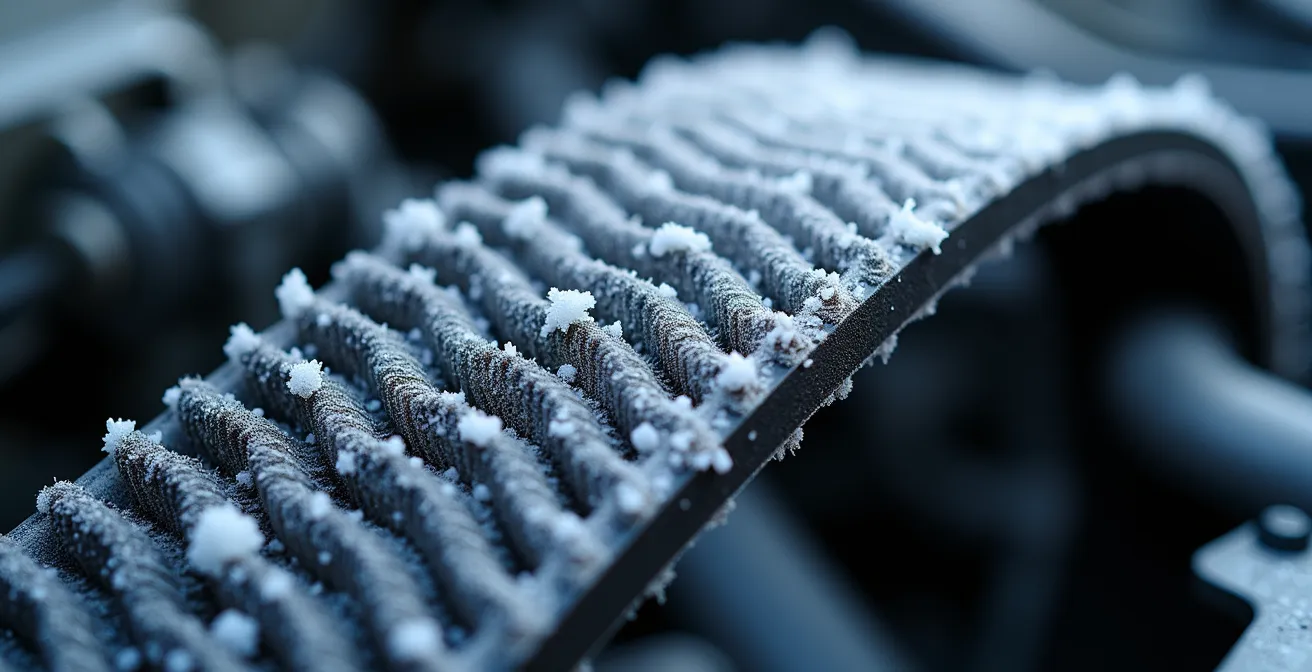
As this image illustrates, the damage isn’t always visible to the naked eye until it’s too late. The cumulative effect of cold starts adds up, making proactive replacement essential for drivers in colder climates. While general guidelines suggest replacement every 96,000 to 160,000 kilometres, your driving habits and local climate are the most important factors. Ignoring the impact of cold is a gamble against your engine’s life.
Your Action Plan: Cold Weather Timing Belt Care
- Regular Inspections: Have a qualified mechanic check the belt’s condition for cracking, fraying, or glazing during routine service.
- Follow Schedule: Adhere to your manufacturer’s severe service schedule for timing belt replacement, not the normal one.
- Keep It Warm: If possible, park in a garage or use a block heater to reduce the severity of cold starts and minimize thermal shock.
- Preventative Replacement: If your vehicle is approaching the replacement interval and shows any signs of wear, replace the belt before winter, not after.
- Use Quality Parts: Always insist on high-quality OEM (Original Equipment Manufacturer) or equivalent parts for maximum durability.
Why you need to flush brake fluid every 2 years regardless of mileage?
Of all the fluids in your car, brake fluid is perhaps the most misunderstood. Many drivers believe that if they don’t drive much, the fluid is fine. This is a dangerous misconception. Brake fluid’s greatest enemy isn’t mileage; it’s time and humidity. The core issue is that common brake fluids (DOT 3 and DOT 4) are hygroscopic, meaning they are designed to absorb moisture directly from the atmosphere.
This absorption happens slowly and invisibly through microscopic pores in brake lines and seals. Research shows that brake fluid can absorb moisture at a rate of 1% or more per year. While 1% sounds small, it has a massive impact. The boiling point of fresh brake fluid is over 200°C. With just 3% water contamination, that boiling point can plummet to around 140°C. During a hard stop or a long descent down a mountain, your brakes generate immense heat. If the fluid boils, it creates compressible gas bubbles in the lines, leading to a soft, spongy pedal and, in the worst case, total brake failure.
Furthermore, this moisture contamination leads to internal corrosion of expensive components like ABS modules, master cylinders, and calipers. A 2024 study on brake fluid contamination confirmed that a time-based interval is more critical than mileage. It found that vehicles should have their fluid replaced every two years (or 30,000 km) to prevent dangerous levels of water content that compromise braking safety. For Canadian drivers who experience wide humidity swings from season to season, this two-year rule is a non-negotiable safety measure.
Green, Orange, Blue: What happens if you mix coolant types?
Walking down the aisle of an auto parts store can be confusing. You’ll see jugs of coolant in a rainbow of colours: green, orange, red, blue, pink. It’s tempting to think « coolant is coolant » and top up your system with whatever is on sale. However, these colours signify vastly different chemical formulations, and mixing them can have disastrous and expensive consequences for your engine’s cooling system.
The problem isn’t the colour itself, but the corrosion-inhibitor technology inside. Older North American vehicles typically used green Inorganic Acid Technology (IAT) coolant. Modern vehicles often use orange or red Organic Acid Technology (OAT) coolants, while others use Hybrid (HOAT) or Phosphate-based (P-HOAT) formulas. Each is designed to protect the specific metals used in a particular engine.
When you mix incompatible types, like traditional green IAT with orange OAT, a chemical reaction occurs. The two types of inhibitors can clash, causing them to « precipitate » out of the solution. This forms a thick, gelatinous sludge or abrasive solid particles. This gel can clog the very small passages in your radiator, heater core, and engine block, leading to overheating, a lack of cabin heat in winter, and premature water pump failure. You’ve effectively turned your life-saving coolant into performance-killing sludge.
The following chart, based on data from automotive service experts, breaks down the risks. As this analysis from Certified Service shows, compatibility is key to engine health.
| Coolant Type | Color | Base Technology | Mixing Risk |
|---|---|---|---|
| IAT (Inorganic) | Green | Silicate/Phosphate | High – Forms gel with OAT |
| OAT (Organic) | Orange/Red | Organic Acids | High – Precipitates with IAT |
| HOAT (Hybrid) | Yellow/Blue | Mixed Technology | Moderate – Limited compatibility |
| P-HOAT | Pink/Blue | Phosphate Hybrid | High – Asian-specific formula |
The voltage reading that tells you your battery won’t start at -20°C
Every Canadian driver knows the sound: the slow, gut-wrenching groan of a car battery struggling to turn over on a frozen morning. A battery that worked perfectly in the fall can suddenly fail when the temperature plummets. This isn’t random; it’s a predictable result of chemistry and physics. The key to predicting failure lies in understanding your battery’s voltage and its Cold Cranking Amps (CCA) rating.
A healthy, fully charged car battery should have a resting voltage of around 12.6 to 12.7 volts. However, as a battery ages, its ability to hold a full charge diminishes. A reading of 12.4 volts indicates a 75% charge, while 12.0 volts is only a 25% charge. In warm weather, a battery at 75% charge will likely start the car without issue. But cold is a game-changer. At -18°C, a battery has only about 40% of the cranking power it has on a warm day. The cold oil in the engine is thick as molasses, requiring much more power to turn over.
This is where the critical failure point emerges. If your battery is sitting at 12.4 volts or less on a mild day, it is a major warning sign. It lacks the chemical reserve to overcome the double-whammy of reduced power output and increased starting demand at -20°C. This is why having your battery tested before winter is so crucial. For reliable winter starting, Bridgestone’s winterization guide recommends a battery with a minimum of 600 CCA. This rating measures the battery’s ability to deliver a strong current for 30 seconds in frigid temperatures, a direct indicator of its winter resilience.
Why replacing your cabin filter helps your windows defrost faster?
It seems unrelated: how can a small paper filter buried deep in the dashboard affect how quickly your windshield clears on a frosty morning? The connection is direct and is all about one thing: airflow. Your car’s defrost function relies on the blower motor pushing a high volume of warm, dry air onto the interior of the windshield. The cabin air filter is the gateway for that air.
Over time, this filter becomes clogged with dust, pollen, leaves, and other airborne debris. When the filter is dirty, it acts like a dam, severely restricting the amount of air the blower motor can pull into the HVAC system. The motor is forced to work much harder to push a smaller volume of air through the vents. When you crank the defrost to full blast, a clogged filter means you’re getting a fraction of the intended airflow, drastically increasing the time it takes to clear your windows.
Case Study: The Canadian Cabin Filter Challenge
According to winter car maintenance experts in Canada, cabin filters in our country face a unique triple-threat. They accumulate summer pollen and dust, followed by decaying autumn leaves, and are finally assaulted by fine, corrosive road salt dust kicked up during winter. This creates an unusually dense and stubborn barrier to airflow. A clogged filter not only slows defrosting but forces the HVAC blower motor to work much harder, especially on the high settings needed for clearing ice and fog. This extra strain can lead to premature and costly motor failure, turning a simple maintenance item into a significant repair.
Replacing a dirty cabin air filter is one of the cheapest and most effective ways to improve your winter driving safety and comfort. It restores maximum airflow to the defrost system, allowing it to work as designed. This means your windows will clear significantly faster, improving visibility and getting you on the road safely on those cold Canadian mornings.

The 3 engine components you should never replace with generic parts
When a repair is needed, the choice between an Original Equipment Manufacturer (OEM) part and a cheaper, generic aftermarket part can be tempting. While aftermarket parts can be a good value for some components, there are certain critical engine parts where choosing generic is a high-risk gamble. For these components, the precision, materials, and testing of an OEM part are non-negotiable for ensuring your vehicle’s reliability and performance.
OEM parts are what your vehicle was built with at the factory. They are designed by the manufacturer to work in perfect harmony with every other component in the system. Generic parts are often reverse-engineered to fit multiple models, sometimes sacrificing precise tolerances or material quality to keep costs down. For most of the car, this is fine. But for the engine’s core systems, « close enough » isn’t good enough.
Here are three components where you should always insist on OEM or a top-tier equivalent from a trusted OEM supplier:
- Engine Sensors (Oxygen, Camshaft/Crankshaft): These sensors provide vital data to your car’s computer in the form of precise electrical signals. Generic sensors may not operate within the exact voltage or resistance ranges the computer expects, leading to persistent « Check Engine » lights, poor fuel economy, failed emissions tests, and incorrect engine performance.
- Timing Belt and Tensioner: As discussed earlier, this system’s failure is catastrophic. OEM timing components are engineered for the specific harmonics and tension requirements of your engine. A generic belt might not have the same durability, and a weak aftermarket tensioner can cause the belt to skip a tooth, wrecking your engine.
- Fuel Pump: The engine management system is calibrated for a specific fuel pressure and flow rate. An OEM fuel pump delivers that precisely. A generic pump might provide inconsistent pressure, leading to a lean condition (damaging the engine) or a rich condition (destroying the expensive catalytic converter).
Why driving less than 5km is considered « severe abuse » for an engine?
It’s the most common type of driving for many Canadians: a quick trip to the grocery store, dropping the kids at school, the short commute to the local train station. These short drives, especially those under 8 km, feel harmless. In reality, they are one of the most damaging things you can do to your engine, which is why they are the number one qualifier for the « severe service » schedule.
The problem is all about reaching the proper operating temperature threshold. Your engine is designed to run most efficiently and cleanly when the oil temperature is around 100°C (212°F). At this temperature, two critical things happen: the oil has thinned to its correct viscosity to properly lubricate tight passages, and more importantly, it’s hot enough to boil off contaminants. During a cold start, a small amount of unburnt fuel and water (a natural byproduct of combustion) blows past the piston rings and contaminates the engine oil.
On a long drive, the engine gets hot enough to evaporate this water and fuel, venting it safely out of the crankcase. On a short trip, the engine never reaches this critical temperature. The water doesn’t boil off. Instead, it stays in the oil and churns into a thick, milky, mayonnaise-like substance called sludge. This sludge clogs oil passages, starves the engine of lubrication, and causes rapid, premature wear. This is especially damaging in Canadian winters, where cold, dense air increases condensation. According to automotive maintenance studies, as many as 80% of drivers don’t drive under normal conditions, with short trips being the main reason. Using a high-quality synthetic oil can provide better protection in these conditions, but it doesn’t eliminate the root cause.
Key Takeaways
- « Normal » Canadian driving—short trips, stop-and-go traffic, extreme cold—is what manufacturers define as « severe. »
- Short trips prevent your engine oil from heating up enough to burn off water contamination, leading to damaging sludge formation.
- Time is more critical than mileage for fluids like brake fluid, which absorb moisture from the air, reducing safety and causing corrosion.
- Extreme cold causes thermal shock to rubber parts like timing belts, making them brittle and prone to premature failure.
The « Million Kilometer » Mindset: Fighting Salt and Thermal Shock
Viewing the « severe service » schedule as a burden is a short-term perspective. A more powerful approach is to adopt the « Million-Kilometer Mindset. » This reframes maintenance not as a cost, but as a proactive strategy to combat the specific environmental forces in Canada that are constantly trying to wear your vehicle out. It’s about making your car last in a country that is uniquely tough on automobiles.
Throughout this guide, we’ve seen two primary antagonists: thermal shock and moisture contamination. From making timing belts brittle to ruining your engine oil on short trips, these two forces are responsible for a huge percentage of premature failures. The third major antagonist in Canada is, of course, road salt. Its corrosive effects on the underbody, brake lines, and exhaust system are well-known, but it also gets kicked up as a fine dust that clogs filters and accelerates corrosion on engine components.
The severe service schedule is your playbook for fighting this three-front war. More frequent oil changes directly combat the sludge from short-trip moisture. Time-based fluid flushes prevent internal corrosion and safety failures. Proactive replacement of rubber components mitigates the risk of catastrophic failure from thermal shock. As Canadian auto journalist Stephanie Wallcraft notes for CarGurus Canada:
The extreme cold we regularly experience in Canada can have adverse effects on your car that are unique to our climate
– Stephanie Wallcraft, CarGurus Canada Maintenance Guide
Ultimately, the « severe service » schedule isn’t a trap. It is the manufacturer’s admission that their vehicle requires extra care to achieve longevity in a demanding environment like Canada. Embracing it is the most logical and effective way to protect your investment and keep your vehicle safe and reliable for hundreds of thousands of kilometers to come.
Protect your investment by treating the severe service schedule as the default for Canadian driving. Discuss these points with your certified service advisor to create a maintenance plan that ensures your vehicle is ready to face the unique challenges of our climate, paving the way for a long and reliable journey.