The manufacturer’s maintenance schedule is a recipe for premature vehicle failure in Canada; true longevity comes from actively fighting environmental decay.
- Extreme temperature swings fatigue engine gaskets and seals, a threat « lifetime » fluids are not designed to handle.
- Corrosive salt brine requires a dynamic washing schedule and professional oil-based rustproofing, as electronic modules are ineffective.
Recommendation: Immediately adopt the « Severe Service » maintenance schedule as your baseline and focus on preserving mechanical components, not just preventing cosmetic rust.
For the pragmatic Canadian vehicle owner, the goal is simple: run it until the wheels fall off. We buy for the long haul, expecting a decade or more of reliable service. Yet, we watch as our vehicles succumb to rust and mechanical failures far sooner than they should. We follow the owner’s manual, perform the recommended services, and still, the harsh Canadian climate wins. The common advice—wash it, check fluids, get it rust-proofed—is so generic it’s almost useless. It fails to address the two specific, relentless enemies your vehicle faces: violent thermal shock and adhesive salt brine.
The standard maintenance schedule in your glovebox was not written for a country where temperatures can swing 40 degrees in a day and where roads are coated in a corrosive chemical cocktail for five months of the year. Relying on it is like preparing for a blizzard with a light jacket. The key to achieving true, million-kilometer longevity isn’t about following these generalized rules. It’s about understanding the specific mechanisms of decay in our environment and adopting a strategic, defensive posture against them.
This is the « Million Kilometer » Mindset. It’s a shift from passive, by-the-book maintenance to an active, informed strategy of asset preservation. It means ignoring the « lifetime fluid » marketing myth, recognizing that your daily commute qualifies as « severe service, » and knowing which rustproofing technology actually works versus which is expensive snake oil. This guide will break down the science behind Canadian vehicle aging and provide a clear, actionable framework to preserve your vehicle’s mechanical strength, not just its shine, for years to come.
This article provides a detailed roadmap to implementing this resilient mindset. We’ll explore the hidden stresses on your engine, debunk common maintenance myths, and lay out a clear strategy for protecting your vehicle’s most vulnerable systems.
Summary: The « Million Kilometer » Mindset: Fighting Salt and Thermal Shock
- What happens to your engine gaskets when temps swing from -30°C to +100°C?
- Lifetime Fluid? Why you must ignore the manual if you drive in Canada
- Why 90% of Canadian drivers qualify for « Severe Service » maintenance schedules
- The $50 bushing that saves your $1000 tires from uneven wear
- How often should you wash your undercarriage to neutralize salt brine?
- The hidden rust spots that make 80% of Ontario classics a bad investment
- Oil Spray vs Electronic Modules: Which actually stops rust in Canada?
- Rustproofing 101: How to Preserve Mechanical Strength Against Road Salt?
What happens to your engine gaskets when temps swing from -30°C to +100°C?
The most violent assault on your engine isn’t high-speed driving; it’s a cold start on a January morning. When your vehicle sits overnight in -30°C weather, every metal and rubber component contracts. The engine block, cylinder heads, and the gaskets sandwiched between them shrink at different rates, creating immense internal stress. Upon starting, the engine rapidly heats to an operating temperature over 100°C, causing violent expansion. This cycle of extreme contraction and expansion is known as thermal shock, and it is a primary driver of mechanical fatigue in Canadian vehicles.
Gaskets and seals bear the brunt of this abuse. Made from materials designed to be pliable, they become hard and brittle in the deep cold. When the hot engine components expand against them, these brittle seals can crack, tear, or lose their sealing ability. This leads to the slow, insidious leaks of coolant and oil that often mark the beginning of the end for a high-mileage engine. In severe cases, the shock can be so great that it leads to immediate head gasket failure, a catastrophic and costly repair. Furthermore, this stress isn’t limited to seals; it affects fuel injectors, causing them to operate less precisely, which results in rough idling, reduced power, and wasted fuel.
To combat this, the first 10 minutes of operation are critical. Avoid high-revving or heavy loads until the temperature gauge reaches its normal position. This gradual warm-up allows gaskets to regain their pliability and components to expand more uniformly. Using a high-quality full synthetic oil is also non-negotiable, as it remains more fluid at low temperatures, providing vital lubrication faster and helping to maintain the integrity of engine seals. This isn’t just about following a schedule; it’s about actively managing the physical forces trying to tear your engine apart from the inside.
Lifetime Fluid? Why you must ignore the manual if you drive in Canada
One of the most misleading terms in modern automotive marketing is « lifetime fluid. » Manufacturers often claim that transmission fluid, coolant, or differential fluid is good for the life of the vehicle. But what defines a vehicle’s « life »? For a manufacturer focused on the warranty period, that might be 100,000 kilometres. For a pragmatic Canadian owner, that’s just getting started. A typical vehicle is on Canadian roads for 11 years, with many owners pushing for 15, 20, or even more.
These « lifetime » fluids are not immune to the laws of chemistry. The same thermal shock that attacks gaskets also degrades your fluids. Extreme heat cycles break down the additives in transmission fluid, reducing its lubricating properties and leading to shuddering, slipping, and eventual transmission failure—a repair that can easily cost thousands. Coolant loses its anti-corrosion properties over time, allowing rust and scale to build up inside the engine and radiator, compromising the entire cooling system.
Ignoring these fluids is a gamble against a stacked deck. The « Million Kilometer » Mindset dictates that there is no such thing as lifetime fluid in a severe climate. A proactive fluid replacement schedule is your best insurance policy against premature powertrain failure. For a vehicle you plan to keep long-term, a transmission fluid and filter change every 100,000 km and a coolant flush every five years or 150,000 km is a more realistic and responsible strategy. The cost of this preventive maintenance is trivial compared to the cost of replacing a transmission or an engine. As experts in long-term ownership note, the financial benefits are significant.
Many drivers don’t realize the long-term financial benefits of keeping a car for 200,000 kilometres. Although there are repairs along the way, you can save around $30,000.
– ThinkInsure, ThinkInsure Insurance Help Centre
Why 90% of Canadian drivers qualify for « Severe Service » maintenance schedules
Buried deep within every owner’s manual is a small section that most drivers ignore: the « Severe Service » or « Severe Driving Conditions » schedule. This accelerated maintenance plan is intended for vehicles operating under challenging circumstances. The criteria typically include frequent short trips, driving in dusty conditions, extensive idling, and driving in extreme temperatures. Sound familiar? For the vast majority of Canadians, this isn’t an exception; it’s the daily reality of driving.
A winter commute of less than 15 minutes doesn’t allow the engine to fully warm up, leading to condensation buildup in the oil that degrades its protective qualities. Stop-and-go traffic in Toronto or Montreal constitutes severe use. Driving on gravel roads in rural Alberta or salted highways in Ontario qualifies. In short, if you drive in Canada, you are operating your vehicle under severe conditions. The « normal » schedule is designed for an idealized California highway commute, not a slushy, stop-and-go drive to work in February.
This split-screen comparison shows the stark reality. On the left, a vehicle operating under « normal » conditions. On the right, the same vehicle facing a typical Canadian winter, with components stressed by cold and coated in corrosive salt. Adopting the severe schedule is the single most effective strategic shift you can make.
Following the severe schedule means more frequent fluid changes, inspections, and filter replacements. It might seem like an added cost, but it’s a strategic investment in longevity. The table below illustrates how drastically the recommended service intervals change. An oil change interval might be cut in half, from 15,000 km to 7,500 km. Air filters, brake inspections, and coolant flushes all happen more frequently, catching wear and contamination before they cause cascading failures.
This table outlines the typical differences between a standard maintenance plan and the one that truly applies to Canadian driving realities.
| Service Item | Normal Service | Severe Service (Canadian Conditions) |
|---|---|---|
| Oil Changes | 16,000 km | 8,000 km |
| Air Filter | 48,000 km | 24,000-32,000 km |
| Brake Inspection | 64,000 km | 40,000 km |
| Coolant Flush | 160,000 km | 120,000 km |
The $50 bushing that saves your $1000 tires from uneven wear
The « Million Kilometer » Mindset is about focusing on the small, inexpensive parts that protect the large, expensive ones. Nowhere is this more evident than in the suspension system. Your car’s suspension is a complex network of arms, links, and joints, all connected by rubber bushings. These simple pieces of rubber or polyurethane are designed to absorb vibrations and allow for controlled movement. In Canada, they live a life of constant abuse, frozen solid in the winter and attacked by salt and road grime.
Over time, these bushings dry out, crack, and fail. A failed control arm bushing, which might cost $50, allows for excessive movement in the suspension. This seemingly minor issue throws off your vehicle’s wheel alignment. Now, your $1,000 set of premium all-weather tires is no longer meeting the road squarely. The inner or outer edges begin to wear down rapidly, a condition known as « cupping » or « feathering. » Within 20,000 kilometers, a brand-new set of tires can be destroyed, all because of a small, failed rubber component.
This is a classic example of a cascading failure. The initial problem is cheap and easy to fix if caught early. The resulting damage is expensive and frustrating. This is why the « Severe Service » schedule’s emphasis on frequent inspections is so crucial. A technician performing a thorough brake or suspension check will spot a deteriorating bushing long before it causes tire wear. The average driver may not notice the subtle change in handling, but the evidence will be clear to a trained eye. While routine maintenance has its costs, it’s a defense against much larger, unexpected bills. Investing in proactive inspections protects against major suspension failures that could cost thousands in tire replacement and alignment repairs, far exceeding the typical annual costs for upkeep.
How often should you wash your undercarriage to neutralize salt brine?
The second great enemy of Canadian vehicles is road salt. But the real danger isn’t the familiar white crystals you see on dry winter roads; it’s the invisible, sticky liquid known as salt brine. Highway departments across Eastern Canada and the Prairies increasingly use calcium chloride and magnesium chloride brines, which are sprayed on roads before a storm. This liquid is designed to stick to surfaces, and it does its job exceptionally well—on your vehicle’s undercarriage.
In Ontario, Quebec and the Maritimes, highway departments heavily use calcium chloride and magnesium chloride. The brine sticks to metal when wet and when dry become a powder that permeates every nook and cranny of your car.
– Rust Check, Rust Check – Stop Killing Your Car
This brine works its way into seams, frame rails, and behind body panels, holding moisture directly against the metal. Even when it dries, it leaves a concentrated salt powder that reactivates the moment it gets wet again. A simple « drive-thru » car wash that only cleans the painted surfaces is completely ineffective against this threat. The only defense is a targeted, high-pressure undercarriage wash. But how often?
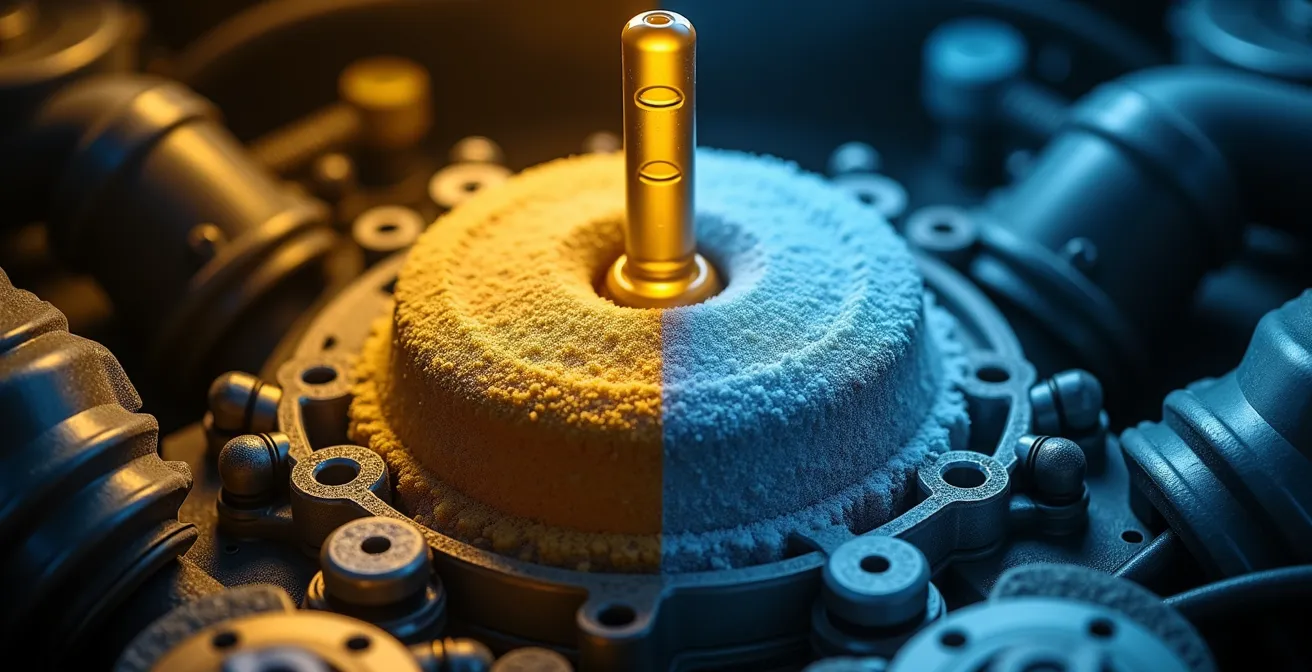
This close-up view shows how salt brine crystallizes on metal surfaces, trapping moisture and accelerating corrosion far more effectively than dry salt.

The answer isn’t a fixed schedule, but a dynamic one based on weather conditions. Rust is a chemical reaction that is most active just above the freezing point. Therefore, your washing frequency should increase during the freeze-thaw cycles common in November, March, and April. A good rule of thumb is to wash the undercarriage within two or three days of any major salting event. During periods where temperatures hover around 0°C, a weekly wash is a wise investment. Critically, a final, thorough undercarriage cleaning in the spring is essential to remove all residual salt before the warmer, more humid summer months accelerate any remaining corrosion. However, avoid undercarriage washing in a deep freeze (below -15°C), as this can freeze parking brake cables and door locks.
The hidden rust spots that make 80% of of Ontario classics a bad investment
Rust is the most visible sign of a vehicle’s age in Canada, but what you see on the surface is only the tip of the iceberg. Modern vehicles are built with galvanized steel and advanced coatings, meaning they often look pristine for years. In fact, an Automobile Protection Association (APA) analysis notes that most modern vehicles do not show visible signs of rusting until they are over 5-6 years old. This creates a false sense of security. The truly destructive corrosion is happening out of sight, deep within the vehicle’s structure.
The most vulnerable areas are the ones that trap moisture and salt: the insides of rocker panels, the bottom seams of doors and tailgates, the frame rails, and suspension mounting points. By the time a rust bubble appears on a fender, the metal behind it has likely been corroding for years. For buyers of used vehicles, especially classic or « future classic » models from salt-belt provinces like Ontario, this is a massive financial risk. A car can look perfect on the outside while its structural integrity is being quietly compromised.
The consequences of this hidden decay can be catastrophic, turning a prized investment into a dangerous liability. This isn’t just a cosmetic issue; it’s a fundamental threat to the vehicle’s safety and structural integrity.
Case Study: The Toyota Tacoma Frame Corrosion Crisis
One of the most infamous examples of structural rust damage in Canadian automotive history involved Toyota Tacoma pickups from the mid-2000s. The vehicle’s frame was improperly protected from the factory and was highly susceptible to salt corrosion. Owners reported frames rusting so severely that they could literally break in half, leading to a massive recall and vehicle buy-back program. This case highlights how even a vehicle renowned for its reliability can be destroyed by hidden rust, proving that no manufacturer is immune to the effects of road salt if structural protection is inadequate.
For any pragmatic owner or potential buyer, a pre-purchase inspection that includes a thorough examination of the undercarriage and internal body panels with a borescope camera is not optional—it is essential. Assuming a clean exterior equals a healthy vehicle is a mistake that has cost Canadian buyers millions.
Oil Spray vs Electronic Modules: Which actually stops rust in Canada?
When it comes to rust protection, the market is flooded with options, but they are not created equal. The two main categories are annual oil-based sprays and one-time electronic rust modules. For any long-term owner in Canada, choosing the right one is a critical decision. Despite aggressive marketing, the science and real-world evidence are clear: electronic modules are ineffective on automobiles.
These devices claim to work via « impressed current cathodic protection, » a technology that is effective in consistent, stable environments like on pipelines or the hulls of ships submerged in seawater. A car, however, is the exact opposite. It’s a complex structure of different metals constantly moving through a chaotic mix of air, fresh water, and salt spray. There is no consistent « electrolyte » for the electronic module to work in, rendering it useless. The APA and other consumer watchdogs have consistently found no evidence that they prevent rust on vehicles.
In contrast, traditional oil-based sprays have a proven track record. These products work by creating a physical barrier between the metal and moisture. Formulations like Krown or Corrosion Free use a light, creeping oil that contains rust inhibitors. This liquid is designed to penetrate deep into seams, welds, and body cavities—the very places where rust starts. Its « self-healing » nature means that if the coating is scratched, the oil creeps back over the exposed area. A study conducted for the Canadian Department of National Defence on its fleet of vehicles provided clear evidence on which commercial products performed best.
Of the CPCs tested, Corrosion Free, Formula 3000 showed the most corrosion inhibition
– Department of National Defence, Review of Corrosion Control Programs and Research Activities for Army Vehicles
The data clearly shows that while dealer-applied wax coatings and electronic modules offer poor value, an annual oil spray provides superior, verifiable protection.
| Method | Effectiveness | Annual Cost | Application |
|---|---|---|---|
| Oil Spray (Krown) | Excellent with annual reapplication | $145-$175 | Annual |
| Oil Spray (Corrosion Free) | Best in severe environments | $150-$200 | Annual |
| Electronic Modules | Ineffective on vehicles | $300-$500 | One-time |
| Dealer Wax-based | Poor – cracks over time | $499-$795 | One-time |
Key takeaways
- Canadian driving conditions are inherently « severe »; the manufacturer’s normal maintenance schedule is inadequate for long-term ownership.
- Thermal shock from extreme temperature swings causes mechanical fatigue in engine gaskets and seals, a threat that requires gradual warm-ups and high-quality synthetic fluids.
- Effective rust prevention relies on neutralizing salt brine with dynamic undercarriage washing and applying a proven, annual oil-based spray, not ineffective electronic modules.
Rustproofing 101: How to Preserve Mechanical Strength Against Road Salt?
The ultimate goal of a rustproofing strategy isn’t just to prevent cosmetic blemishes on body panels. It’s about preserving the mechanical and structural integrity of the entire vehicle. A rust bubble on a door is ugly, but a rusted-through brake line or suspension mount is a life-threatening failure. The « Million Kilometer » Mindset prioritizes protecting these critical, load-bearing, and safety-related components above all else.
Even with a quality oil spray, the application is everything. A technician who rushes the job or doesn’t know the specific problem areas of your vehicle’s model can leave critical systems vulnerable. This is a common issue with dealer-applied or generic undercoatings. A CAA study from the 1980s, still relevant in its findings, revealed that 85% of dealer-applied rustproofing left one or more high-risk areas unprotected. A proper application requires drilling small, discreet access holes in doors and rocker panels to ensure the rust-inhibiting oil reaches the internal structures.
A true asset preservation strategy involves specifically targeting the systems where corrosion poses the greatest risk. This means ensuring your rustproofing technician pays special attention to the steel brake and fuel lines running along the frame, the fuel tank straps, suspension mounting points on the subframe, and critical electrical connections. These are the components that, if they fail, can lead to a complete loss of control or create a serious fire hazard. Protecting them is the core principle of long-term vehicle ownership in a salt-belt region.
Your Critical Systems Audit Checklist: What to Protect from Salt
- Steel brake lines: Inspect for any signs of pitting or swelling; a rupture means total brake failure.
- Fuel tank straps: Check the condition of the metal straps holding the gas tank; failure can cause the tank to drop, creating a fire hazard.
- Suspension mounting points: Examine where control arms and struts bolt to the subframe and unibody for any signs of flaking or deep rust.
- Metal gas tanks and electrical grounds: Ensure the gas tank itself is not corroding, and check that main electrical grounding points on the frame are clean and protected.
- Air conditioner lines: Look for corrosion on the aluminum AC lines, as perforation leads to expensive refrigerant loss and system failure.
Adopting the « Million Kilometer » Mindset is a conscious choice to treat your vehicle as a long-term asset in a hostile environment. It requires moving beyond the manufacturer’s baseline and implementing a proactive strategy tailored to the realities of Canada. By managing thermal shock, neutralizing salt brine, and focusing on mechanical integrity, you are not just preventing rust; you are investing in years of future reliability and saving tens of thousands of dollars in the long run. Begin today by assessing your maintenance schedule and booking a consultation with a trusted, specialized rustproofing provider.
Frequently Asked Questions about The « Million Kilometer » Mindset: Fighting Salt and Thermal Shock
Why don’t electronic rust modules work on vehicles?
Electronic modules are based on ‘impressed current cathodic protection’ which requires a consistent electrolyte like seawater. Vehicles are exposed to constantly changing conditions of air, water, and salt spray, making this technology ineffective.
How do oil sprays actually prevent rust?
Oil sprays contain rust inhibitors, lubricants and capillary agents that allow the product to creep into all areas of bodywork, coating sheet metal and displacing moisture that causes rust.
Should I rust proof a new vehicle?
Yes, rust begins forming in hidden areas during the first year, invisible without dismantling panels. When rust appears 6-7 years later, the damage actually began years ago.