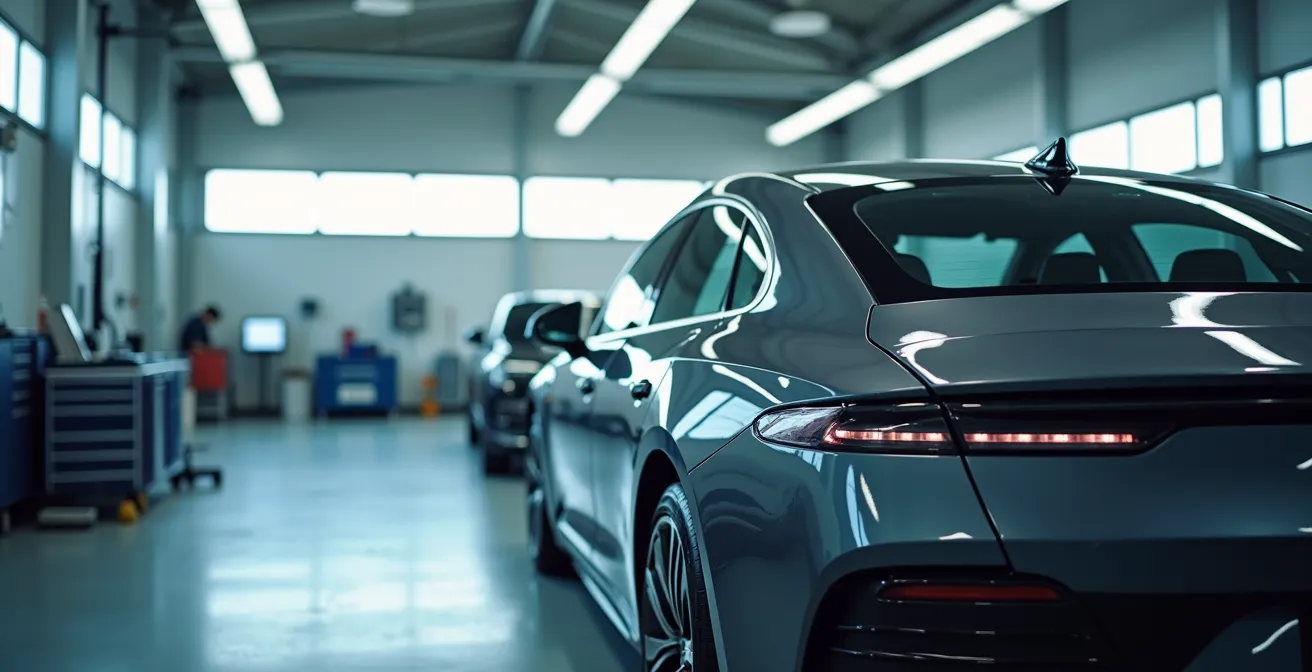
That shocking windshield replacement quote isn’t an upcharge; it’s the new reality of servicing your car’s digital nervous system.
- Windshield replacement now involves a mandatory, high-precision recalibration of safety cameras and sensors (ADAS).
- A millimeter of error can disable or impair life-saving features like automatic emergency braking, especially in Canadian winters.
Recommendation: Treat ADAS calibration as a non-optional medical procedure for your car and use the specific language in this guide to confirm insurance coverage before approving the work.
That sharp crack spreading across your windshield is frustrating enough. But the real shock often comes with the repair quote. You were probably expecting a few hundred dollars, a cost you’ve paid before. Instead, you’re looking at a bill north of $500, maybe even over $1,000. It’s understandable to feel like you’re being taken for a ride. For decades, a windshield was just a passive piece of safety glass. Now, it’s the most critical window for your car’s electronic eyes.
The sticker shock comes from one word: calibration. If your vehicle is equipped with Advanced Driver-Assistance Systems (ADAS)—like lane-keeping assist, adaptive cruise control, or automatic emergency braking—its forward-facing camera is mounted on the windshield. Replacing that glass is no longer a simple swap. It’s a delicate technological procedure that involves reconnecting and verifying the most important part of your car’s digital nervous system. The extra cost isn’t for the glass; it’s for the painstaking labour and specialized equipment needed to ensure those safety systems see the world exactly as they should.
But what if you skip it? Can it really be that important? From a technician’s standpoint, the answer is firm: calibration is not optional. This guide will walk you through exactly why this procedure is essential, what it entails, and how to navigate the conversation with your Canadian insurance provider. Think of this not as an explanation for an upcharge, but as a crucial briefing on the new reality of automotive safety.
To understand the stakes and the specifics, this article breaks down the entire process. We will explore the consequences of the smallest misalignments, the reasons behind the lengthy service time, the critical differences in glass quality, and the steps you can take to ensure you’re covered.
Summary: The Real Cost of a Modern Windshield Replacement
- What Happens if Your Lane Assist Camera is Off by 1 Millimeter?
- Why Does the Shop Need Your Car for 4 Hours to Change a Windshield?
- Does Aftermarket Glass Distort the View for ADAS Cameras?
- Did a Wheel Alignment Knock Your Radar Sensors Out of Sync?
- How to Ensure Your Insurer Covers the Full Cost of OEM Calibration?
- Should You Lower Your Comprehensive Deductible for Windshield Cracks?
- Why Do Shadows Under Bridges Trigger Your Emergency Brakes?
- OPCF 27 and Beyond: Which Optional Coverages Are Essential?
What Happens if Your Lane Assist Camera is Off by 1 Millimeter?
It sounds insignificant, like a rounding error. But in the world of ADAS, one millimeter of misalignment at the windshield can translate to a multi-foot error down the road where the system is looking. This isn’t a theoretical problem; it has life-or-death consequences. Your car’s automatic emergency braking (AEB) system relies on the camera to calculate the distance to an obstacle and your closing speed. A tiny angular error completely corrupts this calculation.
The stakes are incredibly high. Research shows that even a 0.6-degree misalignment can reduce AEB reaction time by 50%. That’s the difference between stopping safely and a serious collision. For features like Lane Keeping Assist, the system might fail to see lane markings, or worse, see them in the wrong place, causing the vehicle to drift or pull unexpectedly. This isn’t just an inconvenience; it’s a critical failure of a core safety system.
In Canada, this precision is even more vital. A study on ADAS performance in winter conditions, highlighted by research presented to Transport Canada, shows that snow, slush, and faint lane markings already degrade system performance. A perfectly calibrated system has a fighting chance to see through the « noise » of a Canadian winter. A miscalibrated one is effectively blind, leaving you without the safety net you paid for and rely on. That one millimeter is the margin between the system working as intended and failing when you need it most.
Why Does the Shop Need Your Car for 4 Hours to Change a Windshield?
The lengthy service time is one of the most common points of confusion for customers. The glass itself may only take an hour to set, but the remaining time is dedicated to the meticulous calibration process. This isn’t a simple « plug and play » reset; it’s a multi-stage procedure that can involve two distinct types of calibration to restore your vehicle’s optical integrity.
The first is Static Calibration. This is performed in the service bay with the car stationary. We place a series of highly specific, patterned targets at precise distances and heights in front of the vehicle. Using laser measurement tools, we then access your car’s computer and command the ADAS camera to look at these targets. The system learns its exact position and angle relative to the car’s centerline. It’s a slow, deliberate process where every measurement must be perfect. Any environmental factors like uneven flooring or poor lighting can compromise the result.

The second, often done in conjunction, is Dynamic Calibration. This requires a technician to drive the vehicle on well-marked roads at specific speeds for a set distance. During this drive, the camera observes real-world conditions—other cars, lane markings, road signs—and fine-tunes its settings based on live data. This ensures the system not only knows where it is but can also correctly interpret the complex environment of an active road. When you factor in both procedures, plus the necessary post-calibration system checks, the four-hour estimate starts to make perfect sense.
Does Aftermarket Glass Distort the View for ADAS Cameras?
This is a major point of contention, but for technicians and vehicle manufacturers, the answer is clear. While aftermarket glass may look identical, it often lacks the stringent optical quality required for ADAS to function correctly. The camera doesn’t just look *through* the glass; the glass is the first lens in a complex optical system. Even microscopic waves or distortions in the glass, invisible to the human eye, can warp the camera’s view, leading to misinterpretations of the road ahead.
Vehicle manufacturers are unambiguous on this point. They design, test, and validate their ADAS technology with Original Equipment Manufacturer (OEM) glass. They make no guarantees about performance with any other product. As General Motors Canada stated in an official position statement on the matter:
We test Genuine GM Parts (OEM glass) as part of our vehicles’ structural and advanced safety systems. We do not approve or test aftermarket glass nor claims of Original Equipment Equivalent (OEE) glass. With the evolution of ADAS, the windshield has an even greater role in vehicle safety.
– General Motors Canada, GM Position Statement on Aftermarket Glass
The issue goes beyond simple clarity. OEM glass has the camera mounting brackets affixed at the factory to exact specifications. With some aftermarket glass, the technician must manually glue the bracket onto the new windshield, introducing a significant risk of placement error. This seemingly small variance can lead to failed calibrations or, worse, a calibration drift over time, where the system slowly loses accuracy. The choice between OEM and aftermarket is not about brand loyalty; it’s about ensuring the foundational component of your safety system meets the non-negotiable specifications it was designed for.
The following table, based on industry analysis, breaks down the key differences and their direct impact on ADAS performance. A comparative analysis from recalibration specialists highlights these critical distinctions.
| Aspect | OEM Glass | Aftermarket Glass |
|---|---|---|
| Optical Clarity | Strict tolerances for optical distortion | May have microscopic warping affecting camera accuracy |
| ADAS Compatibility | Designed with precise curvature for camera calibration | Variances can lead to incomplete calibrations or off-center readings |
| Manufacturer Support | Tested and approved by vehicle manufacturer | No manufacturer testing or approval |
| Camera Mounting | Certified brackets and attachment points | May require manual bracket placement increasing error risk |
| Long-term Performance | Maintains calibration over time | Higher rates of recalibration failure or drift over time |
Did a Wheel Alignment Knock Your Radar Sensors Out of Sync?
It’s a surprising connection for many drivers, but your car’s alignment is now directly tied to its digital vision. Many ADAS systems, especially adaptive cruise control and forward collision warning, use radar sensors mounted in the grille or front bumper in addition to the windshield camera. These systems make a critical assumption: that the car is traveling perfectly straight when the wheels are pointed straight. The vehicle’s « thrust angle »—the direction the vehicle moves in relation to its centerline—is a foundational piece of data.
A bad wheel alignment, often caused by hitting a classic Canadian pothole, can throw off the thrust angle. If the car is slightly « crabbing » down the road, the radar sensors are no longer looking directly ahead. This misalignment can cause the adaptive cruise control to track a car in the adjacent lane or trigger false warnings. According to auto service experts, any deviation greater than +/- 0.1 degrees in thrust angle requires radar calibration. This is why many manufacturers now mandate an ADAS calibration check after any wheel alignment, suspension work, or even a tire change.
Your vehicle’s digital nervous system is a web of interconnected sensors. An error in one area (suspension geometry) can create a phantom problem in another (radar targeting). If you’ve recently had an alignment or hit a significant pothole and are noticing strange ADAS behavior, the two are likely related. A proper four-wheel alignment followed by an ADAS calibration is the only way to restore the system’s geometric baseline and ensure it’s aimed where you’re actually going.
Your Post-Pothole ADAS Checklist
- Notice vehicle pulling: Check for a consistent pull to one side even after a recent wheel alignment.
- Observe lane-keeping behaviour: Watch for the system « hunting » or bouncing between lane markings instead of tracking smoothly.
- Log intermittent warnings: Note any random beeps, system disengagements, or « sensor blocked » messages that appear without obvious cause.
- Document phantom events: Record any instances of « phantom braking, » where the car brakes for no apparent reason, especially the location and conditions.
- Assess following distance: Pay attention to whether the adaptive cruise control feels like it’s following too closely or too far back compared to its normal behaviour.
How to Ensure Your Insurer Covers the Full Cost of OEM Calibration?
Navigating insurance coverage is often the most stressful part of the process. Many policies will cover « windshield replacement, » but the adjuster you speak with may not be fully aware that calibration is now a mandatory, non-optional part of that procedure. Being prepared for this conversation is key to avoiding out-of-pocket expenses. Your position should be firm: calibration is not an add-on, it is an integral part of a safe and proper repair as mandated by the vehicle’s manufacturer.
When you speak with your insurance adjuster in Canada, it’s critical to use precise language. Don’t ask if calibration is « covered. » Instead, state that it is required. A highly effective script is: « My vehicle manufacturer’s service information explicitly requires an ADAS recalibration following a windshield replacement to ensure the integrity of the vehicle’s safety systems. Can you please confirm coverage for this non-optional procedure to ensure the vehicle is returned to pre-accident condition and prevent future liability? » This language shifts the conversation from an optional extra to a matter of safety and liability, which is a primary concern for insurers.

The situation can vary depending on your province. In provinces with public insurance like British Columbia (ICBC), Saskatchewan (SGI), and Manitoba (MPI), the policies and preferred shop networks for handling ADAS claims can be specific. It is always best to contact your provincial insurer directly to understand their exact process. For those in provinces with private insurance, like Ontario or Alberta, insisting on OEM parts and a full calibration is your right, but you must be clear and firm in your communication. Document your conversation, noting the date, time, and the name of the adjuster you spoke with.
Should You Lower Your Comprehensive Deductible for Windshield Cracks?
For years, the conventional wisdom was that a higher comprehensive deductible could save you money on premiums, as you were unlikely to make small claims. However, the advent of ADAS technology has completely upended this calculation. A windshield replacement is no longer a « small claim. » With costs easily exceeding $1,000 for glass and calibration, your deductible is now a much more significant factor.
Consider the new math. If you have a $500 or $1,000 comprehensive deductible, a single rock chip that spreads could mean you’re paying the entire bill out-of-pocket. Lowering your deductible to $300 or even $250 might slightly increase your annual premium, but it provides a crucial financial buffer against this increasingly common and expensive repair. You are essentially pre-paying a small, predictable amount to avoid a large, unexpected one.
The decision depends on your personal risk tolerance and driving habits. If you drive frequently on gravel roads or major highways like the 401 where debris is common, the probability of a windshield impact is high. In this scenario, a lower deductible often makes financial sense. It transforms the potential for a $1,000+ surprise into a more manageable, fixed cost. It’s a strategic shift from thinking about « if » your windshield will get hit to « when, » and planning your insurance coverage accordingly. This is a conversation worth having with your insurance broker to model the premium difference versus the potential claim cost.
Why Do Shadows Under Bridges Trigger Your Emergency Brakes?
This terrifying experience, known as a « phantom event, » is a classic symptom of an ADAS system that is confused or improperly calibrated. Your car’s camera and software are designed to interpret visual data and identify threats. However, unusual conditions can trick the system into seeing an obstacle that isn’t there. A sharp, dark shadow under a bridge on a bright day, a large piece of roadside debris, or even heavy rain or snow can be misinterpreted as a stationary vehicle or pedestrian, causing the car to brake suddenly and dangerously.
While some phantom events can be caused by software bugs that require a dealer update, many are exacerbated by poor environmental conditions or, more critically, an underlying calibration issue. An improperly calibrated camera is already working with a flawed view of the world. Add in ambiguous visual data from a Canadian winter, and the system is more likely to make a mistake.
Poor weather conditions can trick ADAS into seeing things that aren’t there or lower object ID accuracy. Snowdrifts might be mistaken for obstacles, leading to unnecessary braking or swerving. Road markings can become obscured, preventing systems from making appropriate lane corrections.
– 1Source ADAS, What Winter Weather Conditions Mean For ADAS Components
If you experience these phantom events, it’s crucial to document them. A log of these incidents provides a technician with valuable data to diagnose whether the problem lies with the system’s software or its calibration. Your documentation is also vital if you need to report a potential safety defect. Here’s what you should record:
- Note the exact time, date, and prevailing weather conditions (e.g., bright sun, heavy rain, snow).
- Document the specific location, especially if triggers repeatedly occur at the same spot (e.g., a particular overpass or tunnel).
- Write down any warning messages that appear on your dashboard immediately before or after the event.
- Keep this log to establish a pattern, which can help differentiate a calibration issue from a software bug, and report persistent, dangerous events to your dealership and Transport Canada’s Defect Complaint system.
Key Takeaways
- ADAS calibration is a non-negotiable part of modern windshield replacement, essential for safety system function.
- A millimeter of camera misalignment can lead to a 50% reduction in automatic emergency braking effectiveness.
- Using OEM (Original Equipment Manufacturer) glass is critical for maintaining the optical clarity required by ADAS cameras.
- You must be firm and specific when talking to your insurer, framing calibration as a mandatory part of a safe repair to ensure coverage.
OPCF 27 and Beyond: Which Optional Coverages Are Essential?
Being prepared for a modern vehicle repair goes beyond just having basic insurance. With ADAS calibrations potentially taking your car out of commission for a day or more, having the right optional insurance endorsements can save you significant hassle and expense. These are no longer niche add-ons; they are becoming essential for any driver with a newer vehicle. In Canada, the names of these endorsements vary by province, but their function is similar.
The most critical is coverage for a rental vehicle during repairs. A multi-day calibration process means you’ll be without your car. In Ontario, this is the OPCF 27 (Liability for Damage to Non-Owned Automobiles). In Alberta, it’s the SEF 27, and in Quebec, the QEF 27. This endorsement extends your own insurance coverage to a rental car, which is crucial as the repair is no longer a same-day service. Another important consideration, especially for newer cars, is a depreciation waiver (like Ontario’s OPCF 43), which ensures that if a complex ADAS-related issue leads to a total loss, you are compensated for the full value of your vehicle, not a depreciated amount.
Understanding which endorsements are available and relevant to you is the final piece of the puzzle. Public insurers in BC, Saskatchewan, and Manitoba have their own specific systems, so a direct call is necessary. For others, a proactive conversation with your insurance broker is the best strategy. The table below outlines some key endorsements across different Canadian provinces that are highly relevant in the age of ADAS.
| Province | Endorsement | Coverage | ADAS Relevance |
|---|---|---|---|
| Ontario | OPCF 27 | Liability for Non-Owned Auto | Covers rental during multi-day calibration |
| Alberta | SEF 27 | Legal Liability for Non-Owned Auto | Essential for extended repair periods |
| Quebec | QEF 27 | Civil Liability for Non-Owned Auto | Rental coverage during calibration work |
| Ontario | OPCF 43 | Waiver of Depreciation | Protects against ADAS-related total loss in first 2-3 years |
| BC/SK/MB | Public Insurance | Different system entirely | Contact provincial insurer for ADAS coverage details |
The next time you get a quote for a windshield, you’ll be prepared. The key is to review your current insurance policy now, before you need it. Contact your broker or provider and specifically ask about your comprehensive deductible and coverage for rental vehicles during repairs. Being proactive is the best way to turn a future surprise into a predictable, manageable process.