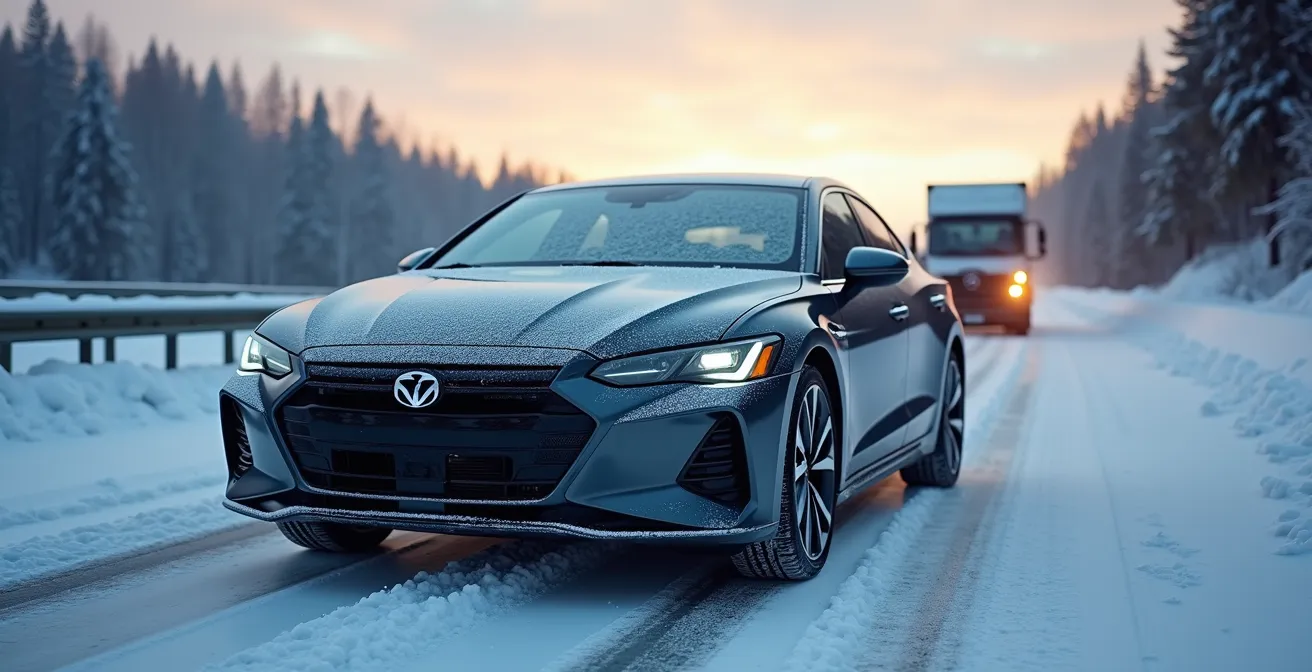
That « Radar Obstructed » warning on your dashboard during a light Canadian snow flurry isn’t just an annoyance; it’s a symptom of « sensor blindness. » The issue isn’t simply that your sensors are dirty. The real problem lies in the materials science of winter road grime—how a thin, semi-translucent film of salt can scatter sensor signals more effectively than a thick layer of snow. This guide moves beyond simple wipe-downs to provide a field tester’s methodology for maintaining the optical integrity of your vehicle’s advanced safety systems through the harshest winter conditions.
You’re driving on a major Canadian highway, like the 401, in what seems like minor winter weather. A light slush is kicking up from the transport truck ahead, but visibility is still decent. You try to engage your adaptive cruise control, but a frustrating amber light appears on your dash: « Radar Obstructed. Front Assist not available. » This scenario is increasingly common for drivers of modern vehicles equipped with Advanced Driver-Assistance Systems (ADAS). Your car, packed with sophisticated technology designed to keep you safe, has suddenly gone partially blind.
The conventional wisdom is to simply « keep your sensors clean, » but this advice often fails in practice because it misses the fundamental reasons for the failure. The problem is more complex than a patch of snow. It involves understanding how different sensors perceive the world and how a nearly invisible layer of dried road salt can be a more formidable enemy than a completely covered bumper. It’s about realizing your car’s sensors aren’t just rugged components; they are sensitive scientific instruments.
Instead of just repeating the basics, this guide adopts the perspective of a field tester to delve into the « why » behind these failures. We will explore the specific vulnerabilities of radar, lidar, and camera systems to the unique challenges of a Canadian winter. By understanding the physics of sensor obstruction and the principles of optical integrity, you can move from frustrating guesswork to a precise, effective maintenance routine.
This article will dissect the most common failure points, from the chemistry of road salt to the critical importance of millimeter-perfect alignment. Follow along to learn how to properly diagnose and resolve these issues, ensuring your car’s advanced safety features are there for you when you need them most.
Summary: Sensor Blindness: Keeping Your Smart Car « Seeing » in Slush
- Why a thin layer of dried salt disables your emergency braking?
- How to clean a backup camera without scratching the lens coating?
- Can you use Rain-X on lidar and radar sensors?
- How to tell if your radar heater is burned out?
- What systems remain active when the « Radar Obstructed » warning appears?
- Why wiping your backup camera is as important as scraping your windshield?
- What happens if your lane assist camera is off by 1 millimeter?
- ADAS Confusion: When Your Car Misreads the Road
Why a thin layer of dried salt disables your emergency braking?
It’s a counter-intuitive scenario: a sensor completely caked in thick, heavy snow might simply report an obstruction, but a thin, almost transparent film of dried road salt can cause more erratic system behaviour. The reason lies in physics, not just cleanliness. Your car’s forward-facing radar, essential for Autonomous Emergency Braking (AEB) and Adaptive Cruise Control (ACC), works by emitting radio waves and analyzing the signals that bounce back. This system is designed to filter out noise and identify solid objects.
However, a dried layer of road salt doesn’t behave like a solid wall. It forms a crystalline structure. When radar waves hit this jagged, semi-translucent surface, they don’t reflect cleanly. Instead, they scatter in countless directions, a phenomenon known as signal attenuation and diffusion. The sensor receives back a weak, chaotic, and nonsensical « picture » of the world. To the system’s logic, this is worse than no signal at all, as it could be misinterpreted as a complex field of non-existent small objects.
In this state of confusion, the system’s fail-safe protocol is triggered. Rather than risk a « phantom braking » event based on faulty data, it disables functions like AEB and ACC entirely, alerting you with a « Radar Obstructed » message. This is why a quick swipe that leaves a salty residue can be ineffective; the sensor isn’t just « dirty, » its perception of reality is being actively distorted by the crystalline structure of the salt.
How to clean a backup camera without scratching the lens coating?
Your backup camera lens is not just a piece of plastic; it’s a sophisticated optical component with delicate coatings designed to reduce glare and repel water. Treating it like a piece of glass can lead to permanent damage. The primary culprit in a Canadian winter is the combination of road salt and fine sand, which creates a highly abrasive paste when wiped improperly.
Using a gas station squeegee, a paper towel, or even the sleeve of your winter jacket can cause irreversible micro-abrasion. While invisible to the naked eye at first, these tiny scratches accumulate, scattering light and progressively degrading the camera’s performance. The result is a permanently foggy, blurry, or low-contrast image that no amount of cleaning can fix, severely compromising its function as a safety device.
The illustration below shows an extreme close-up of how sharp salt crystals appear on a delicate lens coating, highlighting the potential for scratch damage with every improper wipe.

The correct method treats the lens with the care of an expensive camera. The goal is to lift the abrasive particles off the surface, not grind them into it. Always start by rinsing the lens with water or washer fluid to dislodge the larger, sharper pieces of grit and salt. Only then should you gently wipe it with a clean, high-quality microfiber cloth. Keep a dedicated cloth in your car for this purpose. A dirty microfiber cloth will just re-apply the grit you’re trying to remove, defeating the purpose and causing the very damage you want to avoid.
Can you use Rain-X on lidar and radar sensors?
The temptation to apply a hydrophobic product like Rain-X to every exterior surface to repel ice and slush is understandable, but it’s a critical mistake for most ADAS sensors. The answer to whether you can use it depends entirely on the type of sensor. For camera-based systems, the answer is an emphatic no. For radar systems, it’s generally unnecessary and not recommended.
Camera lenses and lidar ports rely on « optical integrity »—a perfectly clear, undistorted path for light to travel. Applying a hydrophobic coating, which is not designed for the precise tolerances of automotive optics, can create a thin film that subtly distorts the light. This can affect the camera’s ability to accurately measure distances or identify lane markings, potentially confusing the system. As one expert from Consumer Reports warns, wiping a lens can degrade the surface, and applying unapproved chemicals only accelerates this process.
For radar-based systems, the situation is different. Tammy Meehan, a manager for automotive sensor solutions at 3M, notes that radar is less susceptible to these issues because the unit is typically located behind a bumper or grille emblem, which already serves as its protective cover or « radome ». The radio waves it uses operate at a frequency that is not significantly affected by thin chemical coatings. Therefore, while applying Rain-X to the plastic emblem covering your radar sensor probably won’t harm it, it also offers no real benefit and is not an approved procedure. Your efforts are better spent keeping these areas physically clear of thick ice and mud.
For safe cleaning, always stick to the basics:
- Gently wipe all sensors with a damp microfiber cloth.
- Avoid harsh, aggressive chemical cleaners not approved for automotive use.
- Ensure no stickers, license plate frames, or other objects are blocking any sensors.
- Keep the windshield itself pristine, as this is critical for forward-facing cameras.
How to tell if your radar heater is burned out?
Many forward-facing radar units, especially in vehicles sold for cold climates like Canada, are equipped with a small, internal heating element. Its sole purpose is to gently melt away a light layer of ice or frost that forms on the sensor’s surface while driving or when the vehicle is parked. If you find your radar is constantly obstructed in cold, damp weather even after cleaning, you might have a problem with this heater, not just with surface dirt.
Unfortunately, there is no simple dashboard light that says « Radar Heater Failed. » The system will only report the symptom: the « Radar Obstructed » warning. As a driver, the best clue is a pattern of behaviour. If the warning appears on cold mornings but then clears after 15-20 minutes of driving (as engine heat soaks the front of the car), it could point to a functioning heater struggling to keep up. However, if the warning appears in the cold and never clears on its own despite a clean sensor surface, a burned-out heater is a strong possibility.
The definitive diagnosis requires a trip to a qualified technician with an appropriate scan tool. When they plug into your car’s OBD-II port, they look for specific Diagnostic Trouble Codes (DTCs). According to ADAS diagnostic standards, B-codes (Body codes) typically indicate local component circuit issues, which include failures in heater elements, internal sensor faults, or problems with the wiring. A technician can read these codes to confirm if the heater circuit is open or shorted, providing a clear diagnosis that goes beyond a simple visual inspection.
What systems remain active when the ‘Radar Obstructed’ warning appears?
The appearance of a « Radar Obstructed » warning can be alarming, but it’s crucial to understand it doesn’t mean all your car’s safety systems are offline. Modern vehicles use a principle of sensor de-confliction and redundancy. The master computer knows which safety feature relies on which specific sensor. When one sensor reports an unreliable signal, the system intelligently disables only the features that depend exclusively on that data, while keeping others active.
Your car’s primary forward-facing radar is the key input for systems that need to measure the distance and speed of objects far ahead, such as Adaptive Cruise Control (ACC) and Forward Collision Warning (FCW). When this radar is blinded by slush or ice, these systems are the first to be disabled as a safety precaution. However, many other systems remain fully functional because they use different sensors located elsewhere on the vehicle.
For example, Lane Keeping Assist typically uses a camera mounted at the top of your windshield. Blind Spot Monitoring and Rear Cross Traffic Alert use separate, smaller radar units tucked into the corners of your rear bumper. And foundational safety systems like ABS and Traction Control rely on wheel speed sensors. As long as their respective sensors are clear and functional, these systems will continue to operate normally.
The following table, based on common ADAS logic, breaks down which systems are typically active or disabled when the front radar is blocked.
| System Type | Status When Front Radar Obstructed | Alternative Sensor Used |
|---|---|---|
| Adaptive Cruise Control | Disabled | None – Requires front radar |
| Forward Collision Warning | Disabled | None – Radar dependent |
| Autonomous Emergency Braking (radar-based) | Disabled | None – Primary sensor blocked |
| Standard Cruise Control | Active | Speed sensor only |
| Lane Keeping Assist | Active (if camera clear) | Windshield-mounted camera |
| Blind Spot Monitoring | Active (if side radars clear) | Separate rear bumper radars |
| ABS & Traction Control | Always Active | Wheel speed sensors |
This data from an analysis of ADAS diagnostic behavior shows that a single sensor failure results in a graceful degradation of features, not a total system failure. The most important takeaway is that you can often switch from adaptive cruise control to standard cruise control, which only maintains speed and does not rely on the front radar.
Why wiping your backup camera is as important as scraping your windshield?
In the era of advanced driver aids, we must update our pre-drive safety rituals. For decades, scraping the windshield has been the non-negotiable first step of winter driving in Canada. We do it because a clear view is fundamental to safety. Today, the same logic must be applied to the car’s sensors, especially the backup camera. An obscured windshield robs the driver of vision; an obscured backup camera robs the car of its situational awareness, a sense you have come to rely on for low-speed maneuvering.
Relying on a backup camera daily trains your brain to trust its perspective when reversing. When that view is suddenly a blurry, slush-covered mess, your spatial judgment is compromised. You are suddenly missing a critical sensory input, increasing the risk of backing into an obstacle, or worse, not seeing a child or pedestrian. This reliance on technology makes its maintenance a primary safety task. As Jennifer Stockburger of the Consumer Reports Auto Test Center notes:
The fact that dirty car sensors or inclement weather can obstruct these systems’ view is another reason that we need to remain attentive and engaged in our driving tasks.
– Jennifer Stockburger, Consumer Reports Auto Test Center
Integrating sensor cleaning into your routine is not just about convenience; it’s about maintaining the integrity of the safety systems you depend on. It should become as automatic as kicking the snow out of your wheel wells or checking your mirrors.
Your Action Plan: Winter Sensor Cleaning Protocol for Canadian Drivers
- Thoroughly clear the entire car of snow after each storm before driving—this is a legal requirement in some Canadian jurisdictions.
- Keep a dedicated snow brush and microfiber cloth in your vehicle to clear sensors multiple times during a trip in heavy slush or snow.
- Always perform cleaning in a safe location like a parking lot or rest stop, never on the shoulder of a busy road.
- Schedule regular car washes during breaks in the weather to remove the persistent film of salt and grime from all sensors and cameras.
- When hand-washing, use a mild, automotive-specific detergent to avoid damaging paint or sensor coatings.
- Be extremely gentle when cleaning fenders and bumpers, as embedded salt and sand are highly abrasive to your car’s paint.
- After washing, use a clean towel to dry sensor areas to prevent a new layer of ice from forming immediately.
What happens if your lane assist camera is off by 1 millimeter?
A lane assist camera, mounted at the top of the windshield, is not just a simple webcam. It’s a precision measurement instrument. It calculates your vehicle’s position relative to lane markings by analyzing perspective, angle, and distance with incredible accuracy. For this to work, the system must know its exact position and orientation relative to the center of the vehicle. If this calibration is off by even a tiny amount, the entire system’s geometry is compromised.
Think of it like the sights on a rifle. If the rear sight is moved by just one millimeter, the bullet’s trajectory will be off by several feet at a distance. The same principle applies to your car. ADAS calibration specialists warn that even one degree of misalignment can cause the system to be significantly off axis when looking 50 feet down the road. This means a 1-millimeter error in the camera’s mounting position could cause the car to misjudge the lane’s center by inches, leading it to hug one side of the lane or even trigger false lane departure warnings.
This is a particularly relevant issue for Canadian drivers. A windshield replacement due to a rock chip from a gravel truck, a wheel alignment after hitting a severe post-winter pothole, or even a minor fender-bender that shifts the bumper can all throw off these precise calibrations. If a sensor is replaced or moved for any reason, a full ADAS recalibration is not an optional upsell; it is a mandatory safety procedure to ensure the system’s geometric calculations are accurate. Without it, your lane assist may become unreliable or dangerously inaccurate.
Key takeaways
- Sensor failure is often a materials science problem (salt crystals scattering signals), not just a « dirty lens » issue.
- The right tool matters: always use a clean microfiber cloth after rinsing to avoid permanently scratching optical coatings.
- A single « obstructed » warning does not mean all safety systems are off; the car intelligently disables only the dependent features.
- Post-repair calibration is not optional. A 1mm misalignment can render a lane-keeping system inaccurate and unsafe.
ADAS Confusion: When Your Car Misreads the Road
We have explored how « sensor blindness » can be caused by physical obstructions, surface damage, electronic failures, and misalignment. All these issues lead to the same fundamental problem: ADAS confusion. When a car’s sensors provide conflicting or nonsensical data, the system is designed to fail gracefully by shutting down features. This is a far safer alternative than acting on bad information, but it underscores a critical truth for the modern driver: these systems are powerful aids, not infallible co-pilots.
Winter weather, as noted by experts at Bendix, puts immense pressure on these systems. The constant assault of snow, ice, and road grime means that maintaining sensor input accuracy is a continuous battle. Before any long winter trip, a driver’s responsibility extends beyond checking tire pressure; it must now include confirming that all camera and radar surfaces are physically clear and that no active diagnostic trouble codes are present. This proactive mindset is the cornerstone of safely operating a vehicle equipped with ADAS.
Ultimately, the responsibility for navigating safely remains with the person behind the wheel. When a system deactivates, it is handing control and full responsibility back to you. Understanding why these systems fail allows you to anticipate the issues, perform the correct maintenance, and, most importantly, remain an attentive and engaged driver, ready to take full command when your vehicle’s digital eyes are inevitably confused by the realities of the road.
Your vehicle’s safety is a shared responsibility between you and its technology. Before your next winter drive, perform the sensor safety check outlined in this guide. A few minutes of preventative cleaning and inspection is the most effective way to ensure your car’s advanced safety features are ready to assist you.