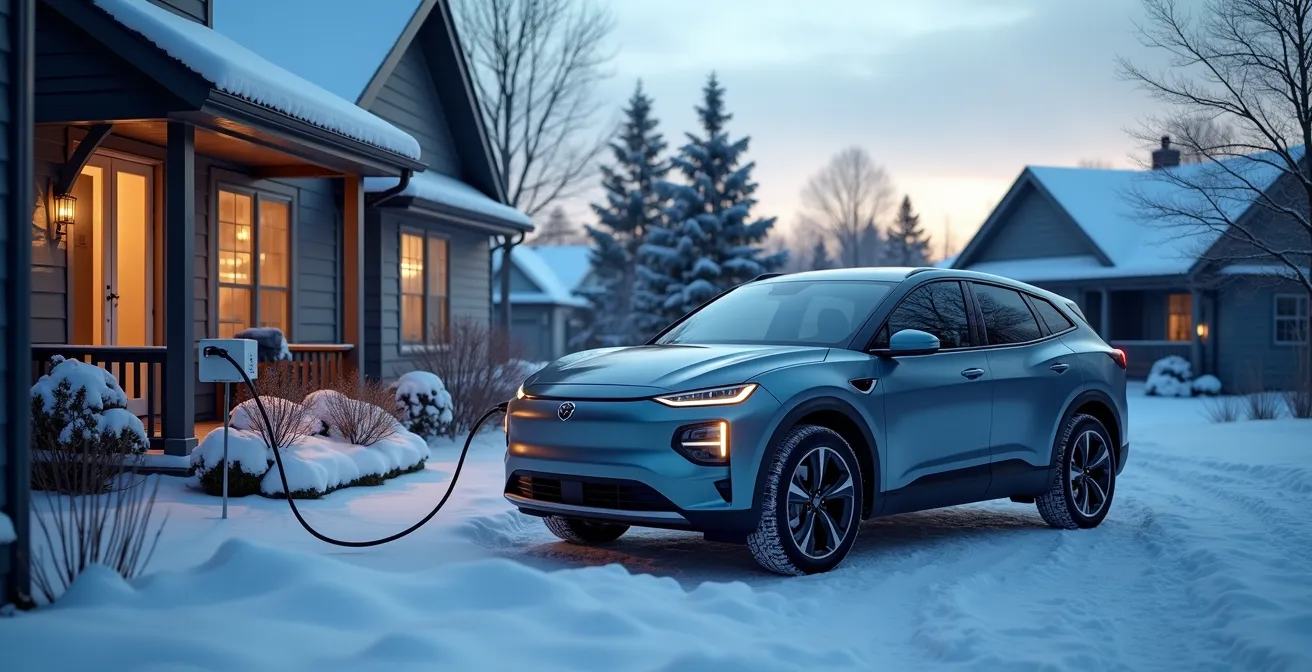
A PHEV’s value for a Canadian suburban family isn’t a given; it’s earned through disciplined daily use that goes far beyond simply driving.
- Success requires mastering winter thermal management to protect electric range and strategically using « Save Mode » on highways for energy arbitrage.
- The initial price premium is often erased by federal rebates, but long-term savings depend entirely on the operational discipline of consistent home charging.
Recommendation: Treat your PHEV like a specialized tool, not a simple car, to truly minimize your fuel bill and outperform a standard hybrid.
For the Canadian suburban family, the calculus of car ownership is changing. With gas prices fluctuating and the federal carbon tax steadily climbing, the allure of electric driving is stronger than ever. Yet, the vast distances of our country and the lingering fear of being stranded on a cold highway—what many call range anxiety—make a full battery electric vehicle (BEV) a daunting leap for many. This is where the Plug-in Hybrid Electric Vehicle (PHEV) enters the conversation, positioned as the perfect, no-compromise solution.
The common refrain is that PHEVs offer the « best of both worlds »: silent, zero-emission electric power for daily errands and the reliable security of a gasoline engine for long road trips to the cottage or across provinces. But what if this promise is dangerously oversimplified? What if the key to a PHEV’s value isn’t its existence, but a specific set of user behaviours that most people don’t consider? The pragmatic reality is that a PHEV is a complex tool, and when mismanaged, it can become a heavier, less efficient, and more expensive burden than the standard hybrid it was meant to replace.
This article moves beyond the clichés. We will not just tell you *what* a PHEV is; we will show you *how* to master it in the unique context of Canadian suburban life. We’ll dissect the non-negotiable daily habits, the counter-intuitive winter quirks, and the strategic thinking required to ensure your investment truly pays off, turning your fuel bill anxiety into a calculated advantage.
This guide provides a pragmatic roadmap for any Canadian family considering a PHEV. We will explore the critical questions that determine whether this technology is a financial masterstroke or a costly mistake, giving you the clarity needed to make the smartest choice for your driveway.
Summary: A Pragmatic Guide to PHEV Ownership in the Canadian Suburbs
- Why does your engine turn on in winter even if the battery is full?
- Does the fuel saving justify the $5,000 price premium over a hybrid?
- Do you have to maintain the gas engine if you mostly drive electric?
- The daily driving habit that ruins PHEV fuel economy
- When to use « Save Mode » to maximize efficiency on long drives?
- Why idling your car for 20 minutes actually wastes $300 a winter?
- Compact vs Hybrid: Which car creates the least stress in downtown traffic?
- How to Cut Your Fuel Bill by 20% Despite Canada’s Rising Carbon Tax?
Why does your engine turn on in winter even if the battery is full?
It’s a frustrating scenario for new PHEV owners in Canada: the battery is fully charged, but on a cold January morning, the gasoline engine roars to life. This isn’t a defect; it’s a critical feature of the vehicle’s thermal management system. In frigid temperatures, using the electric battery to generate cabin heat would drastically reduce your driving range. The car’s computer knows it’s more efficient to run the engine to quickly produce heat for you and to warm the battery to its optimal operating temperature. This preserves your precious electric kilometres for propulsion.
This is a fundamental reality of EV technology in northern climates. In fact, comprehensive road tests conducted by the Canadian Automobile Association (CAA) in sub-zero conditions confirmed this effect. Their findings showed that a 14 to 39 percent reduction in electric range is common for electric vehicles operating between -7°C and -15°C. For a PHEV, the engine kicking in is a built-in mitigation strategy.
Understanding this behaviour is the first step toward mastering your PHEV. Instead of seeing it as a failure of the electric system, view it as an intelligent, automated decision to protect your primary goal: efficient driving. The key is to minimize how often the car has to make this choice for you, which we’ll cover in the section on pre-conditioning.
Does the fuel saving justify the $5,000 price premium over a hybrid?
On paper, the price difference between a PHEV and its standard hybrid counterpart can be daunting, often in the range of $5,000 or more. This initial sticker shock causes many Canadian families to question if the potential fuel savings can ever justify the upfront cost. However, this calculation is incomplete without factoring in a crucial piece of the puzzle: government incentives. In Canada, many PHEVs are eligible for the federal iZEV (Incentives for Zero-Emission Vehicles) program.
This program significantly alters the financial equation. According to Canada Drives, Canadian PHEVs qualify for federal incentives of $2,500 to $5,000, with additional provincial rebates available in places like Quebec and British Columbia. For a vehicle with a $5,000 premium, a matching $5,000 rebate makes the cost identical to a standard hybrid from day one, effectively giving you the plug-in capability for free. This dramatically accelerates your break-even velocity.
When the rebate erases the premium, every dollar saved on fuel becomes an immediate net gain. The table below illustrates how quickly a PHEV like the popular Toyota RAV4 Prime can become more economical than its hybrid version, especially when the federal rebate is applied. The « break-even » point happens instantly.
| Vehicle Type | Initial Premium | Federal Rebate | Annual Fuel Savings | Break-even (years) |
|---|---|---|---|---|
| PHEV (RAV4 Prime) | $5,000 | $5,000 | $800-1,200 | Immediate with rebate |
| PHEV (without rebate) | $5,000 | $0 | $800-1,200 | 4-6 years |
Therefore, the question isn’t whether the fuel savings justify the premium, but rather: are you prepared to adopt the habits required to *achieve* those annual savings? With the premium often neutralized by rebates, the financial advantage is there for the taking.
Do you have to maintain the gas engine if you mostly drive electric?
One of the most common and costly misconceptions among new PHEV owners is that if they drive primarily on electric power, the gasoline engine can be ignored. This is false. A PHEV is not two separate power systems; it’s a single, integrated one. The internal combustion engine (ICE) requires regular maintenance, regardless of how little it’s used. In fact, infrequent use can create its own set of problems, such as stale fuel and dried-out seals.
To address this, most PHEVs have built-in preservation cycles. As the Canadian Automobile Association notes, it’s a counter-intuitive but necessary process: « Many PHEVs will automatically run the engine to burn old fuel, a counter-intuitive but necessary maintenance cycle for low-gas-usage owners ». This is part of the operational discipline required—understanding that the car will sometimes act in ways that seem inefficient in the short term to ensure long-term reliability. Neglecting this leads to expensive repairs that can quickly erase any fuel savings you’ve accumulated.
Maintaining both the high-voltage electric system and the traditional engine requires a specific schedule. Following a clear plan is the only way to ensure the longevity and efficiency of the entire vehicle.
Your Essential PHEV Gas Engine Maintenance Checklist
- Oil Changes: Change the oil annually, regardless of mileage. Even minimal use degrades oil over time and requires a yearly change to protect engine components.
- Fuel Cycling: Allow the engine to run at least monthly to circulate fluids and prevent fuel from going stale. Many PHEVs will do this automatically if you don’t.
- Cooling Systems: Ensure both the battery and engine cooling systems are inspected regularly by a certified technician, as they are distinct and equally vital.
- Engine Preservation Mode: Be aware of your vehicle’s engine preservation mode, which automatically activates to lubricate components, and don’t interrupt its cycle.
- Annual Inspection: Schedule annual inspections with technicians certified in high-voltage systems, as they possess the specialized knowledge standard mechanics may lack.
Treating the gas engine as a « backup » you can forget is a recipe for failure. Proper maintenance is a non-negotiable part of PHEV ownership.
The daily driving habit that ruins PHEV fuel economy
There is one single habit that completely negates the primary benefit of owning a PHEV: failing to plug it in every night. A PHEV that is not regularly charged becomes what can be termed a « Phantom Hybrid ». It carries the significant extra weight of a large, depleted battery pack without ever using it for propulsion. This transforms it from a hyper-efficient vehicle into something worse than the standard hybrid it was based on.
The extra mass of the battery and charging components means the gasoline engine must work harder to move the car, burning more fuel for every kilometre driven. The impact is significant. Industry analysis shows that failing to charge a PHEV nightly results in 10-15% worse fuel consumption than a standard hybrid. You end up paying a premium for a vehicle that performs more poorly and costs more to run.
This habit is the ultimate pitfall. It’s often born from a busy lifestyle or the misconception that « I’ll just charge it this weekend. » But the entire value proposition of a PHEV is predicated on maximizing electric miles, which can only be achieved with consistent, daily charging. If your lifestyle, parking situation (e.g., apartment street parking), or discipline doesn’t support plugging in every single night, a PHEV is unequivocally the wrong choice. You would be financially better off with a cheaper, lighter, standard hybrid.
When to use « Save Mode » to maximize efficiency on long drives?
Beyond the simple act of plugging in, mastering a PHEV involves thinking like an energy strategist. This is most evident on long drives, like a family road trip on the Trans-Canada Highway. Most PHEVs have a « Save Mode » or « Hold Mode » that allows the driver to conserve the battery’s charge for later use. Using this feature effectively is a prime example of energy arbitrage: deploying your cheapest energy (electricity) where it provides the biggest advantage.

Gasoline engines are relatively efficient at constant highway speeds, whereas they are extremely inefficient in stop-and-go city traffic. The opposite is true for electric motors. Therefore, the optimal strategy is to use the gas engine for the highway portion of your trip and save the full electric charge for your destination city, where you can drive in silent, zero-emission mode.
Case Study: The Optimal Save Mode Strategy for a Canadian Road Trip
Imagine a family driving from suburban Calgary to downtown Banff. The smart PHEV owner would engage « Save Mode » upon entering the highway. The car operates as a regular hybrid, using the gas engine efficiently for the 120 km/h cruise. Upon exiting the highway and entering Banff’s lower-speed, congested streets, they switch back to EV mode. They can then navigate the town, find parking, and run errands using only the saved battery charge, where a gas engine would be wasting fuel and creating emissions. This simple act of strategic mode-switching maximizes the efficiency of both power sources.
This level of active management is what separates the novice PHEV owner from the expert. It requires forethought and an understanding of where each type of energy performs best. It’s the key to stretching your fuel and electricity budget on any journey that exceeds your vehicle’s electric range.
Why idling your car for 20 minutes actually wastes $300 a winter?
The classic Canadian winter ritual of starting the car and letting it idle for 20 minutes to warm up is not just outdated—it’s incredibly wasteful, especially with a PHEV. While you may not be using battery power, you are burning gasoline for zero kilometres of travel. Over the course of a winter, this cost adds up significantly. In fact, some estimates show that 20 minutes of daily winter idling costs approximately $76.50 in direct fuel costs over a single month, which can easily approach $300 over a full season, not to mention the accelerated wear on the engine.
This is the « dumb » way to achieve a warm cabin. The « smart » way leverages your PHEV’s most significant advantage: the ability to use grid power. This is achieved through pre-conditioning, a feature that allows you to heat the cabin and the battery *while the vehicle is still plugged into the wall*. This uses cheap household electricity instead of expensive gasoline. It also ensures the battery is at its optimal temperature, maximizing your electric range from the moment you unplug.
Adopting a pre-conditioning routine is a fundamental part of mastering winter thermal management. It’s a simple shift in habits that saves money, reduces emissions, and improves the vehicle’s performance.
- Always Plug In: Keep your PHEV plugged in overnight when temperatures are expected to drop below freezing.
- Schedule Departure: Use your vehicle’s app or infotainment system to set your departure time. The car will automatically start warming itself at the optimal moment.
- Stay Plugged In: Even after the battery is fully charged, leaving it plugged in allows the car to draw power from the grid for heating, not the battery.
- Use Seat/Wheel Heaters: Once driving, using heated seats and a heated steering wheel is far more energy-efficient than running the main cabin heater at full blast.
By replacing the habit of idling with the discipline of pre-conditioning, you turn a major winter energy drain into a source of efficiency.
Compact vs Hybrid: Which car creates the least stress in downtown traffic?
The benefits of a PHEV extend beyond fuel savings and into the realm of driver well-being, a factor often overlooked in purely financial comparisons. For a suburbanite who commutes into a busy downtown core like Toronto or Vancouver, the driving experience itself is a major consideration. Here, the PHEV offers a profound advantage over both conventional and standard hybrid cars: silence.
In bumper-to-bumper traffic, a standard hybrid’s engine is constantly cycling on and off. While efficient, this process involves noticeable noise, vibration, and harshness that contributes to driver fatigue and stress. A PHEV operating in pure EV mode eliminates this entirely. The experience is one of smooth, silent, and vibration-free progress, transforming a stressful commute into a far more serene one. This qualitative benefit is a powerful argument for the technology. As one Canadian owner noted about their experience in city traffic:
The Mitsubishi Outlander PHEV offers a fully electric range of 61 kilometres, perfect for silent, vibration-free operation in bumper-to-bumper traffic, dramatically reducing driver stress compared to constant engine cycling.
– Adventure Awaits Canada
This real-world experience is backed by expert analysis. The constant sensory input from a cycling engine is a known contributor to cognitive load. Removing it allows the driver to remain more relaxed and focused. AutoTrader Canada’s analysis confirms this, stating, « In pure EV mode, the silent, vibration-free operation of a PHEV dramatically reduces driver stress compared to the constant on/off cycling of a standard hybrid’s engine ». This makes the PHEV not just a more efficient choice for the city, but a healthier one for the driver.
Key Takeaways
- Master Winter Pre-Conditioning: Always use scheduled pre-conditioning while plugged in to heat your cabin and battery with grid power, preserving your electric range and saving fuel.
- Charge Nightly Without Fail: The entire financial benefit of a PHEV hinges on the operational discipline of plugging it in every night to maximize electric miles.
- Practice Energy Arbitrage: Use « Save Mode » on the highway to conserve your battery, and deploy your cheap electric power for inefficient stop-and-go city driving.
How to Cut Your Fuel Bill by 20% Despite Canada’s Rising Carbon Tax?
For many Canadians, the federal carbon tax feels like an unavoidable and growing expense tacked onto every litre of gasoline. However, for a disciplined PHEV owner, it represents an opportunity. By shifting the majority of your driving from gasoline to electricity, you are not just saving on fuel; you are actively sidestepping a significant portion of the carbon tax. The more you drive on electricity, the less tax you pay.
The savings are tangible. According to the Canada Energy Regulator, PHEV owners driving 80% on electricity save approximately $317 per year in avoided carbon tax alone. This is a direct financial benefit that grows as the tax increases, future-proofing your transportation budget. This saving is in addition to the core fuel cost difference between gasoline and electricity, which remains dramatic across Canada, even with regional variations in electricity prices.
The following table provides a clear comparison of the cost to travel 100 kilometres using different energy sources, factoring in both the current carbon tax and provincial electricity rates. It starkly illustrates the power of operational discipline.
| Energy Source | Cost per 100km | Carbon Tax Impact | 2030 Projection |
|---|---|---|---|
| Gasoline (with carbon tax) | $15.30 | $1.76 | $18.50 |
| Electricity (Quebec) | $2.50 | $0 | $2.75 |
| Electricity (Ontario) | $4.20 | $0 | $4.60 |
| PHEV Mixed (80% electric) | $5.50 | $0.35 | $6.20 |
Ultimately, a PHEV empowers you to take control of your energy costs. By committing to the habits outlined in this guide—charging nightly, pre-conditioning in winter, and using drive modes strategically—a suburban family can realistically shift 80% or more of their driving to cheap, clean electricity. This is how you cut your fuel bill by 20% or more and turn the rising carbon tax from a liability into a competitive advantage.
To determine if a PHEV is the right tool for you, the next logical step is to honestly assess your daily driving patterns, your access to nightly charging, and your willingness to adopt these new habits.
Frequently Asked Questions About PHEV Efficiency
What happens if I never plug in my PHEV?
The vehicle will continue to run as long as it has gasoline, but without plugging in, it becomes a heavier, less efficient vehicle than a standard hybrid. You will experience worse fuel economy and higher costs, effectively paying a premium for a subpar vehicle.
Does aggressive acceleration affect electric range?
Yes, significantly. Hard accelerations in electric mode can reduce the advertised EV range by up to 20%. This aggressive driving style defeats the purpose of maximizing efficiency for urban driving and drains the battery much faster than smooth, controlled acceleration.
Should I use remote climate control while unplugged?
No, you should avoid this. Using the remote climate control feature to heat or cool the cabin while the vehicle is not plugged in draws power directly from the main traction battery. This will reduce your available electric range before you even start driving.