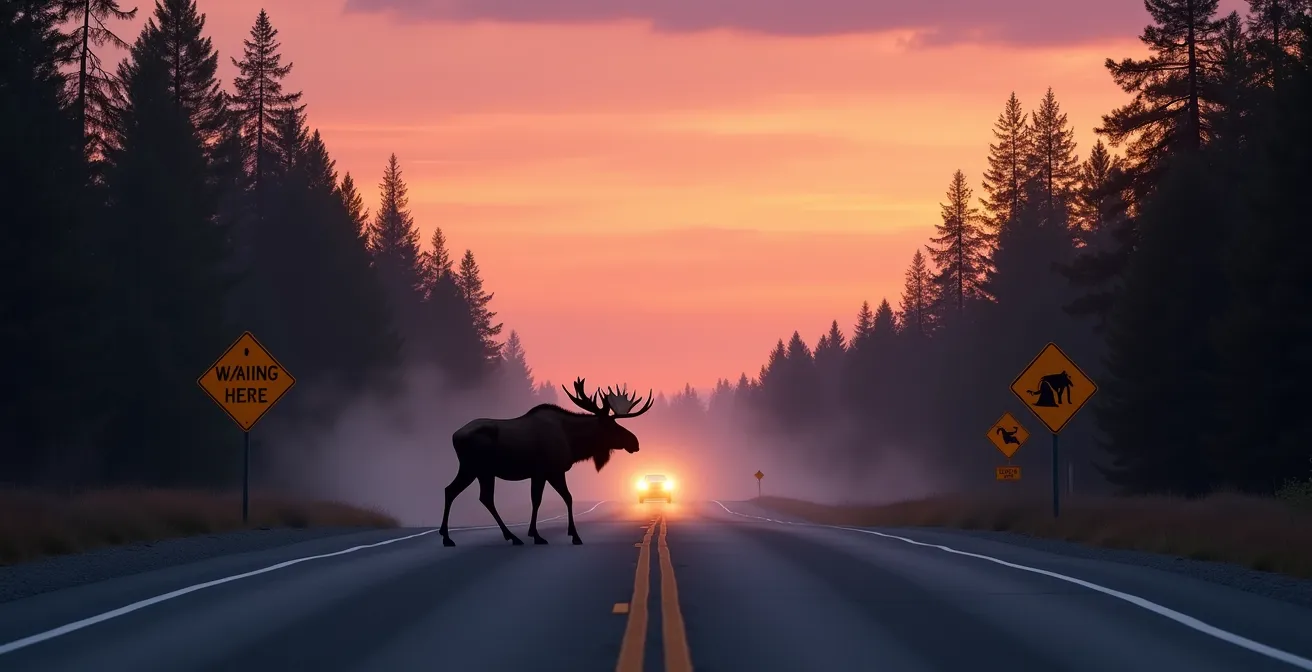
The instinct to swerve for an animal is a fatal mistake; true survival on Canadian roads depends on knowing when to brake and when to control the impact based on animal-specific physics.
- Braking hard for a moose is critical due to its high centre of gravity, which can cause it to crash through the windshield.
- Swerving is the primary cause of driver fatalities in wildlife encounters, often leading to a more dangerous secondary collision or rollover.
Recommendation: Internalize the different reaction protocols for moose versus deer, as this split-second, counter-intuitive decision is the most critical factor in a collision’s outcome.
The twin beams of your headlights cut a lonely path through the immense darkness of a rural Canadian highway. The forest on either side is a wall of black. Every driver who has travelled these roads knows this feeling: a low-grade tension, a hyper-awareness that anything could step out of the shadows. Standard advice tells us to be cautious at dawn and dusk, to slow down, and to scan the shoulders. While this advice is not wrong, it is dangerously incomplete. It creates a false sense of security by treating all wildlife encounters as equal.
The devastating truth is that the correct survival reaction is not universal. The strategy that might save you from a deer could be fatal with a moose. Surviving an unavoidable large animal collision is not about luck; it’s about a split-second application of counter-intuitive physics and animal-specific behavior. It’s about overriding your natural instinct to swerve and instead making a calculated decision based on the type of animal in your path. This is not just a driving tip; it’s a survival protocol.
This guide moves beyond the platitudes to provide a strategic framework for wildlife collision avoidance and survival in Canada. We will dissect the physics of impact, debunk common myths, and outline the specific tactics required to navigate the very real dangers posed by Canada’s largest wildlife. Understanding these principles before you see those glowing eyes in your headlights is what makes the difference between a close call and a tragedy.
To navigate this critical topic, this article breaks down the essential knowledge into distinct, actionable sections. You will learn the specific, life-saving reactions for different animals, how to identify threats in the dark, and what to do in the crucial moments after an impact in a remote area.
Summary: A Survival Guide to Wildlife Collisions on Canadian Roads
- Why you should brake for a moose but never swerve for a deer?
- Do sonic deer whistles actually work or are they a placebo?
- Why November is the deadliest month for animal collisions in Canada?
- How to spot animals by the color of their eyes in your headlights?
- When to dip your high beams to see an animal better?
- Why do SUVs struggle more than sedans on the Prairies during wind storms?
- Why the « free » 10km towing limit is useless in rural Canada?
- The 3 tools to keep in your trunk to avoid calling a tow truck?
Why you should brake for a moose but never swerve for a deer?
In the terrifying moment an animal appears in your headlights, your instinct screams « swerve! » This is almost always the wrong reaction. The decision-making process must be cold, immediate, and based on a brutal calculation of physics. The core principle is this: your goal is to maintain control of the vehicle at all costs, as the secondary impact—hitting a tree, rolling into a ditch, or veering into oncoming traffic—is often more lethal than hitting the animal itself. In fact, TIRF’s analysis reveals that one in three wildlife collision fatalities were due to drivers swerving to avoid wildlife.
The strategy changes drastically between a moose and a deer. A moose is a top-heavy animal, standing on long, stilt-like legs. When you hit a moose, the car’s front end takes out its legs, and its massive body (up to 600 kg) continues forward at speed, directly into your windshield and cabin at head-level. This is a catastrophic, often fatal, scenario. Therefore, when facing a moose, you must brake as hard as possible in a straight line. Your goal is to scrub off as much speed as you can before impact to reduce the kinetic energy. Even if a collision is unavoidable, hitting it at 50 km/h is vastly more survivable than hitting it at 90 km/h. The high fatality rate is a stark reminder of this danger; between 2000 and 2020, over 50% of the 570 wildlife collision deaths in Canada involved moose.
A deer, while still dangerous, presents a different physical challenge. Its center of gravity is much lower. When struck, a deer is more likely to be thrown over the hood of the vehicle or pushed aside. While still causing significant vehicle damage, the risk of cabin intrusion is far lower than with a moose. Swerving to avoid a deer introduces the greater risk of losing control and causing a rollover or secondary collision. The correct, albeit counter-intuitive, action is to brake firmly but maintain your lane, controlling the vehicle through the impact. Your vehicle type also dictates strategy; the lower profile of a sedan increases moose cabin intrusion risk, making maximum braking even more critical, while an SUV’s higher center of gravity makes it more prone to rollovers if you swerve.
Do sonic deer whistles actually work or are they a placebo?
In the search for a simple solution to a complex problem, many drivers turn to vehicle-mounted deer whistles. These small, inexpensive devices claim to emit a high-frequency sound when the vehicle is in motion, warning deer and other animals of your approach. Unfortunately, the consensus among wildlife biologists and collision experts is that these whistles are ineffective and may create a dangerous false sense of security. The science simply does not support their claims.
The primary issue lies in the frequency of the sound they produce and the hearing range of the animals they are meant to deter. A comprehensive summary of research by the University of Georgia found no rigorous scientific evidence that deer whistles reduce collisions. Critically, it noted that a common 12 kHz whistle emits a sound that is likely ineffective because it falls outside the best hearing sensitivity range of deer. As wildlife biologist Keith Munro of the Ontario Federation of Anglers and Hunters states, « There’s no demonstrative effectiveness, so as a result, they don’t appear to be a way to reduce deer-vehicle collisions. »
Furthermore, the sound produced by these whistles is easily masked by ambient road and wind noise. For a whistle to be effective, an animal would need to hear it from a significant distance, recognize it as a threat, and have time to move out of the way. In reality, by the time an animal is close enough to potentially hear the whistle over the engine’s roar, it’s already too late. Relying on an unproven gadget is a poor substitute for the only truly effective tools: driver alertness, speed management, and active visual scanning of the road and its shoulders.
Why November is the deadliest month for animal collisions in Canada?
While wildlife collisions are a year-round threat on Canadian roads, the risk is not evenly distributed. A clear and dangerous spike occurs in late autumn, with November consistently ranking as the deadliest month in many parts of the country. Data from Manitoba Public Insurance, for example, often shows November as the peak, with one recent report logging over 2,000 wildlife collisions in that month alone. This surge is driven by a dangerous convergence of biological and environmental factors.
The primary driver for this November peak, particularly in Ontario, Quebec, and the Prairies, is the deer rutting (mating) season. During this period, deer—especially bucks—are highly active, less cautious, and far more likely to chase does across roads without regard for traffic. Their behavior becomes erratic and unpredictable. This biological imperative coincides with decreasing daylight hours, meaning that the peak commuting times of dawn and dusk align perfectly with the hours when deer are most active. The shorter days and often deteriorating weather conditions of November further reduce driver visibility, creating a perfect storm for collisions.
However, this pattern is not uniform across Canada, and understanding regional variations is key to assessing your specific risk. The following table illustrates how peak seasons differ depending on local wildlife and environmental pressures.
This table from the Wildlife Collision Prevention Program highlights the varying peak seasons for animal encounters across different Canadian regions, emphasizing that risk assessment must be localized.
| Province/Region | Peak Wildlife | Peak Months | Key Factor |
|---|---|---|---|
| Ontario/Quebec | Deer | November | Rutting season |
| British Columbia | Bears | Aug-Oct | Food depletion at high elevations |
| Maritimes | Moose | Dec-Jan | Winter migration to valleys |
| Alberta | Elk | Dec-Feb | High snowfall periods |
Whether it’s the November deer rut in the east or winter elk migrations in the west, understanding the temporal risk factors is non-negotiable for safe rural driving in Canada.
How to spot animals by the color of their eyes in your headlights?
At night, an animal’s eyes reflecting your headlights are often the first—and sometimes only—warning you get. This glow, known as eyeshine, is caused by the tapetum lucidum, a reflective layer behind the retina in nocturnal animals that helps them see in low light. Learning to identify animals by the color and height of this reflection can provide a crucial split-second advantage in assessing the threat level.
While not an exact science, as the angle of light can alter the color, there are general guidelines for Canadian wildlife. A quick identification can help you prepare for the animal’s likely behavior and size. The most important distinctions are between large ungulates like deer and moose versus smaller predators.
- Deer: Typically have a bright, almost electric yellow-green or white reflection. Their eyes are at a mid-height relative to a passenger car.
- Moose: Often reflect a yellow-orange or reddish glow. Critically, their eyes may not be visible at all.
- Bears: Their eyeshine is a faint, dull red, and often, there is no reflection visible due to a less developed tapetum lucidum.
- Coyotes/Wolves/Foxes: Present a pale green to white reflection, positioned much lower to the ground than deer.
The most dangerous exception to this rule is the moose. Because they stand so tall, a moose’s eyes are often above the main beam of a passenger car’s headlights. Many drivers in fatal moose collisions report never seeing eyeshine, only a « dark shape » or « black wall » appearing suddenly. For this reason, you must train yourself to scan not just for glowing eyes, but for dark, tall silhouettes that break the treeline or snow line. Relying on eyeshine alone is a fatal oversimplification when dealing with North America’s largest deer.
When to dip your high beams to see an animal better?
Using your high beams on dark, rural roads is an essential safety practice, doubling your visible range and giving you more time to react to a potential hazard. However, once you spot an animal, especially a deer, your high beams can become part of the problem. The intense, direct light can trigger a « freeze » response, causing the animal to become mesmerized and remain stationary in the middle of the road.
As Manitoba Public Insurance advises, this is a critical moment to change your lighting strategy to break the spell.
Bright lights may freeze them in place. Dim your headlights to encourage them to move along.
– Manitoba Public Insurance, Wildlife collision prevention guidelines
Dipping your headlights can sometimes be enough to break the deer’s trance and prompt it to move off the road. Some experts even suggest flashing your lights from high to low beam while slowing down. However, like all wildlife encounters, the correct strategy is nuanced and depends on the animal and the situation. Your primary goal is always to reduce speed while maintaining control. Advanced adaptive headlights can help by automatically shaping the light beam around obstacles, but manual control remains a vital skill.
The specific lighting tactic varies by species, according to guidance from the Canada Safety Council. For a moose, whose eyes are often above your beams, keeping high beams on provides maximum warning distance and visibility of its large body. For a deer already on the road, dipping the lights immediately is the best way to break its freeze response. In adverse conditions like fog or blowing snow, using low beams is crucial to reduce glare that can blind you and shorten your depth perception, making any animal encounter more dangerous.
Why do SUVs struggle more than sedans on the Prairies during wind storms?
Vehicle choice plays a significant role in the dynamics of a wildlife collision, but its impact is amplified when combined with challenging environmental conditions. On the vast, open highways of the Canadian Prairies, strong crosswinds are a constant factor. In these conditions, SUVs and pickup trucks, despite their perceived safety, can become more vulnerable than smaller sedans.
The issue is a matter of simple physics. An SUV or a large truck has a much larger side profile than a sedan, creating a « sail effect. » A sudden, powerful gust of wind can physically push the vehicle sideways, demanding immediate steering correction from the driver. This inherent instability is manageable in normal driving, but it becomes a critical liability during an emergency wildlife avoidance maneuver. If a deer steps onto the road and a driver makes a sudden swerving motion just as a 70 km/h crosswind hits the vehicle, the combination of forces can easily overwhelm the vehicle’s stability control. The higher center of gravity of an SUV makes it far more susceptible to a rollover in this scenario.
Saskatchewan collision data analysis points to these compound risks, where wildlife encounters frequently happen during early morning or evening hours—times that often coincide with strong wind events on the Prairies. A sedan, with its lower profile and center of gravity, is less affected by crosswinds and is inherently more stable during sudden steering inputs. While no vehicle is immune to the dangers of a collision, understanding your specific vehicle’s handling characteristics in adverse weather is a critical, and often overlooked, component of rural driving safety.
Why the « free » 10km towing limit is useless in rural Canada?
Surviving a wildlife collision is the first priority, but the aftermath presents its own serious challenges, especially in the vast, remote regions of Canada. A common blind spot for many drivers is underestimating the logistical nightmare of a vehicle breakdown far from a service center. Many standard auto insurance policies and basic roadside assistance plans offer a « free » tow, but the devil is in the details: this coverage is often limited to a mere 10 or 15 kilometers. In urban settings, this might be adequate. In rural Canada, it is virtually useless.
The distance between towns on the Trans-Canada Highway or northern routes can easily exceed 100-200 kilometers. A 10km tow will get you from the ditch to the side of the road, leaving you stranded and facing a massive out-of-pocket expense for the remaining distance. The estimated $800-million annual cost of wildlife collisions in Canada is borne heavily by those in rural areas, where towing and repair costs are significantly higher. Being prepared means having a realistic roadside assistance plan.
The following table provides a general comparison of typical roadside assistance tiers available in Canada, highlighting the inadequacy of basic plans for rural travel.
| Provider | Basic Coverage | Premium Coverage | Rural Suitability |
|---|---|---|---|
| Standard Insurance | 10km free | 50km | Inadequate |
| CAA Basic | 10km | N/A | Inadequate |
| CAA Plus | 160km | N/A | Adequate |
| CAA Premier | 320km | N/A | Excellent |
For anyone who regularly travels outside of major urban centers, investing in a premium roadside assistance plan like CAA Plus or Premier is not a luxury; it’s a non-negotiable piece of safety equipment. The modest annual fee is negligible compared to the potential cost of a single long-distance tow.
Key Takeaways
- Brake for Moose, Control for Deer: The most critical survival decision is based on animal-specific physics to avoid cabin intrusion (moose) or loss of control (deer).
- Scan for Silhouettes, Not Just Eyes: A moose’s eyes are often above your headlight beams, making it appear as a ‘dark wall’. Active scanning for shapes is essential.
- Prepare for Self-Reliance: In rural Canada, standard roadside assistance is inadequate. A premium plan and a well-stocked emergency trunk kit are mandatory for post-collision survival.
The 3 tools to keep in your trunk to avoid calling a tow truck?
After a collision with wildlife in a remote area, the ability to perform a basic vehicle assessment and make minor, temporary repairs can be the difference between driving to safety and a long, cold wait for a tow truck that may be hours away. While major damage requires professional help, many impacts result in non-critical issues like a dangling bumper or a cracked headlight casing. Being your own first responder starts with having the right tools on hand. Your goal is not to perform a full repair, but to make the vehicle safe enough to limp to the nearest town.
Beyond a standard first-aid kit, your post-collision toolkit should focus on three areas: securing loose parts, providing hands-free light for assessment, and ensuring you can call for help when there is no cell service. These items are inexpensive, take up minimal space, and provide an immense sense of security and capability when you need it most. Having work gloves is also essential for handling sharp, broken plastic or metal without injury.
This simple preparation can prevent a manageable situation from escalating into a dangerous one. A damaged bumper rubbing against a tire can cause a blowout, and assessing fluid leaks in the dark without a headlamp is nearly impossible. Self-reliance is the core of rural driving safety.
Your Post-Wildlife Collision Emergency Kit Checklist
- Securement Tools: Stock heavy-duty zip ties and a roll of duct tape to secure damaged bumpers, fenders, or underbody panels away from the tires and ground.
- Hands-Free Lighting: Carry a high-powered LED headlamp to allow for a thorough, hands-free damage assessment of the engine bay, undercarriage, and tires in complete darkness.
- Communication Lifeline: Keep a satellite messenger device (e.g., Garmin inReach, ZOLEO) fully charged in your vehicle. This is critical for contacting help in the vast areas of Canada with no cellular coverage.
- Warning Devices: Have emergency flares or reflective triangles ready to deploy to warn other drivers on dark, unlit highways, preventing a secondary collision.
- Personal Protection: A pair of durable work gloves is essential for safely handling sharp broken plastic or metal debris from collision damage without cutting your hands.
Your survival and safety on remote Canadian roads depend not on luck, but on knowledge and preparation. Before your next rural drive, take the time to assemble this kit and review the safety strategies outlined in this guide. The life you save may be your own.
Frequently Asked Questions on Moose, Deer, and Bears: Avoiding Wildlife Collisions in Canada
How do I check for critical fluid leaks after hitting wildlife?
Look for puddles forming under the vehicle, check for a sweet smell (coolant), a slippery feel (oil), or clear fluid (brake fluid). Any significant leak means do not drive.
Can I drive with a damaged headlight after a collision?
Only if one headlight remains fully functional and it is a short distance to safety. Never drive in darkness with no working headlights.
When is it safe to continue driving after hitting a large animal?
Only when: no fluid leaks are present, all lights are functional, the hood latches securely, no tire or wheel damage is visible, and the steering feels normal.