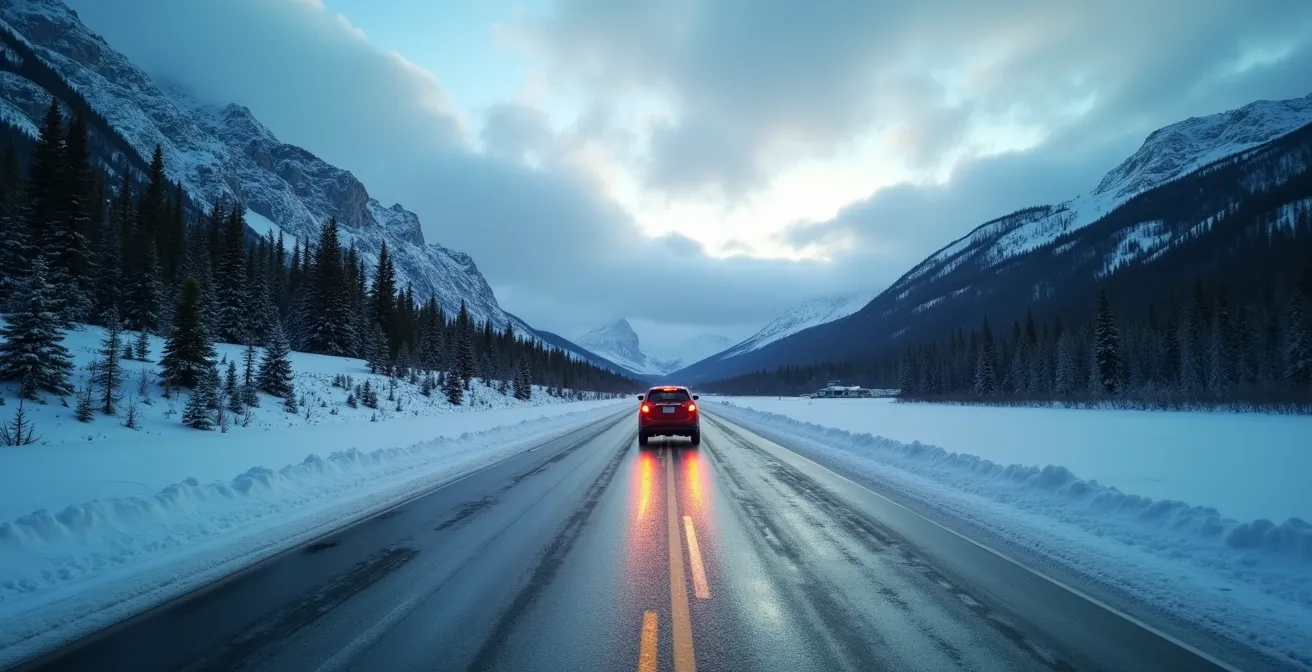
Controlling a car on ice isn’t about memorizing rules; it’s about managing your tire’s limited ‘grip budget’ like a professional driver.
- Four-wheel drive helps you accelerate but offers no advantage when braking on ice; only proper tires and technique do.
- Oversteer (rear sliding) and understeer (front sliding) require completely different driver inputs based on weight transfer.
Recommendation: Focus on smooth, deliberate inputs to manage the car’s energy and weight, transforming reactive panic into proactive control.
The feeling is unmistakable. A patch of innocent-looking black ice, a slight correction of the wheel, and suddenly the world is moving in slow motion. You feel the frantic, rhythmic pulse of the ABS under your foot, but the car isn’t slowing down. It’s a moment of pure helplessness, a stark reminder that even with modern technology, ice is the ultimate equalizer. Many drivers in this situation fall back on outdated advice: pump the brakes, yank the wheel, or simply freeze up. They believe technology is a safety net, but they don’t have a plan for when that net fails.
The common wisdom revolves around buying winter tires and driving slowly. While essential, this is purely preventative. It doesn’t equip you with the reactive skill needed in that critical split-second when control is lost. The truth is, most drivers have never been taught the physics of what’s happening to their vehicle. They don’t understand the forces at play, the limits of their tires, or how their inputs can either worsen a skid or gracefully resolve it. This is where the mindset of a professional driver becomes a crucial survival tool.
But what if the key wasn’t just reacting to a skid, but fundamentally understanding the energy you’re trying to manage? The secret lies in a concept from the world of performance driving: the Traction Circle. Imagine each tire has a finite amount of grip. You can use 100% of it for braking, 100% for cornering, or a combination of the two. The moment you ask for more than 100%—by braking too hard while turning, for example—you lose control. Mastering ice driving isn’t about fighting the car; it’s about learning to operate within this unforgiving budget of grip.
This guide will deconstruct that moment of panic. We will move beyond the platitudes and into the physics of vehicle control. We’ll explore why 4WD can give a false sense of security, how to diagnose and correct different types of skids, and when to strategically override your car’s technology. By the end, you will have a new mental model for managing your vehicle’s energy, turning fear into focused, deliberate action on any icy Canadian road.
text
This article provides a comprehensive breakdown of advanced winter driving techniques. Explore the sections below to build your expertise, from understanding vehicle dynamics to handling specific on-road hazards unique to Canada.
Summary: Mastering Ice Driving for Canadian Winters
- Why 4WD Helps You Go but Doesn’t Help You Stop on Black Ice?
- Oversteer vs Understeer: Why Your Reaction Must Be Different?
- When to Turn off Traction Control to Get Unstuck from Deep Snow?
- The 3 Road Features Where Black Ice Forms First
- How to Calculate the « 6-Second Rule » for Safe Winter Following?
- Why Do SUVs Struggle More than Sedans on the Prairies During Wind Storms?
- Why You Should Brake for a Moose but Never Swerve for a Deer?
- How to Maintain High-Speed Stability on the Trans-Canada Highway in Windy Conditions?
Why 4WD Helps You Go but Doesn’t Help You Stop on Black Ice?
This is the most dangerous misconception in Canadian winter driving. You buy a 4WD or AWD vehicle for security on snow and ice, and its ability to accelerate from a stop is indeed impressive. The system sends power to all four wheels, effectively doubling the points of traction for getting moving. But when you hit the brakes, that advantage disappears completely. Braking force is already applied to all four wheels, regardless of whether your vehicle is 2WD, 4WD, or AWD. On a slick surface like black ice, your ability to stop is determined by one thing only: the grip of your tires.
This is where the concept of the Traction Circle, or your « grip budget, » is critical. Your tires have a finite amount of grip. 4WD helps you « spend » that budget efficiently for acceleration. But for stopping, it adds nothing to the budget itself. This is why a 4WD vehicle on all-season tires will be dangerously outperformed by a 2WD vehicle on proper winter tires. In fact, winter tire tests consistently show that a vehicle equipped with them can have a stopping distance that is up to 40% shorter than one on all-seasons. The 4WD system can even create overconfidence, leading drivers to enter turns too quickly, only to find they have no extra grip to slow down.
When your ABS fails, you must manually manage this grip budget. This technique is called threshold braking: you apply firm, steady pressure to the brake pedal right up to the point where the wheels are about to lock up, then slightly release to allow them to roll again. This is what ABS does automatically, hundreds of times per second. Doing it manually requires immense focus and a feel for the car, but it is the only way to achieve maximum braking on ice without the system’s help. You are searching for that fine line at the edge of the traction circle, where the tires are slowing the car most effectively without skidding.
Oversteer vs Understeer: Why Your Reaction Must Be Different?
When a car loses traction on ice, it does so in one of two ways: oversteer or understeer. Your survival depends on instantly recognizing which is happening and applying the correct, counter-intuitive input. Reacting incorrectly will guarantee a spin. Both situations are about a loss of grip, but on opposite ends of the car, driven by weight transfer. Every time you brake, accelerate, or steer, you are moving the vehicle’s weight, changing the grip at each of the four tires. Mismanaging this weight transfer is what initiates a skid.
Understeer is when the front wheels lose grip and the car plows straight ahead, even though you’re turning the steering wheel. This is common in front-wheel-drive cars when entering a corner too fast. The driver’s instinct is to turn the wheel more, which is the worst possible action. This only increases the steering angle and asks more of the front tires that already have no grip to give. The correct response is to *reduce* your inputs: ease off the throttle and slightly unwind the steering wheel to allow the front tires a chance to regain their grip. Look where you want to go, and as soon as you feel the tires bite again, you can re-apply gentle steering input.
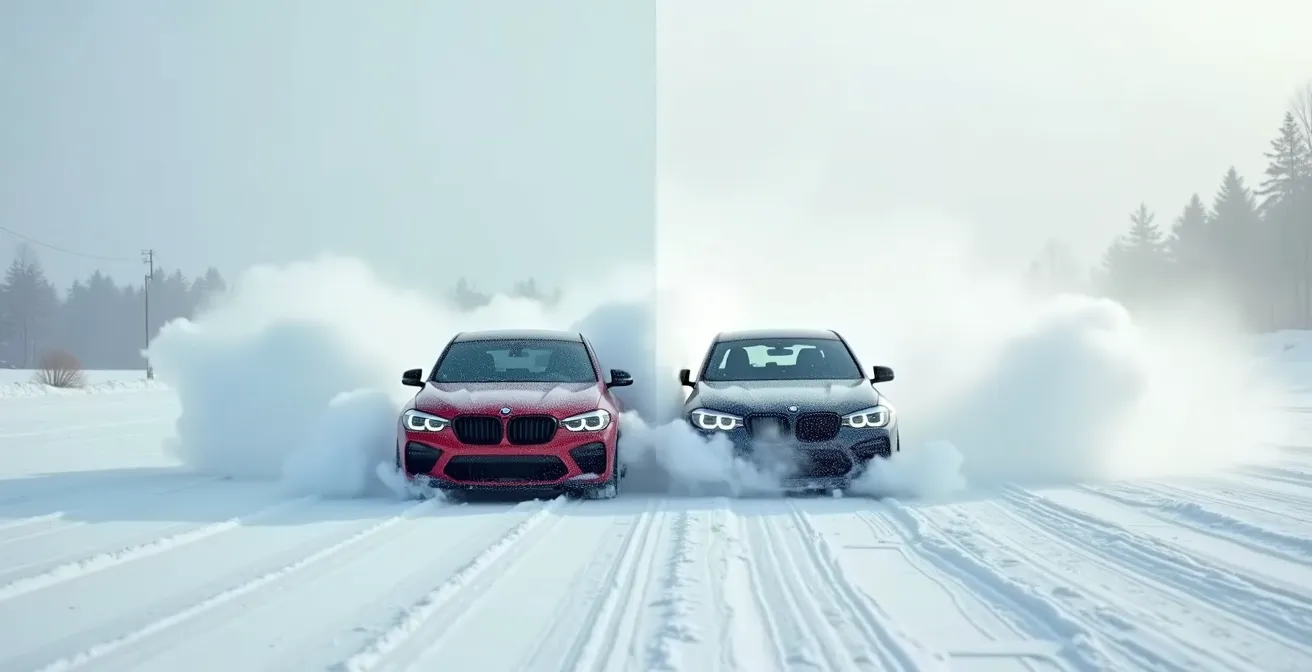
Oversteer is the opposite and often more dramatic scenario: the rear wheels lose grip, and the back of the car starts to slide outwards, trying to overtake the front. This is the classic « fishtail. » The famous advice is to « steer into the skid, » which is correct. If the rear slides right, you steer right. However, this is only half the equation. The key is to be incredibly smooth and precise. Your eyes are your most important tool: look far down the road where you want to go, not at the ditch you’re trying to avoid. Your hands will follow your eyes. As you correct the steering, you must also manage the throttle to stabilize the weight. A gentle, steady application of throttle can help transfer weight to the rear wheels, increasing their grip and pulling the car straight.
When to Turn off Traction Control to Get Unstuck from Deep Snow?
Traction Control Systems (TCS) and Electronic Stability Control (ESC) are phenomenal safety features for 99% of winter driving. They work by detecting wheelspin and automatically reducing engine power or applying brakes to an individual wheel to help maintain grip. In a skid or during acceleration on a slippery road, they can be lifesavers. However, there is one specific scenario where this helpful technology becomes a hindrance: when you are completely stuck in deep snow.
When you’re bogged down, you actually need a degree of controlled wheelspin to get out. You need the tires to dig through the loose snow and find a firmer surface or grip underneath. TCS is designed to prevent exactly this. It will sense the wheels spinning, cut the engine power, and you’ll go nowhere. In this one instance, you need to manually override the system. Most vehicles have a button with an icon of a car with squiggly lines underneath it (often labeled « TCS » or « ESC »). A short press usually disables TCS, while a long press may disable the full ESC suite. Your owner’s manual will have the specific procedure.
As Transport Canada advises in their winter driving guidelines, this is a critical step for self-rescue. They state with authority:
If you get stuck, turn off your ESC.
– Transport Canada, Winter Driving Safety Guidelines
Once TCS is off, you can use the « rocking » technique. This involves gently shifting between drive and reverse, using the car’s momentum to build a small track for it to climb out of. The key is to be gentle with the throttle; you want controlled spin, not a rooster tail of snow that just digs you in deeper. Once you are free and moving again, it is absolutely essential to immediately turn TCS and ESC back on for safe driving.
Your Action Plan: The Rocking Technique for Getting Unstuck
- Clear the way: Start by clearing as much snow as you can from around your tires and under the car. Create a clear path for the wheels to move into.
- Add grip: Place any available traction aids, like sand, kitty litter, or floor mats, directly in the path of your drive wheels (front wheels for FWD, rear for RWD).
- Disable the tech: Turn off your Traction Control System (TCS/ESC) using the dedicated button on your dashboard. This is crucial to allow for necessary wheelspin.
- Build momentum: Gently shift from forward to reverse repeatedly. Apply only minimal throttle, allowing the car to « rock » back and forth, packing the snow and building a small runway.
- Find the bite and escape: As you rock, gradually apply a little more throttle to maintain a controlled wheelspin that digs for grip. Once you feel the car start to move, maintain steady momentum to pull completely free, then immediately re-enable your TCS/ESC.
The 3 Road Features Where Black Ice Forms First
Black ice is the most treacherous hazard of winter driving precisely because it’s invisible. It’s a thin, transparent layer of ice that forms on the road surface, making it look merely wet. A proactive driver doesn’t wait to feel the slip; they anticipate where it is most likely to be. Certain road features and weather conditions create perfect microclimates for its formation. The RCMP notes that the most dangerous temperature window is not deep-freeze, but when the air is hovering around the freezing point. They report that black ice can be present on roads with temperatures between 4°C and -4°C, when moisture can easily freeze, thaw, and refreeze.
There are three primary locations where you must heighten your awareness and assume black ice is present, even if the rest of the road seems clear. These are the hotspots where the road surface temperature can drop below freezing much faster than the surrounding pavement.
Bridges and overpasses are the number one culprit. A bridge is cooled by cold air from both above and below, allowing it to freeze long before the insulated ground on either side. The second hotspot is shaded areas. A stretch of road that runs through a dense forest or is in the shadow of a large building won’t get any direct sunlight to warm it up. These patches can remain frozen all day. The third is any area near a body of water, like a river or lake, where moisture in the air is higher and can condense and freeze on the cold pavement. Recognizing these features from a distance allows you to prepare by easing off the throttle and covering your brake before you’re on top of the hazard.
This comparative table breaks down the highest-risk areas and what to look for. Treating these zones with extreme caution is a non-negotiable part of professional-level defensive driving.
| Location Type | Risk Level | Why It Forms First | Visual Indicators |
|---|---|---|---|
| Bridges/Overpasses | Extreme | Cooled from above and below simultaneously | Glossy, wet-looking patches |
| Shaded Areas | High | No direct sunlight to warm surface | Different color than surrounding road |
| Near Water Bodies | High | Lake-effect moisture freezes on road | Frost patterns on nearby objects |
| Intersections | Moderate | Exhaust melts then refreezes snow | Polished, mirror-like surface |
How to Calculate the « 6-Second Rule » for Safe Winter Following?
The single biggest mistake drivers make in winter is following too closely. On dry pavement, the standard two-to-three-second following distance might be adequate. On ice, it’s a recipe for a multi-car pile-up. Your perception of a safe distance is calibrated to dry roads, and this instinct is dangerously wrong in winter. You need a new, much more conservative mental model. The reason is simple physics: on a polished sheet of ice, your braking distance isn’t just a little longer; it’s exponentially longer. It can take up to 10 times the distance to stop on ice compared to dry pavement.
This means your standard following distance needs to be dramatically increased. The « 6-second rule » is a good starting point for general winter conditions like packed snow. To calculate it, watch the vehicle ahead of you pass a fixed object, like a signpost or a shadow on the road. Then, start counting « one-thousand-one, one-thousand-two… » until your own vehicle reaches that same marker. If you don’t reach « one-thousand-six, » you are following too closely and have no margin for error.
However, a true professional adapts their following distance to the specific conditions of the day. The « 6-second rule » is not a fixed number but the midpoint on a sliding scale of safety. For driving in Canada, an adaptive approach is essential:
- Rain or slush conditions: Maintain a minimum of 4 seconds following distance.
- Packed snow conditions: Increase to a 6-8 second following distance.
- Known icy conditions: Extend your buffer to 10 seconds or more.
- Whiteout/blizzard conditions: If you must continue, a 12+ second gap is the bare minimum. The safest action is often to pull over when you can.
This generous buffer isn’t just about giving you more space to stop. It gives you time to think and act deliberately. It allows you to see developing problems far ahead, make smoother, more gentle inputs, and avoid the kind of panic braking that overwhelms your tires’ grip budget and initiates a skid in the first place. Space is time, and on ice, time is safety.
Why Do SUVs Struggle More than Sedans on the Prairies During Wind Storms?
Many people assume that a heavier SUV, especially one with 4WD, is inherently more stable and safer in a winter storm. While the weight and traction are beneficial in snow, they become a significant liability during one of the Prairie provinces’ signature events: a high-wind storm across an open highway. In these conditions, a tall, high-profile SUV can be more dangerous than a lower, more aerodynamic sedan.
The issue is basic aerodynamics. An SUV presents a much larger « sail area » to a crosswind. A strong gust of wind hitting the side of a tall, flat-sided vehicle exerts a powerful tipping force. A sedan, being lower to the ground and often more rounded, allows the wind to flow over and around it with much less effect. The high centre of gravity of an SUV further exacerbates the problem, making it more susceptible to being pushed off-line or, in extreme cases, rolled over. This is a well-documented hazard on the open plains of Alberta, Saskatchewan, and Manitoba.
A Transport Canada analysis of winter driving hazards specifically highlights this danger. Their findings point to how the straight, wide-open highways of the Prairies create a wind-tunnel effect. When crosswinds reach 80-100 km/h, they can easily overwhelm a high-profile vehicle. This is particularly dangerous when combined with blowing snow that reduces visibility, as drivers may not see a gust coming across an open field until it hits them. The combination of a sudden lateral force on a vehicle with a high centre of gravity is a primary cause of single-vehicle rollovers in the region during winter.
To counteract this, SUV drivers must be more vigilant. This means maintaining a firm two-handed grip on the wheel, reducing speed significantly below the posted limit, and making small, smooth steering corrections to counteract the wind’s pressure. Anticipating gusts when passing large trucks or moving from a sheltered area into an open one is a critical survival skill. In this specific scenario, the laws of physics favour the low-slung sedan over the mighty SUV.
Why You Should Brake for a Moose but Never Swerve for a Deer?
A dark shape suddenly appears in your headlights on a remote stretch of Canadian highway. Your reaction in the next 1.5 seconds will determine the outcome. While any wildlife collision is dangerous, the correct defensive action changes dramatically depending on the animal’s size. The instinct to swerve is powerful, but it’s often the wrong one, especially on slippery winter roads where an abrupt steering input can easily initiate an uncontrollable skid. Statistics show this is a common scenario, with a Canadian government report noting that in 2017, nearly 30 per cent of collisions happened on wet, snowy or icy roads.
The rule of thumb taught to professional drivers is this: brake for a moose, but do not swerve for a deer. The logic is based on a brutal calculation of impact physics. A deer, while large, is a low-level impact. When you strike a deer, the collision is typically with your bumper and grille. The animal will go under or over your car, but the main cabin is likely to remain intact. Swerving to avoid it, however, introduces a much higher risk of losing control, rolling the vehicle, or veering into oncoming traffic—outcomes that are often more catastrophic than the initial impact.
A moose is an entirely different category of threat. An adult moose is a top-heavy animal weighing up to 700 kg, standing on long, spindly legs. When you strike a moose, the bumper takes out its legs, and the massive torso, at windshield height, continues directly into the passenger compartment. This type of collision is frequently fatal. Because the risk of cabin intrusion is so high, a moose is one of the very few hazards for which swerving may be the lesser of two evils—but only if the path is absolutely clear. The primary action is still maximum, straight-line braking to scrub off as much speed as possible before impact.
This risk assessment table clarifies the appropriate response based on the animal. The goal is always to minimize risk, and sometimes that means accepting a collision to avoid a more dangerous loss of control.
| Animal | Average Weight | Impact Zone | Recommended Action | Secondary Risk |
|---|---|---|---|---|
| Deer | 70-140 kg | Hood/bumper level | Brake firmly, maintain lane | Swerving causes rollovers |
| Moose | 350-700 kg | Windshield level | Maximum braking, swerve if clear | Fatal roof intrusion |
| Elk | 250-450 kg | Hood/windshield | Heavy braking, assess escape route | Significant cabin damage |
| Black Bear | 90-140 kg | Bumper/hood | Moderate braking, stay in lane | Vehicle damage mainly |
Key Takeaways
- Grip is finite: 4WD and AWD help you accelerate, but they do not help you stop or turn on ice. Only your tires determine your ‘grip budget’.
- Identify the skid: Your correction for an understeer (front plowing) is the opposite of your correction for an oversteer (rear sliding). Misdiagnosing guarantees a spin.
- Space equals time: On ice, your following distance is your most important safety tool. The ‘6-second rule’ is a minimum; 10+ seconds is realistic for icy conditions.
How to Maintain High-Speed Stability on the Trans-Canada Highway in Windy Conditions?
Driving the Trans-Canada Highway in winter is a uniquely Canadian experience, presenting a marathon of changing conditions. Maintaining stability at speed is not just about skill but about endurance and proactive strategy. The biggest threats to high-speed stability are not just ice, but sudden, powerful crosswinds, which can act like an invisible hand pushing your vehicle across the lane. Disabling cruise control is the first, most critical step, as it prevents the car from trying to maintain speed when you need to be making subtle throttle adjustments to manage grip and balance.
The principle of chassis loading is key here. By maintaining a light, steady pressure on the throttle, you keep the suspension loaded and the car settled. When you lift off the throttle abruptly or coast, the car’s weight shifts, making it more vulnerable to being upset by a gust of wind or a patch of ice. Smoothness is everything. All your inputs—steering, braking, and throttle—must be deliberate and gentle to avoid upsetting the car’s delicate balance at the edge of traction.
A study of the Trans-Canada Highway’s wind hazards identifies several notorious zones that demand maximum respect. The open Prairies section through Manitoba and Saskatchewan can have sustained winds of up to 100 km/h. The northern shore of Lake Superior is famous for lake-effect squalls that produce sudden, violent gusts. And the Wreckhouse area in Newfoundland is legendary, with winds recorded over 200 km/h that have physically overturned transport trucks. In these areas, reducing speed by 20-30 km/h isn’t just cautious; it’s necessary. A firm, two-handed grip at the 9 and 3 o’clock positions gives you the leverage to resist the wind’s push without overcorrecting.
Ultimately, high-speed stability is a mental game. It’s about constantly scanning the environment, anticipating changes, and managing the vehicle’s energy. It’s the culmination of all the principles: understanding your grip budget, recognizing hazards before you’re on them, leaving a massive space cushion, and knowing how your specific vehicle will react to the forces of nature. This proactive, focused mindset is what allows a driver to traverse the continent with confidence, no matter the weather.
Your journey to mastering winter driving begins not on the ice, but in your mind. Start internalizing these principles of energy and grip management on every drive, so when you need them, they are pure instinct. Assess your vehicle, invest in the best winter tires you can, and practice these concepts mentally until they become your default response.