A new luxury car’s value isn’t just about the badge; its depreciation is a predictable financial equation based on specific Canadian market forces.
- Corporate fleet lease cycles and high out-of-warranty repair liabilities disproportionately reduce the value of certain European sedans in Canada.
- Appreciating modern classics and prioritizing specific « winter-readiness » features offer a strategic hedge against rapid value loss.
Recommendation: Mitigate financial risk by leasing high-depreciation models or timing your trade-in just before the 80,000-kilometre « warranty cliff. »
For the financially savvy professional, the acquisition of a six-figure luxury vehicle is as much an investment analysis as it is an emotional purchase. The allure of cutting-edge technology, unparalleled comfort, and brand prestige is potent. Yet, the silent and swift erosion of value—depreciation—can turn a dream purchase into a significant financial liability. The common wisdom suggests that all cars lose value, and that certain brands hold up better than others. While true on the surface, this advice is dangerously simplistic for the Canadian market.
Standard advice often revolves around brand reputation or fuel economy, failing to account for the unique variables that dictate value in a country with harsh climates and specific corporate leasing habits. It’s easy to assume that a premium badge guarantees a certain level of retained value, but the data often tells a different, more complex story. The real financial risk isn’t just depreciation; it’s *unforeseen* depreciation, where a vehicle’s value plummets faster than anticipated.
But what if the key to mastering this financial risk wasn’t just in choosing the ‘right’ brand, but in understanding the underlying equation that governs value retention in Canada? The true leverage lies in decoding a few critical, often-overlooked factors: the impact of corporate fleet saturation, the out-of-warranty cost liability of complex technologies, and the market premium placed on ‘winter-readiness’. This is not about avoiding depreciation—it is about predicting and managing it like any other element in a financial portfolio.
This analysis will dissect these critical variables, moving beyond generic advice to provide a clear framework for your next luxury vehicle decision. We will explore why some models are financial traps, how specific features can protect your investment, and when the optimal moment to sell truly is. By understanding this depreciation equation, you can navigate the luxury market with confidence, ensuring your investment is as sound as it is satisfying.
This article provides a detailed breakdown of the key financial considerations for luxury car ownership in Canada. Explore the full analysis to make a truly informed decision.
Summary: Decoding the Depreciation Equation for 2024’s Top Models
- Why do German luxury sedans depreciate faster than Japanese SUVs?
- The air suspension failure that costs $4,000 to fix out of warranty
- Lease or Finance: Which is safer for a $100,000 vehicle in this economy?
- The 3 flagship features that actually increase future resale value
- When to trade in your luxury car to minimize the depreciation hit?
- Supra Mk4 vs New Supra: Which one really costs more to own in 2024?
- Why the insurance offer is thousands less than what you paid?
- Why Are 90s Japanese Sports Cars Skyrocketing in Value Across Canada?
Why do German luxury sedans depreciate faster than Japanese SUVs?
The disparity in depreciation rates between German luxury sedans and their Japanese SUV counterparts is a stark reality of the Canadian used car market. It’s not uncommon to see flagship sedans from premium German brands lose a staggering 50-60% of their value in just five years. This phenomenon isn’t merely a reflection of brand perception; it’s a direct result of two powerful, Canada-specific market forces: corporate fleet saturation and the AWD (All-Wheel Drive) premium.
Firstly, major Canadian corporate hubs like Toronto and Montreal have a high concentration of executive lease programs that heavily favour German luxury sedans. Every two to three years, a massive wave of these low-mileage, off-lease vehicles floods the used market simultaneously. This sudden oversupply creates intense price competition among sellers, driving down resale values for everyone. In contrast, Japanese luxury SUVs are more frequently purchased privately by families who tend to hold onto them for longer periods, resulting in a more stable and predictable supply on the used market.
Secondly, the Canadian climate places a tangible premium on all-weather capability. Japanese manufacturers have masterfully positioned AWD as a standard or near-standard feature on their SUVs. German sedans, while offering sophisticated AWD systems like Quattro and 4MATIC, often have Rear-Wheel Drive (RWD) as the standard configuration on many trims. In a country where winter driving is a primary concern for a majority of buyers, a vehicle with standard AWD simply has a broader, more resilient demand base, which directly supports its long-term value.
This table illustrates the key factors driving the depreciation gap between these two vehicle categories in the Canadian context.
| Factor | German Luxury Sedans | Japanese SUVs |
|---|---|---|
| Winter Drivetrain | Often RWD-standard | AWD-standard |
| 5-Year Depreciation | 50-60% | 35-40% |
| Corporate Lease Popularity | High in Toronto/Montreal | Lower lease rates |
| Maintenance Cost Impact | Higher complexity risk | Lower maintenance costs |
Ultimately, the higher depreciation of German sedans is less about the inherent quality of the vehicle and more about the economic principles of supply, demand, and market suitability in a Canadian context.
The air suspension failure that costs $4,000 to fix out of warranty
One of the most significant, yet often underestimated, factors in a luxury vehicle’s depreciation is the concept of out-of-warranty cost liability. Features that provide sublime comfort when new, like adaptive air suspension, can become a major financial risk once the manufacturer’s 4-year/80,000 km warranty expires. A single air strut or compressor failure can easily lead to a repair bill exceeding $4,000, a cost that the second or third owner must bear. Savvy used car buyers are acutely aware of these potential high-cost failures and factor them into their offers, directly suppressing the vehicle’s resale value.
In Canada, this issue is exacerbated by harsh road conditions and extreme temperature swings. The average Canadian driver covers between 15,000-20,000 km per year, meaning many luxury vehicles approach the critical 80,000 km « warranty cliff » in just four years. Potholes, road salt, and ice buildup accelerate wear and tear on complex suspension components, increasing the likelihood of failure shortly after the warranty period ends. This predictability of failure makes the « warranty cliff » a sharp drop-off point for a vehicle’s value.
The perception of unreliability, whether real or exaggerated, has a tangible impact. A model known for expensive post-warranty repairs will depreciate faster than a mechanically simpler counterpart, even if they had a similar initial price. For a financially astute buyer, this means evaluating a vehicle not just on its current state, but on the projected cost of ownership over the next five years. Proactive maintenance and awareness can mitigate some risks, but the market value will always reflect this potential liability.
Proactive Maintenance Checklist for Air Suspension in Canada
- Schedule thorough undercarriage washes after every winter salt exposure to prevent corrosion of lines and sensors.
- Monitor for early warning signs, such as the vehicle sitting unevenly after being parked overnight, especially on cold startups.
- Compare the cost of OEM parts from dealerships versus high-quality aftermarket suppliers like Arnott before a failure occurs.
- Budget for typical labour rates at specialized independent shops in major cities like Calgary or Ottawa, which can be significantly lower than dealership prices.
- Consider a preventative component replacement strategy just before the 80,000 km warranty cliff if you plan to keep the vehicle long-term.
Therefore, when analyzing a flagship model’s depreciation, the cost of its most complex features post-warranty must be treated as a predictable deduction from its future value.
Lease or Finance: Which is safer for a $100,000 vehicle in this economy?
For a vehicle valued at over $100,000, the « lease versus finance » decision transcends simple monthly payment comparisons; it becomes a strategic choice about risk management. Given that many new luxury vehicles lose 20% to 30% of their value in the first year alone, the primary question for a savvy buyer is: who should bear the risk of that depreciation? In the current Canadian economic climate, with fluctuating interest rates from the Bank of Canada, the answer often points towards leasing as the safer harbour.
When you finance a vehicle, you own it, and therefore you bear 100% of the depreciation risk. If the model’s value drops faster than anticipated, you could find yourself in a negative equity situation, owing more on the loan than the car is worth. Leasing, specifically a closed-end lease common in Canada, effectively transfers this risk to the leasing company. The lease agreement pre-determines the vehicle’s residual value at the end of the term. If the actual market value at that time is lower than the residual, the leasing company absorbs the loss, not you.
Furthermore, leasing offers a significant tax advantage in Canada. With financing, you pay the full provincial sales tax (PST/GST/HST) on the entire purchase price upfront. With a lease, you only pay tax on the monthly payments, preserving capital. For a $120,000 vehicle, this can be a difference of thousands of dollars in initial cash outlay. An analysis of an Audi Q8 purchase shows luxury vehicles can lose an average of 48% of their value after five years. By leasing, you are only paying for the portion of the car you use during its steepest depreciation period, insulated from market volatility by the contract’s residual value guarantee.
In essence, financing is a bet that the vehicle will hold its value well, while leasing is a calculated strategy to cap your financial exposure on an asset known for rapid and significant depreciation.
The 3 flagship features that actually increase future resale value
In a sea of complex infotainment systems and driver-assist technologies that quickly become outdated, only a few specific features consistently add tangible, long-term resale value in the Canadian luxury market. A financially savvy buyer or owner should prioritize these attributes, as they appeal to the core needs and desires of the second-hand market, creating a buffer against depreciation. These value-retaining features can be grouped into three main categories.
First is the « All-Weather Warrior » Package. This goes beyond just having AWD. It includes a comprehensive suite of features that make a vehicle genuinely capable and comfortable during Canada’s harsh winters. Top-tier AWD systems like Audi’s Quattro or Mercedes-Benz’s 4MATIC are the foundation, but the package is completed by factory-installed block heaters, heated steering wheels, and, increasingly, heated rear seats. These are not frivolous luxuries but practical necessities for many Canadian buyers, and their presence can make a vehicle significantly more desirable than a similarly priced model without them.
Second are the Performance-Oriented Trims. While base models suffer the steepest depreciation, dedicated performance lines from manufacturers—such as BMW’s M Sport, Audi’s S-Line, or full-fledged AMG, M, or RS models—hold their value remarkably well. These models appeal to a passionate and knowledgeable enthusiast market that values driving dynamics and aesthetics over pure utility. Their limited production numbers and dedicated following create a strong demand floor that insulates them from the heavy depreciation affecting their more common counterparts.
Third, and perhaps most surprisingly in a digital age, are Timeless Aesthetics. This includes special-order factory paint colours from programs like BMW Individual or Audi Exclusive, paired with upgraded, tasteful factory wheel packages. While a large touchscreen may look dated in five years, a unique and elegant colour combination remains desirable. These aesthetic choices signal a vehicle that was thoughtfully specified by its original owner, differentiating it from the sea of black, white, and silver off-lease models and commanding a premium from discerning buyers.
Some compact sedans, like a Honda Civic, have a better-than-average rate of depreciation because they’re reliable and low-maintenance. Luxury sedans tend to depreciate faster than non-luxury models. Some enthusiast models, like the Porsche 911, hold their value very well, while luxury models like the BMW M4 have high depreciation due to luxury status and high maintenance costs.
– McDougall Insurance Analysis, Least Depreciating Cars in Canada Report
Ultimately, a vehicle equipped with these features is not just another used car; it is a more robust and desirable asset in the competitive Canadian resale market.
When to trade in your luxury car to minimize the depreciation hit?
Timing the sale or trade-in of a luxury vehicle is a critical component of minimizing its total cost of ownership. It’s not just about the age or mileage, but about understanding key inflection points where value drops most precipitously. For a financially astute owner, the goal is to exit the vehicle just before these predictable cliffs. The single most important timing factor in the Canadian market is the 4-year/80,000-kilometre warranty cliff.
The moment a luxury car’s comprehensive factory warranty expires, its value takes a significant, overnight hit. It transitions from being a « certified » or « worry-free » vehicle to one where the next owner assumes all financial risk for potentially expensive repairs. As many cars can lose up to 60% of their value by the fifth year, the end of the fourth year—just before the warranty expires—often represents the optimal selling window. At this point, the vehicle is still new enough to be desirable and can still be sold with a portion of its original warranty, a major selling point that maximizes its trade-in value.
A second crucial timing factor is the manufacturer’s own product cycle. Selling your vehicle just before the announcement of a major redesign or even a mid-cycle refresh can prevent an immediate 10-15% drop in its perceived value. The new model makes the outgoing one look dated instantly, and this « overnight obsolescence » is reflected in its market price. Astute owners should monitor automotive news and plan their sale 6-12 months ahead of an expected model changeover to capture the highest possible value from a market that still views their car as the « current » model.
Finally, seasonality plays a role in Canada. Demand for sports cars and convertibles peaks in the spring, while demand for AWD-equipped SUVs and sedans is strongest in the fall, just before winter. Listing your vehicle for sale in its peak season can result in a quicker sale and a higher price, as you are catering to a larger and more motivated pool of buyers. Aligning your sale with these three timing factors—the warranty cliff, the model cycle, and the season—is a powerful strategy to mitigate the financial impact of depreciation.
By treating the sale as a calculated event rather than an afterthought, you can effectively claw back thousands of dollars from the depreciation curve.
Supra Mk4 vs New Supra: Which one really costs more to own in 2024?
The comparison between a classic 1990s Toyota Supra Mk4 and a new 2024 Toyota Supra presents a fascinating paradox in automotive asset management. One is an appreciating classic, a tangible asset skyrocketing in value; the other is a modern performance car subject to the harsh realities of immediate and steep depreciation. When analyzing the total cost of ownership in Canada, the initial purchase price becomes almost irrelevant compared to the powerful forces of appreciation and depreciation.
A new 2024 Supra, purchased from a dealership, begins losing value the moment it’s driven off the lot, likely shedding 20-30% in its first year. Over five years, it’s expected to follow the typical sports car depreciation curve and lose around 50% of its original MSRP. Insurance is standard, and parts, being based on a current BMW platform, are readily available and relatively affordable. The cost of ownership is predictable but relentlessly negative in terms of the asset’s value.
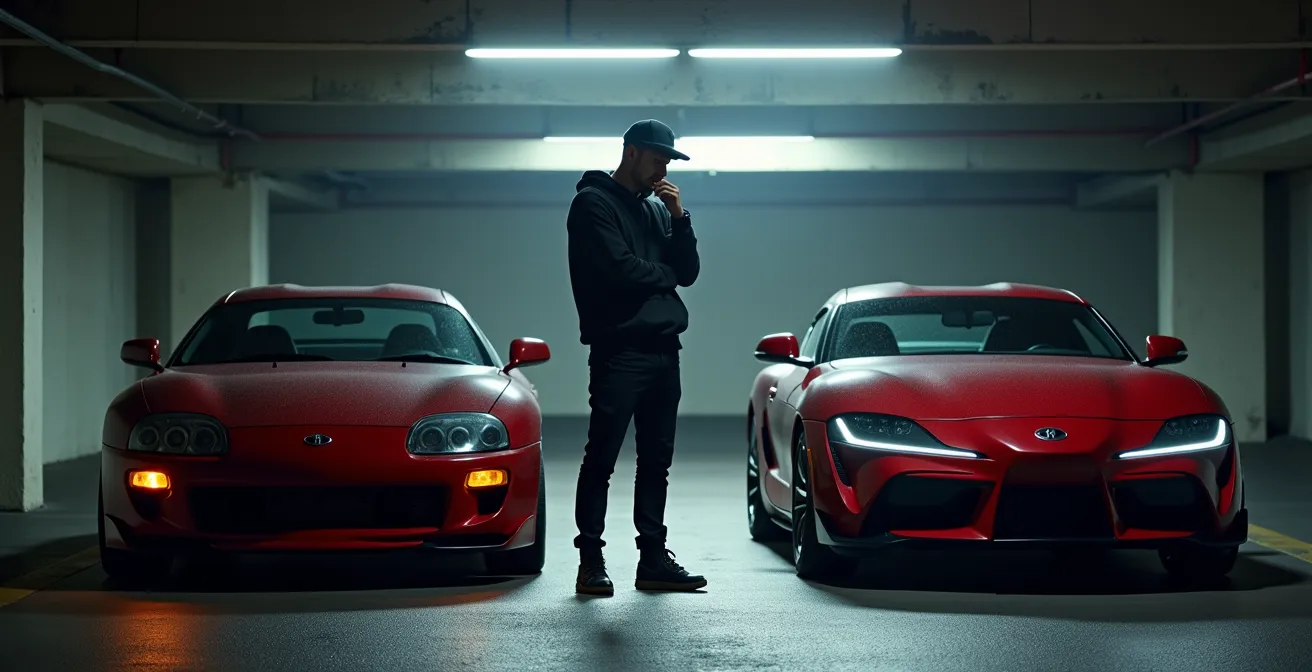
In contrast, a clean, Canadian-market, left-hand-drive (LHD) Mk4 Supra is a different class of asset entirely. While its purchase price might be equal to or even higher than the new model, its value is on a steady upward trajectory. It is no longer a depreciating vehicle but an appreciating investment. Ownership costs are different: insurance requires a specialty policy from a provider like Hagerty Canada, which recognizes its collector status. Original OEM parts can be exceedingly difficult and expensive to source, representing a potential liability. However, every dollar spent on maintenance and preservation contributes to protecting or increasing the asset’s overall value, rather than simply slowing its decline.
This table breaks down the fundamental differences in their five-year cost outlook.
| Cost Factor | Mk4 Supra (LHD Canadian) | New Supra 2024 |
|---|---|---|
| Value Trend | Appreciating Asset | Depreciating 20-30% Year 1 |
| Insurance Type | Specialty (Hagerty Canada) | Standard Coverage |
| Parts Availability | Difficult/Expensive OEM | BMW-based/Readily Available |
| Market Premium | High for Clean LHD Models | Standard MSRP |
| 5-Year Outlook | Potential Appreciation | 50% Depreciation Expected |
Therefore, while the new Supra might have a lower upfront cost in some cases, the Mk4’s appreciation potential means it could ultimately « cost » significantly less to own over a five-year period, potentially even generating a positive return.
Why the insurance offer is thousands less than what you paid?
In the unfortunate event of a total loss, many new car owners in Canada face a shocking reality: the insurance settlement offer is often thousands, or even tens of thousands, of dollars less than the original purchase price or the outstanding loan balance. This gap is not an error by the insurer; it’s a direct consequence of depreciation and the default way insurance policies are structured. Standard policies are based on Actual Cash Value (ACV), not replacement cost.
ACV is defined as the cost to replace the vehicle with a similar one in the same condition *minus* depreciation. Since a new car loses a significant portion of its value in the first one to two years, its ACV drops rapidly. The insurance company is only obligated to pay you what the car was worth the second before the accident, not what you paid for it. This leaves a significant financial gap, especially if you have a loan, as you are still responsible for the full loan amount even if the settlement doesn’t cover it.
The solution to this problem is a crucial but often overlooked insurance endorsement known as a Waiver of Depreciation. In Ontario, this is typically the OPCF 43 endorsement, while in Alberta, it’s the SEF 43R. This endorsement effectively removes depreciation from the settlement calculation for a specified period, usually the first 24 to 36 months of ownership. If your vehicle is written off during this period, the insurer will pay out the lesser of the original purchase price, the manufacturer’s list price at the time of purchase, or the cost to replace it with a new, identical model. This endorsement closes the financial gap and protects your initial investment.
To ensure you are properly protected, follow these critical steps:
- Understand ACV: Recognize that your default coverage is for the depreciated value, not what you paid or what you owe.
- Add the Waiver: Proactively add the Waiver of Depreciation endorsement (e.g., OPCF 43 in Ontario, SEF 43R in Alberta) to your policy. This is usually only possible within the first 12-24 months of purchasing a new vehicle.
- Document Everything: Keep meticulous records of all maintenance and upgrades. This documentation can be used to argue for a higher valuation if you are in a dispute over the ACV offer outside the waiver period.
- Consider Appraisal: If an ACV offer from an insurer like ICBC or SGI seems unfairly low and you don’t have a waiver, a professional third-party appraisal can be a powerful negotiation tool.
Without this waiver, you are self-insuring against the rapid depreciation of your new vehicle, a risk that a financially savvy owner should always transfer to the insurance company.
Key Takeaways
- For vehicles prone to high depreciation (e.g., European sedans), leasing is a superior risk management strategy that caps your financial exposure.
- The optimal time to sell a luxury vehicle in Canada is just before its 4-year/80,000 km warranty expires to maximize its value to the next owner.
- Prioritize tangible, long-lasting features like « All-Weather » packages and timeless aesthetics over complex tech to bolster resale value in the Canadian market.
Why Are 90s Japanese Sports Cars Skyrocketing in Value Across Canada?
The meteoric rise in value of 1990s Japanese sports cars like the Nissan Skyline GT-R, Toyota Supra, and Acura NSX is a striking counter-narrative to the rule of depreciation. In Canada, this trend is amplified by a unique combination of regulatory, cultural, and economic factors that have transformed these vehicles from simple used cars into highly sought-after, appreciating assets. This phenomenon is driven by more than just nostalgia; it’s a calculated investment for a new generation.
The primary catalyst was Canada’s 15-year import rule, which is significantly more lenient than the 25-year rule in the United States. In the mid-2000s and 2010s, this rule opened the floodgates for a wave of right-hand-drive (RHD) models to be imported from Japan. This first wave created awareness and built a passionate enthusiast community. Now, the market has matured. The early, rougher imports have been filtered out, and pristine, original Canadian-market LHD models have become exceedingly rare and valuable, commanding extreme premiums over their RHD counterparts.
Culturally, these cars represent an « analog escape » for a generation that grew up with them in video games and movies. They offer a raw, mechanical driving experience that is a stark contrast to the digitized, insulated nature of modern vehicles. This emotional connection creates a deep and resilient demand base. Economically, for many young Canadians who find themselves priced out of overheated housing markets in cities like Vancouver and Toronto, these cars have become an alternative form of tangible asset investment. Over the past five years, the return on a well-maintained, desirable ’90s Japanese classic has often out-performed traditional stocks or bonds, making it a viable and enjoyable place to park capital.
The combination of limited supply (especially for clean LHD models), a unique regulatory history, and a strong cultural and economic demand has created a perfect storm for value appreciation, turning these ’90s icons into a legitimate alternative asset class.
Apply this analytical framework to your next luxury vehicle acquisition to transform a potential liability into a calculated asset.