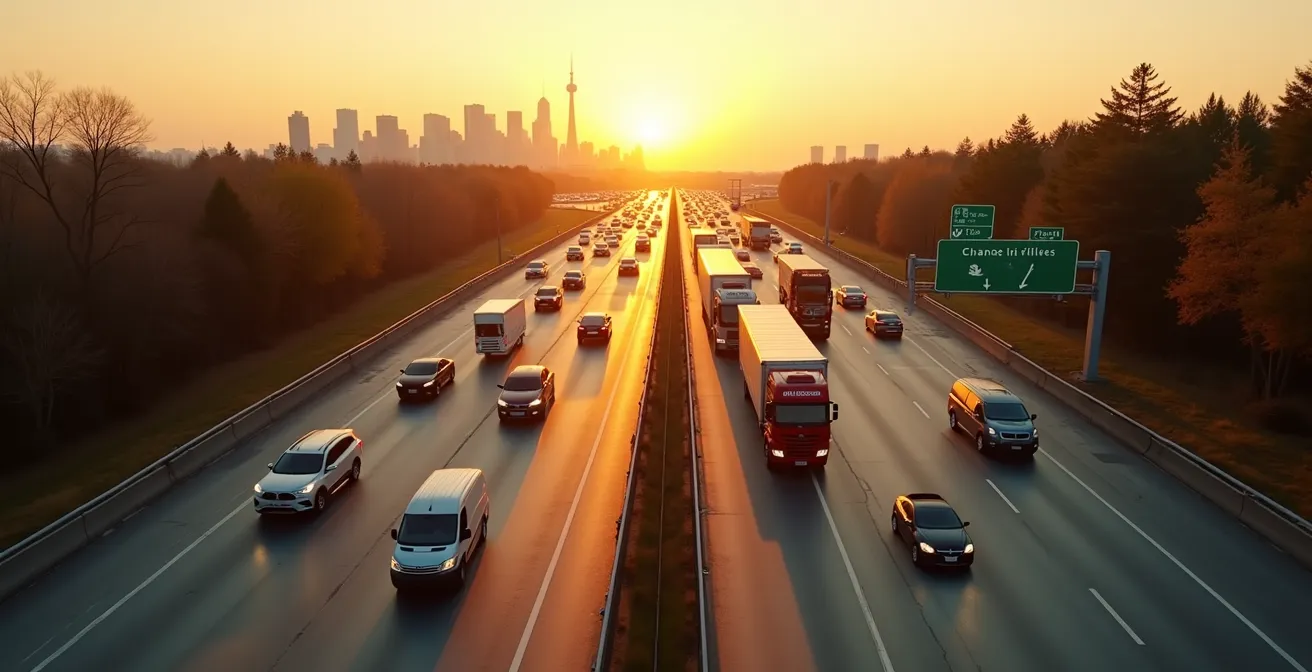
Your daily commute in Toronto or Montreal is costing you more than just time; it’s a significant financial and mental drain that can be systematically optimized.
- Hidden costs of car ownership can exceed $19,000 annually, far more than strategic alternatives like car-sharing combined with transit.
- Choosing the right navigation app for Canadian construction (Waze for Montreal, Google Maps for Toronto) and leveraging HOV lanes can save significant time.
- Reducing aggressive driving habits and optimizing your in-car environment can lower both fuel costs by up to 35% and stress levels.
Recommendation: Treat your commute like a project. Start by auditing your single biggest friction point, whether it’s cost, time, or stress.
For the urban professional in Toronto or Montreal, the daily commute often feels like a non-negotiable tax on time and sanity. The creeping dread of rush hour, the endless sea of brake lights on the Gardiner or the Décarie—it’s a battle fought twice a day. The common advice is to leave earlier, listen to a podcast, or switch to public transit. But for many, driving is a necessity, and these tips only scratch the surface of a much deeper problem.
What if the solution wasn’t just to endure the drive, but to fundamentally re-engineer it? The truth is, your commute is a complex system of interconnected parts: finances, technology, vehicle choice, psychology, and micro-habits. It’s a logistical challenge waiting for a strategic overhaul. The key to reclaiming those lost hours and dollars isn’t about finding a single magic bullet; it’s about conducting a thorough logistical audit of your entire commute ecosystem. It’s about shifting your mindset from a passive victim of traffic to an active manager of your personal logistics.
This guide will walk you through that audit. We will dissect the true financial leaks in your daily drive, evaluate the technology in your dashboard, analyze the strategic value of specific road tactics, and even re-engineer your in-car environment to reduce cognitive load. By treating your commute as a project to be optimized, you can identify critical friction points and implement targeted life-hacks to win back your time, your money, and your peace of mind.
To help you navigate this strategic audit, we’ve broken down the key areas of your commute ecosystem. This structure will guide you from understanding the hidden costs to mastering the urban jungle with advanced, multi-modal tactics.
Summary: A Strategic Guide to Optimizing Your Toronto & Montreal Commute
- Why does your 40km commute cost you $8,000 a year in hidden fees?
- Waze vs Google Maps: Which one handles Canadian construction zones better?
- How much time does the HOV lane actually save during rush hour?
- Compact vs Hybrid: Which car creates the least stress in downtown traffic?
- How to use audiobooks and lighting to lower cortisol while driving?
- The driving habit that increases consumption by 35% in city traffic
- Is it cheaper to use Communauto than to own a car downtown?
- The Urban Jungle: Surviving Traffic and Parking in Montreal & Toronto
Why Does Your 40km Commute Cost You $8,000 a Year in Hidden Fees?
The first step in any logistical audit is to understand the true cost. Most drivers think in terms of gas and maybe insurance, but the reality is a financial black hole. The sticker price of your car is just the entry fee. The « time tax » of a long commute is compounded by a cascade of hidden expenses that drain your bank account far more than you realize. From accelerated depreciation in stop-and-go traffic to the silent creep of interest payments, your 40km drive is a major line item on your budget.
In a city like Toronto, the numbers are staggering. A 2024 analysis reveals that the average cost of car ownership has soared, with many drivers underestimating the total financial burden. According to Hardbacon, the all-in cost of owning a car in Toronto now sits at an astonishing $1,623 per month or $19,476 annually. This figure accounts for gas, insurance, maintenance, and the often-overlooked costs of depreciation and financing.
The « hidden » aspect comes from costs that have ballooned recently. For instance, interest payments now represent 16% of ownership costs, a sharp rise from just 8% in 2019. Add to that the constant threat of rising insurance premiums due to car theft epidemics in the GTA, the cost of winter tire storage and swaps, and the brutal wear-and-tear from city driving. Your vehicle may require four new tires every three years and major repairs within seven, all costs that are easy to forget until the bill arrives. When you factor in the high cost of parking, which can run up to $400 per month downtown, the financial case for daily driving begins to crumble.
Waze vs Google Maps: Which One Handles Canadian Construction Zones Better?
Once you’ve audited the cost, the next lever to pull is technology. Your navigation app is your co-pilot in the war against traffic, but not all co-pilots are created equal, especially in the unique chaos of Canadian urban centres. The constant bloom of orange cones in Montreal and the perpetual state of repair on Toronto’s highways create a dynamic battlefield. Choosing the right app isn’t a matter of preference; it’s a strategic decision based on the type of congestion you face.
The core difference lies in their data sources. Google Maps excels at long-term, predictable changes. It leverages official data for large-scale projects, making it reliable for navigating around the massive Gardiner Expressway rehabilitation in Toronto. Its lane guidance is superior for complex highway interchanges. Waze, on the other hand, thrives on chaos. Its power comes from crowdsourced, real-time reports from other drivers. This makes it indispensable in Montreal, where construction zones can appear overnight with confusing or non-existent signage. Waze users reporting a sudden lane closure or a hidden police car provide an intelligence network that Google’s algorithms can’t match for immediacy.
This image of a navigation app on a car’s dashboard highlights its central role in modern commuting. Your phone is no longer just for calls; it’s a critical logistical tool.

Therefore, a truly optimized strategy involves using both apps. Before leaving, cross-reference the official Mobility Montreal or Ontario 511 websites for major closures. For the drive itself, use Waze as your primary tool in Montreal for its agility in unpredictable situations. In Toronto, rely on Google Maps for its superior handling of scheduled, large-scale construction and complex highway systems. The savvy commuter doesn’t just pick an app; they deploy the right tool for the specific mission.
How Much Time Does the HOV Lane Actually Save During Rush Hour?
With your financial and technological audits underway, it’s time to analyze route tactics. The High-Occupancy Vehicle (HOV) lane is often seen as a coveted escape from the main arteries of gridlock. But is the promise of a faster trip real, or is it a mirage? For the solo commuter, the effort to carpool can be a logistical hurdle. For those eligible, the question remains: what is the actual, data-backed time arbitrage? The answer is a clear and measurable advantage.
Studies conducted on major Greater Toronto Area arteries provide a definitive answer. For commuters on congested routes like Highway 403 and Highway 404, the time savings are not trivial. On average, using the HOV lane shaves about 12 minutes off a typical rush-hour commute. This is the result of maintaining an average speed of around 100 km/h, while the regular lanes crawl along at 60 km/h or less. Twelve minutes per trip, twice a day, five days a week, adds up to two hours of reclaimed time weekly from this single tactic alone.
This isn’t just a temporary fix; it’s part of a long-term provincial strategy. The introduction of HOV lanes on the 404 and 403 were early steps in Ontario’s plan to build a network of over 450 kilometres of HOV lanes by 2040. This commitment signals that these lanes are a permanent and expanding feature of the region’s transportation infrastructure. For the strategic commuter, this means that investing in a carpooling arrangement or choosing a plug-in hybrid or electric vehicle (which often grants solo access) is a future-proofed decision. It’s a calculated move to buy your way into a faster, less congested traffic stream.
Compact vs Hybrid: Which Car Creates the Least Stress in Downtown Traffic?
The vehicle itself is a critical component of your commute ecosystem, and its impact goes far beyond fuel economy. The choice between a nimble compact car and a smooth hybrid/EV is a choice about your daily stress level. In the dense urban cores of Toronto’s Financial District or Montreal’s Plateau, your car becomes either a source of friction or an oasis of calm. An audit of your vehicle should focus on which type minimizes the cognitive load of downtown driving.
The compact car’s primary advantage is agility. Navigating the narrow, one-way streets of the Plateau or squeezing into a tight parking spot near Queen West is significantly easier. This « parking ease » directly reduces a major source of urban driving anxiety. However, this benefit comes at a cost in stop-and-go traffic. The constant shifting between the brake and gas pedal in a traditional internal combustion engine is a physically and mentally taxing act, contributing to driver fatigue.
This is where the hybrid or EV excels. Their ability to operate silently on pure electric power at low speeds transforms the experience of being stuck in traffic. The jerky, noisy, and vibratory nature of a conventional car is replaced by smooth, quiet acceleration. This « silent operation » isn’t just a novelty; it actively reduces the ambient stress and noise pollution that bombards you during a traffic jam. While a hybrid may not be easier to park, its serene performance in the most frustrating part of the commute—the gridlock itself—makes it a powerful tool for stress reduction.
The following table breaks down these stress factors in the context of downtown driving:
| Factor | Compact Car | Hybrid/EV |
|---|---|---|
| Parking Ease | Excellent in tight Montreal Plateau streets | Standard size challenges |
| Stop-and-Go Comfort | Frequent brake/gas pedal switching | Smooth electric low-speed operation |
| Noise Level | Engine noise in traffic | Silent operation reduces stress |
| Monthly Parking Cost (Toronto) | $200-$400 | $200-$400 |
How to Use Audiobooks and Lighting to Lower Cortisol While Driving?
Optimizing your commute isn’t just about the external factors of time and money; it’s about managing your internal state. Your car’s cabin is an environment you can control to actively lower your stress response. With commute times creeping up—some data suggests average daily commutes have nearly tripled for some, reaching 54 minutes—the negative impact on mental health is significant. Instead of passively consuming radio ads, you can transform your car into a decompression chamber using strategic audio and lighting.
The key is to move from passive listening to curated programming. Create playlists of podcasts or audiobooks that match your typical commute duration. Having a 30, 45, and 60-minute playlist ready removes the decision fatigue of choosing what to listen to. This turns dead time into productive learning or entertainment time, giving you a sense of control and accomplishment. This is a classic life-hack: stacking a desirable activity (listening to an interesting book) with an undesirable one (being stuck in traffic).
Lighting also plays a crucial, often overlooked, role. For dark winter morning drives, a low-intensity SAD (Seasonal Affective Disorder) lamp mounted safely on your dash can help regulate your circadian rhythm and improve mood. Modern cars with ambient lighting offer another layer of control. Setting the light to cooler blue tones in the morning can enhance alertness, while shifting to warmer orange or red tones for the evening drive home can signal to your brain that it’s time to wind down. Coupling this with an essential oil diffuser using calming scents like lavender or bergamot can create a multi-sensory relaxing experience. Finally, the most important ritual is the one after you park. Take five minutes of silent « decompression » in your car before re-engaging with work or home life. This creates a mental buffer, preventing you from carrying road stress into the rest of your day.
The Driving Habit That Increases Consumption by 35% in City Traffic
After auditing your finances, tech, and in-car environment, the next domain for optimization is your own behavior behind the wheel. One specific driving style, common in the frustrating stop-and-go dance of urban traffic, can have a disproportionately large impact on your fuel budget. This habit is aggressive driving: rapid acceleration, hard braking, and racing from one red light to the next. It feels like you’re making progress, but in reality, you’re just burning money.
The financial penalty for this habit is severe. For a typical vehicle, aggressive driving in city conditions can lead to a 35% increase in fuel consumption. This isn’t a small number. Over the course of a year, for someone commuting 20,000 km, that translates to hundreds of dollars wasted for essentially no time saved. The core inefficiency comes from converting fuel into kinetic energy (speeding up) only to immediately waste that energy as heat through the brakes (stopping hard). It’s the automotive equivalent of taking two steps forward and one step back, repeatedly.
Breaking this habit requires a conscious shift in perspective—from reactive to predictive driving. Instead of focusing only on the car in front of you, you need to look two or three traffic lights ahead. On major arteries like Toronto’s University Avenue or Montreal’s René-Lévesque Boulevard, this allows you to anticipate light changes and adjust your speed to « ride the green wave. » The goal is to use your accelerator and brakes as little as possible, maintaining momentum by coasting smoothly toward a red light rather than speeding towards it. Gamifying this process using your car’s real-time fuel economy monitor can be a powerful motivational tool, turning fuel conservation into a daily challenge.
Your Action Plan: Fuel-Efficient Driving Audit
- Scan Ahead: Make it a habit to look 2-3 traffic lights ahead on major arteries to anticipate flow.
- Time the « Green Wave »: Instead of racing to red lights, consciously adjust your speed to catch the next set of green lights.
- Coast, Don’t Brake: When you see a red light or stopped traffic ahead, take your foot off the gas and coast smoothly to a stop.
- Use the Monitor: Watch your car’s instantaneous fuel economy display. Treat it like a game where the goal is to keep the number high.
- Apply Steady Pressure: In heavy stop-and-go traffic, avoid jerky movements. Apply gentle, steady pressure to both the accelerator and the brake.
Is It Cheaper to Use Communauto Than to Own a Car Downtown?
The final and most radical part of the logistical audit is to challenge the fundamental assumption: do you need to own a car at all? For a professional living and working in or near the downtown core of Toronto or Montreal, the math of car ownership is often brutal. When you compare the all-in cost of ownership against a strategic blend of car-sharing, ride-hailing, and public transit, a clear winner often emerges.
The break-even point is surprisingly low. The question isn’t whether owning a car is more convenient in absolute terms, but whether that convenience is worth the staggering premium. As we’ve seen, monthly ownership costs can easily surpass $1,600 in Toronto. In contrast, a heavy user of a service like Communauto, supplemented with a monthly transit pass, might spend between $400 and $600 per month. The « time tax » of ownership is also a major factor; time spent searching for parking, dealing with bi-annual tire swaps, and arranging for maintenance is time you don’t get back. Parking alone can be a massive expense, with monthly fees for underground spots in cities like Toronto running anywhere from $50 to over $375.
For many urbanites, the threshold for ownership to make financial sense is if they drive well over 500-600 km per month consistently. Below that, you are likely paying a premium for a depreciating asset that sits idle most of the time.
This comparative analysis shows the stark difference in monthly costs for residents in key downtown postal codes.
| Cost Factor | Downtown Toronto (M5V) | Montreal Plateau (H2X) |
|---|---|---|
| Monthly Car Ownership | $1,623 | $1,400 (est.) |
| Monthly Parking (2 spots) | $500-$800 | $400-$600 |
| Communauto + Transit | $400-$600 | $350-$500 |
| Break-even km/month | Less than 500km | Less than 600km |
Key Takeaways
- Audit, Don’t Endure: Your commute is a system. Analyzing its financial, technological, and psychological components is the key to reclaiming time and money.
- Context is King: The best tool or strategy (Waze vs. Google Maps, Compact vs. Hybrid) depends entirely on your specific city (Montreal vs. Toronto) and driving conditions.
- Beyond the Car: The ultimate optimization may involve challenging the need for ownership. Combining car-sharing services like Communauto with public transit is often the most efficient solution for downtown cores.
The Urban Jungle: Surviving Traffic and Parking in Montreal & Toronto
Having audited every component of your commute, the final step is to synthesize this knowledge into an advanced, multi-modal survival strategy. Surviving the urban jungle of Toronto and Montreal—cities that rank among the worst for traffic in North America—requires more than just driving better. It requires thinking like a master logistician, fluidly combining different modes of transport to exploit the weaknesses in the system. As a GClass Drivers report notes, Toronto and Vancouver are the two worst cities in Canada for traffic congestion, a title that underscores the need for a smarter approach.
The core principle of this advanced strategy is finding the « multi-modal sweet spot. » This means not defaulting to driving the entire way. For instance, a GTA commuter can drive to an under-utilized GO station with cheaper parking, like Kipling or Long Branch, and then take the train downtown. This exchanges driving stress for productive work time on the GO train’s quiet zone. In fact, for many, the 56 minutes average commute for Torontonians can be made productive this way.
This strategy also involves hyper-local knowledge and « legal exploits » of the road network. In Toronto, this could be the « Collector Lane Gambit » on the 401, where entering the collector lanes far earlier than needed allows you to bypass the massive congestion at the express-to-collector merge points. In Montreal, it’s about mastering the « Viaduct Shortcuts »—using lesser-known overpasses to cross train tracks, avoiding the major arteries that always jam. The ultimate level of optimization is integrating public transit schedules directly into your planning. Knowing that many GO buses run only hourly, for example, is a critical piece of data when planning a multi-modal trip. It’s about building a flexible, resilient commute plan that has a backup for every friction point.
Stop letting your commute manage you. Start your logistical audit today by tackling one friction point and reclaim control over your time, money, and well-being. By implementing these strategic hacks, you can transform the worst part of your day into a seamless, optimized, and even productive experience.