
Driving the Trans-Canada isn’t just about distance; it’s a battle against physics where high winds and unpredictable surfaces can compromise even experienced drivers.
- Vehicle stability is a system: it starts with understanding your vehicle’s aerodynamics (SUV vs. sedan) and ends with precise driver inputs on ice.
- Your equipment choices (all-weather tires, adaptive suspension) are not just for comfort; they are critical safety tools against specific Canadian hazards like Prairie crosswinds and Shield frost heaves.
Recommendation: Proactively manage your vehicle’s stability by auditing its configuration and mastering its electronic safety systems before you face adverse conditions.
As a professional driver or sales representative covering the vast expanses of Canada, you know that driving the Trans-Canada Highway is a test of endurance. But beyond the sheer mileage, it’s a constant negotiation with the forces of nature. You already know the basics: slow down, keep two hands on the wheel. But when a sudden gust of wind hits you on a Prairie flatland, or an unseen patch of black ice forms on a bridge deck outside Thunder Bay, that elementary advice feels inadequate. True mastery of high-speed stability doesn’t come from reacting; it comes from a deeper understanding of your vehicle as a dynamic system.
The common wisdom focuses on driver reaction, yet often ignores the proactive choices that determine your vehicle’s behaviour long before a crisis occurs. This guide is not about telling you to slow down. It’s about explaining the physics of why your SUV feels like a sail in a crosswind, why your tire choice dictates your control at 100 km/h, and how your suspension interacts with the notorious frost heaves of the Canadian Shield. We will dissect the mechanical and aerodynamic principles that govern your vehicle’s stability.
By understanding the ‘why’ behind vehicle dynamics, you transform from a passive operator into a proactive manager of grip and control. This article will equip you with the specialized knowledge to configure your vehicle and refine your technique, ensuring you can maintain stability and safety, no matter the weather conditions on Canada’s most iconic highway.
This article provides an in-depth look at the critical factors affecting your vehicle’s stability in challenging Canadian conditions. The following sections will guide you through the key mechanical, aerodynamic, and environmental elements you need to master.
Summary: A Professional Driver’s Guide to Vehicle Dynamics on Canadian Highways
- Why do SUVs struggle more than sedans on the Prairies during wind storms?
- Winter vs All-Weather tires: Which offers better stability at 100 km/h?
- Stiff vs Soft suspension: What is actually safer for Canadian potholes?
- The dashboard light that means you must stop highway driving immediately
- How to install roof racks without destroying your highway stability?
- Standard vs Adaptive: Is the comfort difference noticeable on frost heaves?
- The 3 road features where black ice forms first
- Mastering Ice Driving: How to Keep Control When ABS Fails?
Why do SUVs struggle more than sedans on the Prairies during wind storms?
The dramatic struggle of an SUV versus a sedan in a Prairie crosswind is a direct lesson in physics. It comes down to two key principles: a higher center of gravity and a larger center of pressure. An SUV’s taller stance raises its center of gravity, making it inherently more susceptible to rolling forces. When a strong gust of wind applies lateral force, it acts as a lever against the vehicle’s mass, and a higher center of gravity gives that lever a mechanical advantage, inducing more body roll and instability.
Even more critical is the concept of the center of pressure. This is the imaginary point on the side of your vehicle where the total force of the wind can be said to act. An SUV, with its large, flat sides, presents a much larger « sail » to the wind compared to the lower, more sculpted profile of a sedan. When a gust hits, the force exerted on this large surface area is immense. If the center of pressure is high and far from the vehicle’s center of gravity, it creates a powerful twisting moment that can push the vehicle sideways across a lane or, in extreme cases, initiate a rollover.
This effect is especially pronounced on the open plains of the Prairies, where there are no trees or terrain to break up the wind. The constant, powerful crosswinds apply a sustained force that the driver must continuously correct. For a sedan, these corrections are minor steering inputs. For an SUV, it can feel like a constant fight to keep the vehicle tracking straight, leading to driver fatigue and an increased risk of overcorrection.
Ultimately, a sedan’s lower center of gravity and smaller side profile make it an intrinsically more stable platform in high-wind environments. This isn’t a flaw in SUV design, but a physical reality that every driver must understand and respect when choosing a vehicle for long-distance highway travel in Canada.
Winter vs All-Weather tires: Which offers better stability at 100 km/h?
Your tires are the single most important component for highway stability, as they represent your vehicle’s only four points of contact with the road. When driving at 100 km/h, the choice between pure winter tires and modern all-weather tires becomes a critical decision based on a trade-off between ultimate snow grip and high-speed responsiveness. The key difference lies in the tire’s construction: sidewall stiffness and tread compound.
Pure winter tires are designed with a very soft rubber compound and flexible sidewalls to maintain pliability in deep cold. This design allows the tread blocks to conform to snow and ice, providing exceptional grip in severe winter conditions like those on the Coquihalla Highway. However, on dry or merely wet pavement at highway speeds, this softness can translate into a ‘floaty’ or vague feeling. The flexible sidewalls can deform under the lateral forces of a crosswind, leading to a slight delay in steering response and reduced stability.
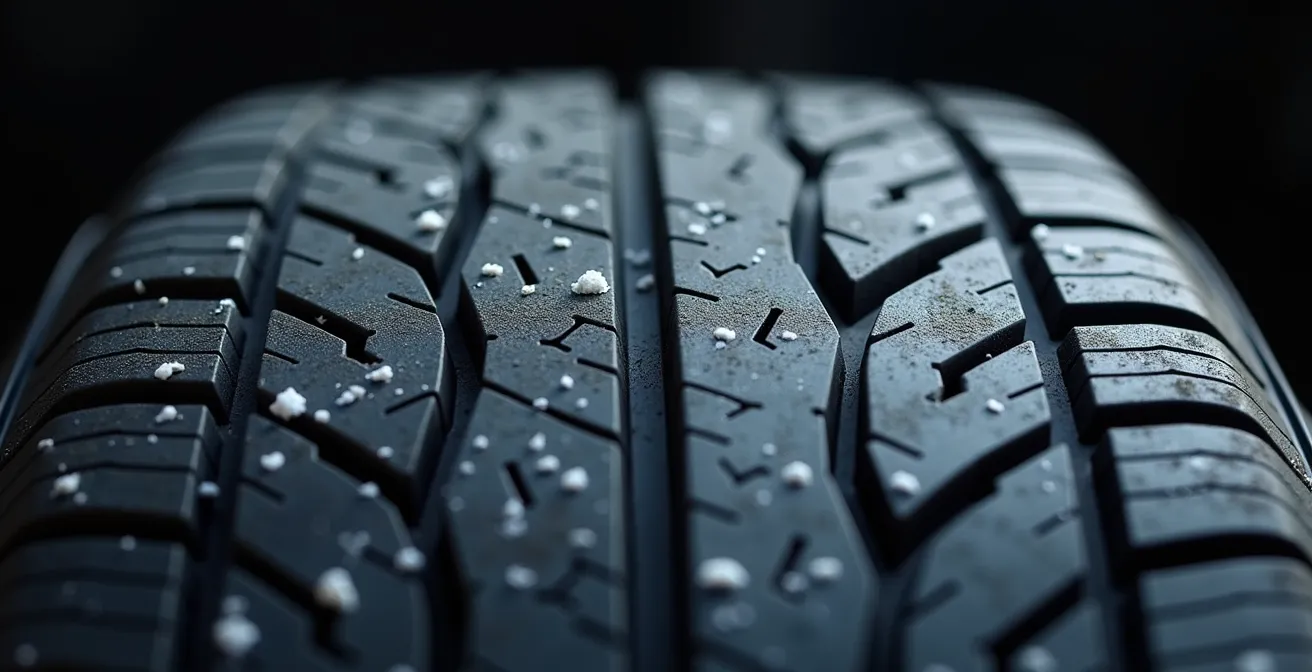
In contrast, all-weather tires, identifiable by the Three-Peak Mountain Snowflake (3PMSF) symbol, are engineered as a hybrid solution. They use a slightly firmer compound and feature stiffer, more reinforced sidewall construction than pure winter tires. This design provides better stability and more direct steering feel on cleared highways, making them more resistant to the forces of crosswinds. While they may not match a dedicated winter tire in deep snow, they offer a superior balance of performance for the mixed conditions often found along the 401 corridor—cold, wet, occasional light snow, and long stretches of clear but windy pavement.
The following table, based on general performance characteristics, breaks down the key differences for highway driving.
| Tire Type | Sidewall Stiffness | High-Speed Stability | Wind Resistance | Best Use Case |
|---|---|---|---|---|
| Pure Winter Tires | Soft/Flexible | Can feel ‘floaty’ on dry roads | More susceptible to crosswinds | Severe snow conditions (Coquihalla) |
| All-Weather (3PMSF) | Stiffer construction | Better stability at 100 km/h | Better crosswind resistance | Mixed conditions (401 corridor) |
For the frequent Trans-Canada traveler who encounters a wide spectrum of conditions, an all-weather tire often provides a safer and more stable experience at highway speeds, reserving pure winter tires for those who operate primarily in regions with consistently severe snow and ice.
Stiff vs Soft suspension: What is actually safer for Canadian potholes?
The debate between stiff and soft suspension isn’t about comfort; it’s a crucial safety calculation that changes dramatically with Canadian geography. The ideal suspension setup for the windy, well-maintained Prairie sections of the Trans-Canada is dangerously different from what’s needed to navigate the frost heaves of the Canadian Shield on Highway 17. A stiff suspension minimizes body roll and provides a sharp, responsive feel, which is excellent for resisting crosswinds and maintaining stability on smooth surfaces. However, when that same vehicle encounters a sharp-edged pothole or a severe frost heave, the stiff setup can’t absorb the impact effectively. The force is transmitted through the chassis, unsettling the vehicle and momentarily causing the tire to lose full contact with the road—a critical loss of grip.
Conversely, a soft, compliant suspension excels at absorbing road imperfections, keeping the tires pressed firmly against the pavement even on rough surfaces. This is essential for safety on roads riddled with potholes and frost heaves. However, this softness comes at the cost of increased body roll in corners and greater susceptibility to crosswinds. This creates a dilemma for the cross-Canada driver: do you optimize for the Prairies or for Northern Ontario? This is where the concept of resonant frequency becomes a life-or-death matter. As an authority on the subject explains:
On the rhythmic, wave-like frost heaves common on roads over permafrost, a standard suspension can enter a dangerous resonant frequency, causing the vehicle to ‘pogo’ and lose tire contact
– Transport Canada, Winter Driving Safety Guidelines
This « pogo » effect, where the suspension’s oscillations are amplified by the rhythm of the bumps, can lead to a complete loss of control. The tires literally bounce off the pavement. A softer suspension might be more prone to this on long-wave heaves if not properly damped.
Case Study: The Canadian Driver’s Dilemma
Consider a trip from Calgary to Sudbury. The long, flat, and windy sections of the Prairies benefit immensely from a stiffer suspension that resists crosswinds. However, once the driver reaches the Canadian Shield section of Highway 17 in Northern Ontario, the road surface changes to one dominated by severe frost heaves and cracks. Here, a stiff setup becomes a liability, jarring the vehicle and compromising grip. A softer, more compliant suspension is required to safely absorb these imperfections. This stark regional variation highlights why a single, fixed suspension setup is always a compromise on a cross-Canada journey, making a strong case for adaptive systems that can adjust to both conditions.
Therefore, neither « stiff » nor « soft » is universally safer. Safety depends on matching the suspension’s characteristics to the specific road conditions, making technologies like adaptive suspension an optimal, albeit more expensive, solution for those who frequently traverse Canada’s diverse terrain.
The dashboard light that means you must stop highway driving immediately
In modern vehicles, your dashboard is not just a collection of gauges; it’s the primary communication interface for the advanced safety systems that are constantly working to keep you safe. As a professional driver, you must interpret these signals not as suggestions, but as direct commands from the vehicle’s brain. While a check engine light might be a deferred problem, a continuously flashing Electronic Stability Control (ESC) light during high-wind driving is an urgent, non-negotiable order to stop.
The ESC system, which is standard equipment on vehicles manufactured from 2012 onwards, works by monitoring your steering input and the vehicle’s actual direction of travel. When it detects a skid or a loss of traction, it intervenes by applying individual brakes and sometimes reducing engine power to bring the vehicle back under control. A single, momentary flash during a slippery turn is normal. However, if the ESC light is flashing constantly while you’re driving in a straight line on a windy highway, it means the system is desperately and continuously intervening to prevent the wind from pushing your vehicle into a skid.
This is the vehicle telling you that you have reached, or are exceeding, the absolute limits of its (and your) ability to maintain control. The system is working at 100% capacity. Any stronger gust, any slight steering error, or any change in road surface could overwhelm the system, resulting in a sudden and total loss of control. Continuing to drive under these conditions is like ignoring a fire alarm while you can still smell smoke. It’s a critical warning that a catastrophic failure of grip is imminent. You must find the nearest safe place to pull over and wait for conditions to improve.
Here are the other critical warnings that demand immediate attention for highway stability:
- Constantly flashing ESC light: The system is in a state of continuous intervention to prevent a skid. Your margin of safety is zero. Stop driving.
- TPMS warning: Underinflated tires severely compromise sidewall stiffness and your vehicle’s resistance to crosswinds. Correct the pressure immediately.
- ABS grinding/pulsating: This indicates the tires have reached their grip limit on ice and the system is active. Reduce speed immediately and increase your following distance.
- Check engine light with reduced power: In some vehicles, the traction control system may limit engine output as a safety measure. This is a sign the vehicle is struggling to maintain grip.
- External warnings: Digital highway signs displaying « HIGH WINDS » or « TRAVEL NOT RECOMMENDED » are official advisories based on real-time data. Heed them.
Ignoring these lights is not brave; it is a reckless disregard for your own safety and the safety of everyone else on the road. A professional driver respects the machine’s limits.
How to install roof racks without destroying your highway stability?
A roof rack is a practical necessity for many long-distance travelers, but improper installation can dangerously compromise your vehicle’s stability, especially in windy conditions. The issue goes beyond just adding weight; it’s about fundamentally altering your vehicle’s aerodynamics by raising its center of pressure and center of gravity. When you add a rack and cargo, you effectively create a large ‘sail’ on top of your car, catching the wind and exerting a powerful levering force that promotes instability and body roll.
To mitigate this, installation must be precise and strategic. First, always use a rack system specifically designed for your vehicle’s make and model. These systems are engineered to mount to the strongest points of the roof and position the crossbars at optimal locations. The goal is to keep the load as low and as close to the vehicle’s center as possible. When positioning the crossbars, follow the manufacturer’s measurements exactly. This isn’t just for structural integrity; it’s to correctly align the load with the vehicle’s chassis, particularly the B-pillar, which is a key structural point.

When loading cargo, think like an aircraft designer. Place heavier, denser items at the bottom and centered between the axles. Lighter, bulkier items go on top. Crucially, the most aerodynamic (lowest-profile) part of your cargo should face forward to reduce drag and lift. Avoid loading large, flat items like sheets of plywood or canoes flat, as they can act like a wing at highway speeds, generating lift that reduces the grip of your tires. Securing the load is paramount; use high-quality cam or ratchet straps to ensure there is absolutely zero movement. A shifting load can cause a sudden and unpredictable change in the vehicle’s balance, which can be catastrophic in a high-speed maneuver.
Your 5-Point Roof Rack Stability Audit
- Component Integrity: Before every long trip, physically check all mounts, bolts, and crossbars. Ensure everything is tight and shows no signs of stress or wear.
- Rack Positioning: Confirm the crossbars are positioned according to the manufacturer’s specifications. This ensures the load is placed on the strongest parts of the roof and helps manage the vehicle’s center of pressure.
- Load Securing: Use at least two high-quality straps per item. The load must be completely immobilized. Push and pull on the cargo from all directions to ensure there is no shifting.
- Aerodynamic Profile: Pack the rack with the lowest and narrowest items at the front. Distribute weight evenly, keeping the heaviest objects low and centered.
- Test Drive: After loading, perform a brief, low-speed test drive around a block. Listen for excessive wind noise or any sounds of shifting, then pull over and re-check all mounts and straps.
By treating your roof rack installation with this level of diligence, you can carry the gear you need without turning your vehicle into an unstable and dangerous liability on the windy stretches of the Trans-Canada Highway.
Standard vs Adaptive: Is the comfort difference noticeable on frost heaves?
On a perfectly smooth highway, the difference between a standard and an adaptive suspension might feel subtle. However, on the frost-heaved sections of the Canadian Shield or northern routes, the difference is not just noticeable—it is a profound distinction between comfort and chaos, and more importantly, between safety and danger. A standard, or ‘passive’, suspension has a fixed damping rate. It’s a compromise, designed to perform adequately in a wide range of conditions but excelling in none. When it encounters the rhythmic, long-wave bumps of a road built over permafrost, it can be easily overwhelmed.
The danger is resonant frequency. If the time between bumps matches the natural oscillation frequency of the suspension, each successive heave amplifies the bouncing motion, causing the vehicle to ‘pogo’. This uncontrolled bouncing can become so severe that the tires lose contact with the road surface entirely, resulting in a complete loss of steering and braking control. A standard suspension, regardless of whether it’s tuned to be ‘stiff’ or ‘soft’, is vulnerable to this phenomenon because it cannot change its response characteristic.
This is where an adaptive, or ‘semi-active’, suspension system demonstrates its immense safety advantage. Using a series of sensors to read the road surface and vehicle body movements in real-time, the system can adjust the stiffness of the dampers in milliseconds. When it detects the slow, long-wave input of a frost heave, it can instantly change the damping force to break the resonant cycle. Instead of amplifying the bounce, it absorbs the initial impact and then immediately stiffens to settle the body, keeping the tire pressed firmly against the pavement.
Case Study: Taming Permafrost on the Alaska Highway
Drivers on northern routes like the Alaska Highway are intimately familiar with roads built on permafrost. These surfaces are in constant, slow motion, creating severe, rolling frost heaves. Here, vehicles with adaptive suspension systems have a clear advantage. The system’s computers identify the repetitive, low-frequency inputs from the heaves and actively counteract them by adjusting damper settings on the fly. This prevents the vehicle from entering the dangerous ‘pogo’ state of resonance, maintaining a stable and controlled ride where a vehicle with standard suspension would be bouncing uncontrollably and struggling to maintain tire contact.
So, is the difference noticeable? On a frost-heaved road at 90 km/h, it is the difference between a controlled, stable drive and a white-knuckle fight to keep the car on the road. For anyone frequently traveling Canada’s northern or shield-country highways, adaptive suspension is one of the most significant safety features available.
Key Road Features Where Black Ice Forms First
Black ice is the ultimate invisible threat on Canadian highways. It is a thin, transparent layer of ice that forms on the road surface, making it look merely wet rather than icy. As the Canadian Centre for Occupational Health and Safety warns, black ice will make a road look like shiny new asphalt, while safe, dry winter pavement should appear grey-white. Understanding where this hazard is most likely to form is not just good practice; it’s a critical defensive driving skill that allows you to anticipate danger before you see it.
The formation of black ice is governed by moisture and temperature. It appears most often when the air temperature is just at or slightly above 0°C, while the ground temperature is below freezing. This temperature difference is the key. Certain road features are uniquely susceptible to creating these conditions. Your ability to identify these high-risk zones and adjust your driving proactively is your primary defence against a sudden, unexpected loss of traction.
Be especially vigilant when approaching these five specific, Canadian-centric environments where black ice loves to hide:
- Exposed Prairie bridge decks and overpasses: These structures are the most notorious locations. Cold air circulates both above and below the road surface, allowing them to freeze much faster than the insulated ground on either side.
- Rock cuts on the Canadian Shield (e.g., Highway 17): The massive rock faces block sunlight, creating persistent shadows. Meltwater runoff from the rocks can trickle onto the cold, shaded pavement and freeze instantly, creating isolated and unexpected patches of extreme slipperiness.
- « Sea smoke » zones near the Great Lakes or Atlantic coast: In very cold weather, moisture evaporating from the relatively warmer water can be carried by the wind over the frigid highway, freezing on contact with the road surface.
- Highway intersections and off-ramps: The repeated braking, stopping, and accelerating of traffic can compress and polish packed snow, melting it slightly from friction and then allowing it to refreeze into a highly polished, mirror-like surface known as ‘glare ice’.
- Shaded, north-facing slopes: These areas receive little to no direct sunlight during winter days, allowing the road surface to remain below freezing even when the ambient air temperature rises, creating a perfect trap for any available moisture.
By learning to read the road and the surrounding environment, you can anticipate where the grip will disappear. When approaching any of these features, reduce your speed, avoid abrupt inputs, and be prepared for the possibility that your traction could vanish in an instant.
Key Takeaways
- High-speed stability is a function of physics; understanding your vehicle’s center of gravity and aerodynamic profile is the first step to control.
- Equipment matters: All-weather tires offer better high-speed stability in mixed Canadian conditions than pure winter tires, while adaptive suspension is a critical safety tool on frost-heaved roads.
- Your vehicle communicates its limits through dashboard warnings; a constantly flashing ESC light in high winds is a non-negotiable command to stop driving immediately.
Mastering Ice Driving: How to Keep Control When ABS is Active
The title of this section is deliberate. The common question « What if ABS fails? » is misleading; modern anti-lock braking systems are incredibly reliable. The real challenge for an experienced driver is not system failure, but mastering the technique of working *with* the system when it’s active at the very limit of traction. When you’re on ice and your ABS starts grinding and pulsating under your foot, it’s not failing—it’s performing its primary function perfectly. It’s preventing your wheels from locking up, thereby preserving your ability to steer. Your job is to use that preserved steering control to save yourself.
The old advice to « pump the brakes » is dangerously wrong for any modern vehicle. Your single most important action is to apply firm, steady, and hard pressure to the brake pedal and hold it down. Let the ABS do its work. You will feel a rapid, loud pulsation or grinding through the pedal—this is the sign it’s working correctly. Your focus must then immediately shift from braking to steering. Look where you want to go, not at the obstacle you’re trying to avoid. Your hands must guide the car toward your « out, » which is often a snow-covered shoulder or an empty lane. The ABS allows you to brake and steer simultaneously, a maneuver that is impossible with locked wheels.
One of the most treacherous situations is a mixed-grip surface, a scenario all too common in Canada.
Case Study: The Mixed-Grip Surface Scenario
Imagine braking hard on a curve where the right-side wheels are on clean pavement and the left-side wheels hit a patch of black ice. Without ABS and ESC, the vehicle would instantly and violently pull to the right, likely spinning out of control. With these systems, as explained by the Canada Safety Council, the computer detects the difference in wheel speed and works to counteract the pull. It will modulate brake pressure to each individual wheel to keep the car straight. The driver’s job is to maintain a firm grip on the steering wheel, pointing it where they want to go, and trust the systems to manage the complex braking forces.
To master control when ABS is active, internalize the « Brake and Look » technique:
- Apply firm, steady, and hard pressure to the brake pedal to activate the ABS. Do not pump.
- Recognize the grinding/pulsating feedback as a positive sign that the system is working at its limit.
- Immediately shift your visual focus to your escape route or « out » (e.g., a snow-covered shoulder). Your hands will follow your eyes.
- Steer smoothly and deliberately toward the area with more grip (snow offers more grip than ice).
- Anticipate a potential pull on mixed surfaces and maintain a firm, steady grip on the steering wheel to keep it pointed toward your target.
By understanding that ABS is a tool that preserves steering, you can change your mindset from panic to performance, using the technology as intended to navigate the most critical moments on an icy road.
Frequently Asked Questions on Adaptive Suspension on Canadian Roads
Should I use Sport mode on frost-heaved roads?
No, use Comfort or Auto mode. On a severely uneven surface like a road with frost heaves, maintaining tire contact with the pavement is far more important for safety than minimizing body roll. Comfort mode softens the dampers, allowing the wheels to follow the road’s contours more effectively.
Can adaptive suspension prevent all frost heave impacts?
It significantly reduces the danger by breaking resonant cycles that cause uncontrolled bouncing, but it cannot eliminate the laws of physics. Severe heaves and potholes encountered at high speed will still deliver a significant jolt and can damage the vehicle. Adaptive suspension is a powerful safety aid, not a substitute for reducing speed in hazardous conditions.
Is adaptive suspension worth it for Trans-Canada trips?
Yes, for a driver who frequently traverses the entire country, it is arguably one of the most valuable features. It provides the optimal adjustment for the vastly different conditions encountered, offering a stiff, stable response for the windy Prairies and a soft, compliant ride for the frost-heaved roads of the Canadian Shield, without the driver having to compromise.