
The biggest risk to tuning your car in Canada isn’t the modification itself, but the lack of proof that you’ve done it correctly and legally.
- ECU tunes are almost instantly detectable by dealers, making them a primary warranty risk.
- Exhaust noise and emissions laws are a complex « provincial patchwork, » requiring specific knowledge for where you live and drive.
Recommendation: Instead of searching for « warranty-safe » parts, focus on building a « Compliance Shield »—a file of documents, photos, and legal knowledge to defend your modifications.
Every enthusiast feels it: the itch for more. More response, more sound, more power. You love your car, but you know there’s untapped potential under the hood. The Canadian market is filled with parts promising easy horsepower, from air filters to exhaust systems. But this excitement is quickly chilled by a paralyzing fear: the dreaded « warranty void » stamp from your dealer, or the flashing lights of a police cruiser pulling you over for a noise violation on a summer night.
The common advice is often too simplistic. « Just use bolt-ons, » they say, or « the dealer has to prove the mod caused the failure. » While there’s a kernel of truth there, the reality in Canada is far more complex. Dealers have sophisticated diagnostic tools, and provincial laws, from Quebec’s stringent exhaust regulations to Ontario’s « unreasonable noise » statutes, create a legal minefield. Many enthusiasts are left wondering if they can have any fun at all without risking thousands in denied repairs or fines.
But what if the approach is all wrong? What if the key isn’t just picking the right parts, but building an ironclad case for them? This guide shifts the perspective. We’re not just listing mods; we’re giving you the tuner’s playbook for building a Compliance Shield. It’s a proactive strategy of documentation, smart choices, and legal awareness designed to protect your passion and your investment. We will explore how dealers detect modifications, navigate the provincial patchwork of laws, and select upgrades that deliver performance without raising red flags.
This article will guide you through the critical questions every Canadian enthusiast must ask before turning a single wrench. We will break down the real risks and provide actionable strategies to ensure your performance journey is both thrilling and secure. Let’s dive into how to be smart, strategic, and successful in your tuning goals.
Summary: Legally Tuning Your Car in Canada
- Why does an ECU remap void your powertrain warranty instantly?
- Do performance air filters actually add horsepower or just noise?
- 0W-20 vs 5W-40:The Airbag Audit: Is Your Used Car Safe to Drive?
- The exhaust modification that can get your car impounded in Quebec
- How to adjust tire pressure for maximum grip on a winding road?
- How to know if your high-flow cat is actually road legal?
- Can you safely swap a steering wheel without disabling the airbag?
- Catalytic Converters and Noise Laws: Staying Legal in 2024
Why does an ECU remap void your powertrain warranty instantly?
This is the single most common warranty landmine for enthusiasts. The promise of unlocking significant horsepower with a simple software flash is tempting, but it comes with a near-certain risk. The old idea of « flashing back to stock » before a dealer visit is largely a myth in the modern automotive world. Manufacturers have invested heavily in protecting their powertrain components from the stresses of unapproved tuning, and their detection methods are ruthlessly efficient.
The primary weapon in a dealer’s arsenal is the « TD1 » flag, a code used within the Volkswagen-Audi group that has conceptual equivalents across most major brands. When a dealer technician connects your car to their diagnostic system (like ODIS for VAG cars), the tool automatically communicates with the manufacturer’s servers. It checks the ECU’s software version and, more importantly, its « flash counter. » Any discrepancy between your car’s data and the factory records triggers an immediate and automated flag.
In fact, an analysis of modern tuning detection shows that modern vehicles with flash counters immediately flag modifications upon connection to dealer tools. This process is automatic; the service advisor often has no discretion. Once the TD1 flag is set, your powertrain warranty is effectively voided for any future claims, whether they are related to the tune or not. Even « piggyback » units that intercept sensor signals can be detected through analysis of freeze-frame data, which may show boost pressures or fuel trims outside of factory specifications.
Some tuners offer their own third-party warranties, like APR Plus, which can provide a layer of protection. However, these are separate from your manufacturer’s warranty and have their own set of limitations. The bottom line is that any form of engine tuning that alters software or tricks sensors carries a significant and easily detectable warranty risk.
Do performance air filters actually add horsepower or just noise?
The aftermarket air filter or cold air intake (CAI) is often the first modification any enthusiast performs. It’s affordable, easy to install, and promises a blend of increased horsepower, better throttle response, and a more aggressive induction sound. While the horsepower claims of 10-15hp are often exaggerated and typically only achievable at the very top of the rev range, these modifications do offer tangible benefits. By reducing restriction, they allow the engine to breathe more easily, which can improve throttle feel and produce a satisfying growl under acceleration.
However, in the unique Canadian climate, the primary concern isn’t just performance—it’s safety. A common fear associated with cold air intakes, which often position the filter lower in the engine bay, is hydrolock. This catastrophic engine failure occurs when water is sucked into the combustion chamber. In a country known for spring slush, deep puddles, and torrential downpours, this is a valid concern. The good news is that it’s a lower risk than many believe.

Real-world experience from Canadian drivers shows that hydrolock is not a common occurrence with a properly installed CAI. For water to be ingested, the filter itself must be completely submerged, typically in 6 to 8 inches of standing water. While driving through a flash flood will certainly kill your engine, navigating typical rain-soaked roads or slushy spring conditions is generally safe, especially if the vehicle’s original splash shields are kept in place. For those in flood-prone areas or who want ultimate peace of mind, installing an intake bypass valve provides an extra layer of security by offering an alternate air path if the main filter becomes submerged.
In terms of warranty, a simple drop-in filter replacement is virtually undetectable and poses no risk. A full CAI is a visible modification, but it is highly unlikely to void a powertrain warranty unless it is proven to have directly caused a failure, such as by allowing debris or water into the engine.
0W-20 vs 5W-40:The Airbag Audit: Is Your Used Car Safe to Drive?
While an airbag audit is a non-negotiable step for ensuring the safety of any used car, a more frequent warranty question for performance enthusiasts revolves around what’s inside the engine. Choosing the correct engine oil is one of the most critical maintenance tasks, yet it’s an area filled with debate and misinformation, especially when modifications enter the picture. Using the wrong oil viscosity can not only harm your engine but also give a dealer a clear reason to deny a warranty claim.
Modern engines are built with incredibly tight tolerances and are designed to use thin, low-viscosity oils like 0W-20 to maximize fuel efficiency. The « 0W » indicates its flow performance in extreme cold (the ‘W’ stands for Winter), while the « 20 » represents its viscosity at operating temperature. An enthusiast might be tempted to switch to a thicker oil, like a 5W-40, believing it offers better protection under high-stress track driving or with a tuned engine. While a thicker oil does provide a more robust film at very high temperatures, using it in an engine not designed for it can cause problems.
Thicker oil can reduce fuel economy and, more critically, may not flow quickly enough during a cold start, especially during a harsh Winnipeg winter at -30°C. This can lead to increased wear on critical engine components. The manufacturer’s recommended oil grade is always the safest bet for warranty compliance. Deviating from it, even to a grade that seems « better, » can be flagged by a dealer during service or oil analysis.
To navigate this, it’s crucial to understand the trade-offs in a Canadian context. The following table, based on a guide from Car Help Canada, breaks down the performance of different oil weights in various Canadian conditions.
| Oil Weight | Winnipeg Winter (-30°C) | Summer Track Days (CTMP) | Rocky Mountain Driving | Warranty Risk |
|---|---|---|---|---|
| 0W-20 | Excellent cold start | May thin excessively | Good fuel economy | Safe if OEM spec |
| 5W-30 | Good cold start | Balanced performance | Versatile choice | Check manufacturer approval |
| 5W-40 | Adequate cold start | Best high-temp protection | Higher consumption possible | May void warranty if not approved |
The key takeaway is to stick with an oil that meets the manufacturer’s specific approval standards (e.g., VW 502 00, Dexos1 Gen 2). If you do choose a different viscosity for specific uses like track days, be prepared to defend your choice and, ideally, switch back to the OEM-spec oil for daily driving and dealer visits.
The exhaust modification that can get your car impounded in Quebec
Changing the exhaust system is a rite of passage for many car enthusiasts. It can unlock a few horsepower, reduce weight, and most importantly, give your car the aggressive soundtrack you crave. However, this is one of the most visible and audible modifications you can make, and it draws immediate attention from law enforcement. Across Canada, the legality of aftermarket exhausts is a « provincial patchwork » of confusing and often subjective laws.
Quebec is notoriously strict. Under Article 258 of the Highway Safety Code, it is illegal for an exhaust to be louder than the one installed by the manufacturer. This is a highly subjective rule that gives SAAQ-authorized police officers significant power. If an officer deems your exhaust too loud, they can issue a 72-hour notice, forcing you to have the vehicle inspected at an authorized facility. If it fails, you must revert to an OEM-compliant exhaust. Continuing to drive without passing inspection can lead to fines and even having your car impounded.
Other provinces have different rules. In Alberta, cities like Edmonton have specific decibel limits (96 dBA), while Ontario’s Highway Traffic Act uses a vague prohibition against « unreasonable noise. » This subjectivity is why building your Compliance Shield is so important. Proactive documentation can be your best defense during a traffic stop. As a guide from TDot Performance highlights, Canadian municipalities have varying decibel limits, making a one-size-fits-all approach impossible. If you are stopped, having proof that your exhaust system meets specific standards, or a baseline decibel reading of your stock system for comparison, can make a significant difference.
Your Action Plan: Building a Compliance Shield
- Baseline Readings: Get a baseline decibel reading of your stock exhaust from a certified shop before you modify it. This gives you a factual comparison point.
- Document Everything: Keep all manufacturer documentation for aftermarket parts, especially those stating compliance with any standards (like EPA noise regulations).
- Professional Installation: Always keep receipts from certified mechanics for the installation of performance parts. This demonstrates professional conduct.
- Certification Numbers: For any emissions components like high-flow catalytic converters, document any EPA or CARB certification numbers stamped on the part.
- Visual Proof: Take photos of the installation, particularly showing that the parts have an OEM-like appearance and are in good working order.
Ultimately, a « cat-back » system (which replaces parts from the catalytic converter to the muffler tips) is generally the safest bet, as it doesn’t tamper with emissions equipment. However, even these can be deemed illegal if they are excessively loud. Choosing a system with a resonator and a high-quality muffler is a smarter choice than a straight-pipe or muffler-delete setup.
How to adjust tire pressure for maximum grip on a winding road?
Performance isn’t just about what happens under the hood; it’s about how that power connects to the pavement. Tires are the single most important performance component of your vehicle, and optimizing them is a crucial skill. While choosing the right performance tire is step one, learning to adjust your tire pressure for different conditions is an advanced technique that can unlock significant gains in grip and handling, especially on Canada’s iconic driving roads.
The pressure listed on your driver’s side door jamb is a compromise, designed for average loads, comfort, and tire longevity. For performance driving, this is merely a starting point. On a technical, winding road with tight hairpins like the Cabot Trail in Nova Scotia, slightly increasing your tire pressure by 2-3 PSI (when cold) can be beneficial. This stiffens the sidewall, reducing flex and preventing the tire from « rolling over » on itself during hard cornering, which leads to a sharper, more precise steering feel.
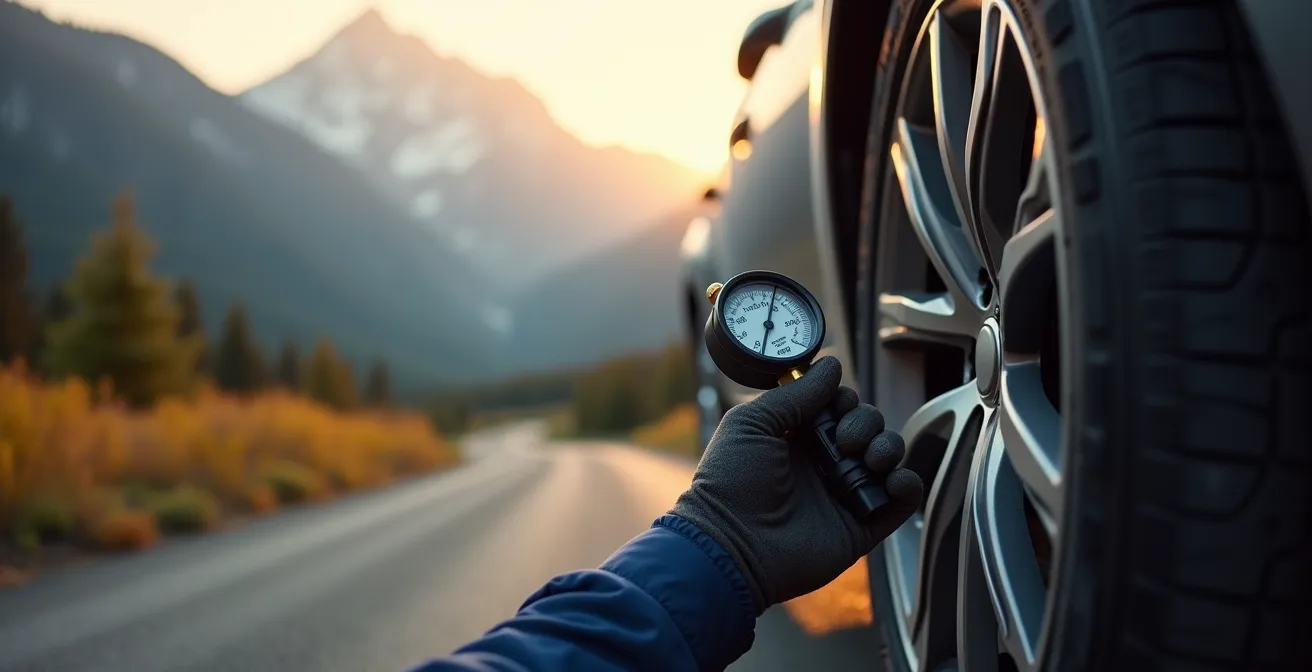
Conversely, on a road with long, sweeping corners like the Sea-to-Sky Highway in British Columbia, sticking closer to the OEM pressure might be better to maximize the size of the tire’s contact patch for sustained grip. It’s a delicate balance. A common technique used by autocross and track drivers is to use chalk on the edge of the tire’s tread. If the chalk is worn off onto the sidewall after a few hard corners, your pressure is too low. If the chalk on the outer edge of the tread isn’t worn at all, your pressure might be too high.
It’s also critical to remember that tire pressure changes with temperature. A pressure set in a cool garage will increase as the tires heat up during spirited driving. As a rule of thumb, for every 10°C change in ambient temperature, tire pressure will change by about 1 PSI. This is especially important during the colder seasons in Canada. From an insurance perspective, the biggest risk isn’t your tire pressure, but running the wrong type of tire altogether. Being caught with summer performance tires during a mandatory winter tire period can absolutely void your insurance coverage in the event of an accident.
How to know if your high-flow cat is actually road legal?
For enthusiasts looking to modify their exhaust for performance, the catalytic converter (« cat ») presents a major legal and ethical hurdle. This component is a critical part of your vehicle’s emissions control system. Removing it entirely with a « test pipe » or « de-cat pipe » is unequivocally illegal across all of Canada and will cause you to fail any emissions test. However, high-flow catalytic converters offer a middle ground, promising improved exhaust flow while still treating harmful emissions.
The challenge is that the market is flooded with cheap, ineffective high-flow cats that do little to control pollution and may still be considered illegal. A truly road-legal high-flow cat must meet specific standards. While Canada doesn’t have a national certification body like the California Air Resources Board (CARB), products that are certified by the US Environmental Protection Agency (EPA) are generally accepted as being compliant for road use in Canada.
As the experts at TDot Performance state in their guide on legal modifications, the core principle is that « Emission Control Equipment manufactured on the vehicle needs to stay in place and operate as intended. » This is the key phrase. A high-quality high-flow cat is designed to operate as intended, whereas a cheap or hollowed-out unit is not.
Emission Control Equipment manufactured on the vehicle needs to stay in place and operate as intended.
– TDot Performance, Legal Car Modifications Guide Ontario
When shopping for a high-flow cat, here are the key things to look for:
- EPA Certification: Look for an explicit statement of EPA compliance and a certification number on the product itself or its documentation.
- Avoid « Off-Road Use Only »: Any product marketed this way is a clear red flag and is not intended for street-driven vehicles.
- Reputable Brands: Stick with well-known manufacturers who stand behind their products’ emissions compliance.
- Maintain OEM Appearance: A converter that looks similar in size and placement to the factory unit is less likely to raise questions during a visual inspection.
It’s also important to understand your province’s testing requirements. As of 2024, provinces like Ontario and British Columbia have eliminated mandatory emissions testing for light-duty vehicles (Drive Clean and AirCare, respectively). While this removes the testing hurdle, it does not make it legal to remove or tamper with emissions equipment. A visual inspection during a traffic stop can still lead to fines if modifications are apparent.
Can you safely swap a steering wheel without disabling the airbag?
The steering wheel is your primary connection to the car. Swapping the stock wheel for an aftermarket one with a sportier design, thicker rim, or Alcantara finish is a popular modification to enhance the driving experience. However, this is one of the most dangerous modifications you can perform if done incorrectly. Modern steering wheels are complex safety devices containing an explosive airbag, and tampering with this system has severe legal and safety consequences.
Let’s be unequivocally clear: removing or disabling your steering wheel airbag is illegal in Canada. It violates federal law, as removing airbags violates Canada’s Motor Vehicle Safety Act. In the event of a crash, not only would you be without a critical life-saving device, but your insurance company would almost certainly deny your claim for personal injury. It will also 100% void any warranty coverage related to the vehicle’s electrical or safety systems. The SRS (Supplemental Restraint System) light on your dashboard will remain permanently illuminated, which is an automatic failure for any safety inspection.
So, does this mean you’re stuck with your factory wheel forever? Not necessarily. The enthusiast community in Canada has found several safe and legal ways to upgrade the feel of their steering wheel without compromising safety:
Case Study: Safe Steering Wheel Upgrades in Canada
Rather than removing the airbag, Canadian enthusiasts are turning to safer alternatives. Professional auto upholstery shops across the country can expertly re-wrap an existing wheel in genuine Alcantara or high-grade leather, adding thickness and a premium feel while keeping the original airbag and controls fully functional. Another popular method is the « OEM+ » swap, where a higher-trim wheel from the same model line (e.g., a Volkswagen Golf R wheel into a base Golf) is installed. These swaps are typically plug-and-play and preserve all safety systems. For a less permanent solution, high-quality, stitch-on leather covers provide a significant improvement in grip and feel without any modification. Aftermarket racing wheels are strictly for dedicated track cars, which must be registered and insured as such and cannot be legally driven on public roads.
The takeaway is simple: your factory airbag is a non-negotiable component. Any modification must work around it, not eliminate it. Enhancing the tactile feel of your wheel is a fantastic upgrade, but it must never come at the cost of your safety or legal standing.
Key Takeaways
- Warranty is about risk management; ECU tunes are the highest risk, while quality bolt-ons are lower risk but not zero.
- Canadian law is a « provincial patchwork. » What’s legal in Alberta might get you fined in Quebec. Know your local rules.
- Documentation is your defense. Keep receipts, certifications, and photos to build your « Compliance Shield. »
Catalytic Converters and Noise Laws: Staying Legal in 2024
As we’ve seen, navigating the world of performance modifications in Canada is less about what’s technically possible and more about what’s legally defensible. Two of the biggest battlegrounds are emissions and noise. As we move through 2024, enforcement trends are shifting, and what was once ignored is now being targeted. Being an informed enthusiast means understanding the current legal landscape to keep your car on the road and out of the impound lot.
The cancellation of large-scale emissions testing programs like Ontario’s Drive Clean and BC’s AirCare has led many to believe that emissions compliance is no longer a concern. This is a dangerous misconception. The laws requiring all original emissions equipment to be in place and functional have not changed. The shift is from proactive testing to reactive enforcement. This means you’re less likely to be caught by a mandatory test, but more likely to be targeted in a roadside inspection if a police officer suspects tampering, often prompted by excessive exhaust noise.
Noise enforcement is also intensifying. In the Greater Toronto Area, police services have launched « Project ERASE » (Eradicate Racing Activity on Streets Everywhere) blitzes, which specifically target illegally modified vehicles and excessive noise. In Quebec, enforcement of the subjective noise law remains active. This provincial patchwork means you must be aware of more than just federal law. The following table provides a snapshot of the legal landscape for modifications across key Canadian provinces.
| Province | Emissions Testing | Noise Regulation | Known Enforcement Trends |
|---|---|---|---|
| British Columbia | AirCare abolished | Municipal bylaws vary | Visual inspections common |
| Alberta | None for light vehicles | Edmonton: 96 dBA | Complaint-driven enforcement |
| Ontario | Drive Clean cancelled | HTA ‘unreasonable noise’ | Project ERASE blitzes in GTA |
| Quebec | None | Article 258 CSR – subjective | SAAQ active enforcement |
Given this complex environment, the « Compliance Shield » strategy is your most powerful tool. It’s about being prepared before you are ever questioned. If you are pulled over, being able to calmly and respectfully present documentation for your high-flow catalytic converter or a receipt for your professionally installed, resonated cat-back exhaust can be the difference between a warning and a ticket with an order for inspection. It demonstrates intent to comply with the law, which can go a long way with an officer.
Your journey to more power starts not with a part, but with a plan. By embracing the mindset of an informed enthusiast and proactively building your compliance shield, you can enjoy the thrill of a modified car while confidently navigating Canada’s legal and warranty landscape. Start building your documentation trail today for a smarter, safer performance experience.