
Disposing of an old car in Canada is not just about removal; it’s a procedural process of asset liquidation and legal liability transfer.
- Maximizing value requires choosing between scrapping for cash, parting out key components, or donating for a significant tax receipt.
- Properly transferring ownership and handling hazardous materials are non-negotiable steps to avoid future legal and environmental consequences.
Recommendation: Always use a certified auto recycler and secure a Bill of Sale to formally notify your provincial ministry, fully severing your liability from the vehicle.
That old car sitting in your driveway is more than just an eyesore; it’s a collection of legal responsibilities and potential financial value. For many Canadian owners, the immediate thought is to simply call a tow truck and have it taken away. However, this approach overlooks critical steps that can protect you from future liability and turn a dormant piece of metal into a surprising financial asset. The process involves navigating provincial regulations, understanding the scrap market, and making informed decisions about environmental stewardship. Standard advice often misses the nuances that differentiate a simple disposal from a strategic one.
Common wisdom suggests either selling it for scrap or donating it to charity. While correct, these options are the starting point, not the entire journey. The real expertise lies in knowing *how* to scrap it for maximum return, *how* to ensure a donation yields the largest possible tax credit, and recognizing the significant legal and environmental risks of improper handling, especially with materials like AC refrigerant. This isn’t merely about getting rid of junk; it’s about formalizing the end of your ownership and responsibility. An estimated 1.6 million vehicles are taken off the road each year in Canada, and each one requires a procedurally sound disposal.
But what if the key wasn’t just getting rid of the car, but rather executing a flawless « liability transfer »? This guide reframes vehicle disposal as a formal process of asset liquidation. We will move beyond the basics to explore the specific, procedural steps that ensure you are legally protected, environmentally responsible, and financially compensated. We’ll detail how to accurately value your vehicle, navigate the donation process for a substantial tax benefit, understand the critical environmental regulations you must not ignore, and, most importantly, complete the crucial final step that severs your legal ties to the vehicle forever. This is your definitive roadmap to responsible and profitable car disposal in Canada.
This comprehensive guide breaks down every critical aspect of the process. From determining your vehicle’s true worth to understanding the long-term threat of road salt, the following sections provide the procedural knowledge you need to act with confidence.
Summary: A Complete Guide to Disposing of an Old Car in Canada
- How much is your dead car actually worth at a Canadian scrap yard?
- How to get a $500+ tax receipt for a car that doesn’t run?
- Why you should never drain AC refrigerant yourself before scrapping?
- Is it worth stripping parts off your old car before calling the scrap yard?
- The crucial step to ensure you aren’t liable for a scrapped car later
- Is it ever worth buying back your written-off car to repair it?
- The hidden rust spots that make 80% of Ontario classics a bad investment
- Rustproofing 101: How to Preserve Mechanical Strength Against Road Salt?
How much is your dead car actually worth at a Canadian scrap yard?
Determining the value of a non-running car is the first step in the asset liquidation process. It’s a common misconception that a « dead » car is worthless. In reality, its value is a composite of its weight in scrap metal, the condition of its salvageable parts, and current market demand for those materials. The price is not fixed; it fluctuates based on global commodity markets for steel, aluminum, and precious metals found in components like the catalytic converter. For vehicle owners in Canada, this means the offer you receive can vary significantly from one month to the next and between different recycling facilities.
The value spectrum is surprisingly wide. While a smaller, older sedan might fetch a few hundred dollars, a larger truck or SUV with more metal can be worth considerably more. Recent data from a prominent Ontario recycler shows that scrap car values range from CA$250 to CA$20,000, with the higher end reserved for vehicles with highly sought-after parts or newer models. The key is to understand that you are not just selling a single object, but a collection of commodities. Even a car that doesn’t run may have a perfectly functional alternator, a good set of tires, or an intact battery, all of which have residual value.
To get a clearer picture, it’s helpful to see how different vehicle types are valued. The weight of the vehicle is often the primary factor for a basic scrap offer, but specific parts can dramatically alter the final price.
| Vehicle Type | Average Value Range | Key Factors |
|---|---|---|
| Small Sedan | $400-$950 CAD | Lower metal weight |
| SUV/Truck | $1,100 CAD (Alberta average) | Higher metal content, industrial demand |
| Junk Car (non-running) | $300-$1,500 CAD | Condition, parts value |
| Catalytic Converter Only | $80-$300 CAD | Precious metal content |
Case Study: Maximizing Scrap Value in Edmonton
A prime example of value optimization involved a 2008 Ford Escape in Edmonton. The vehicle was non-running with 250,000 km, and the initial scrap offer was $600 CAD. Rather than accepting, the owner strategically parted out key components. They removed and sold the catalytic converter for $220, the tires for $120, and the battery for $50. After selling these parts, the scrapyard still offered $800 for the remaining shell. The owner’s total earnings were $1,190 CAD, nearly doubling the initial offer by treating the car as a collection of assets rather than a single piece of junk.
This demonstrates that a few strategic actions can significantly increase the financial return. A proactive approach to understanding your vehicle’s component value is essential for successful asset liquidation.
How to get a $500+ tax receipt for a car that doesn’t run?
For those prioritizing philanthropy over direct cash, donating an old vehicle to a registered Canadian charity is an excellent option that provides a significant tax benefit. This process transforms a depreciated asset into a valuable contribution, supporting a cause you care about while reducing your taxable income. The key to maximizing this benefit is understanding how the donation is processed and what determines the value of your tax receipt. It’s not simply a flat rate; the final amount is directly tied to what the charity ultimately receives for your car.
Most reputable car donation programs in Canada, like Donate a Car Canada, operate by either sending the vehicle to auction or selling it for scrap. If the car is newer (typically within 12 years) and has lower mileage (under 250,000 km), it will likely be auctioned. This is where the highest values are realized, with some auction donations reaching tens of thousands of dollars, resulting in a tax receipt for the full sale price minus a small administrative commission. For older, non-running vehicles, the car is sold to a certified recycler, and your tax receipt will be for the scrap value, which still often amounts to several hundred dollars.
The financial incentive is substantial. Depending on your province and income level, the tax credit you receive can be a significant percentage of the donated amount. For instance, you may receive as much as 49% back on your taxes from the value of your donation. This means a car that sells for $1,000 could translate into a $490 reduction in your tax bill. To ensure the best outcome, it’s vital to work with an established donation program that provides transparent reporting on the sale of your vehicle. Even in a worst-case scenario where a car sells for a very low price or even at a loss after towing fees, most programs guarantee a minimum donation and a corresponding tax receipt for the donor.
Why you should never drain AC refrigerant yourself before scrapping?
While the DIY spirit is commendable when stripping certain parts for resale, there is one system you must never tamper with: the air conditioning. Draining AC refrigerant (often known by the brand name Freon) yourself is not only extremely hazardous to the environment but also illegal in Canada for uncertified individuals. Refrigerants are potent greenhouse gases, and their improper release contributes significantly to ozone depletion and climate change. Federal and provincial regulations mandate that these substances be handled exclusively by trained and certified professionals using specialized recovery equipment.
This is a core principle of environmental stewardship in the auto recycling industry. Scrapyards and auto recyclers are legally bound to follow strict environmental protocols for depolluting end-of-life vehicles (ELVs). This includes safely draining all fluids like oil, gasoline, antifreeze, and, most critically, AC refrigerant. As the Automotive Recyclers of Canada (ARC) states regarding their certified programs:
Only authorized Certified Auto Recyclers who follow a strict code of practice for handling end-of-life vehicles can participate.
– Automotive Recyclers of Canada, Retire Your Ride Program
This professional-only approach ensures that hazardous materials are contained and disposed of or recycled correctly, preventing soil and water contamination. In provinces like Ontario, the government has streamlined this process through systems like the Environmental Activity and Sector Registry (EASR). This registry requires ELV disposal sites to register and adhere to strict operational standards, replacing a cumbersome approval process with a more efficient system that still guarantees environmental compliance. Attempting to bypass this by draining the refrigerant yourself could lead to fines and ensures no reputable recycler will accept your vehicle.
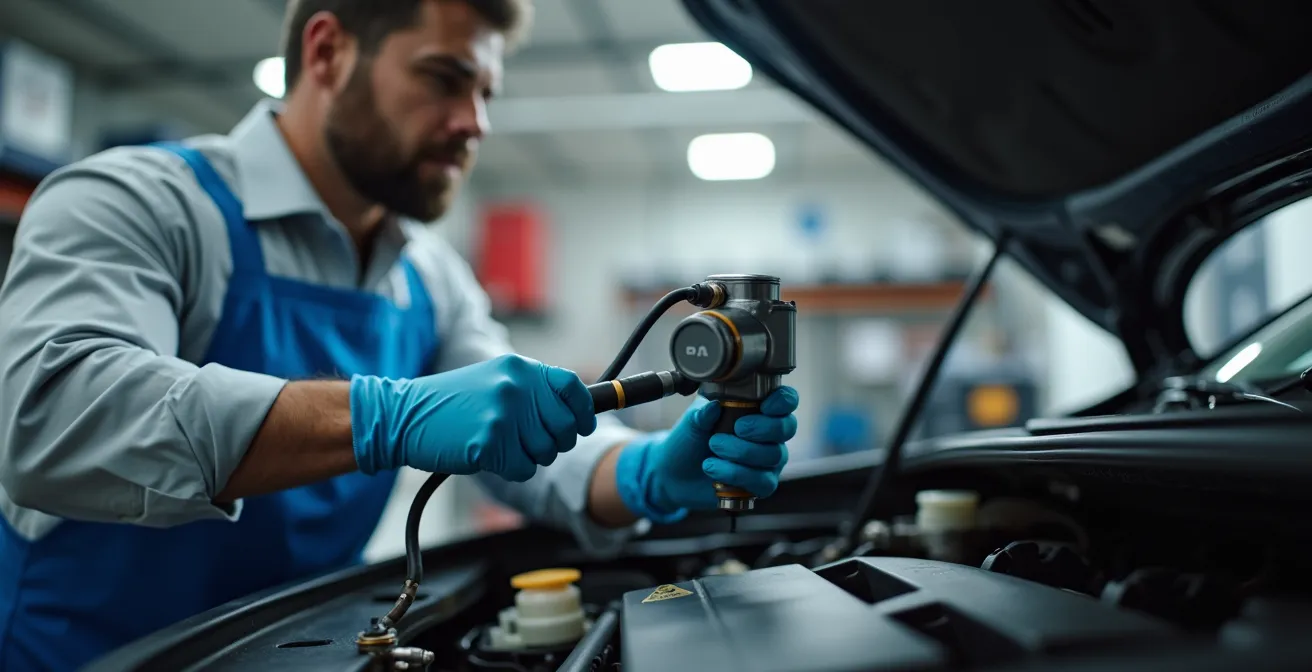
The image above illustrates the proper procedure: a certified technician using specialized equipment to safely capture refrigerant. This is not a task for a home garage. The risk of releasing harmful gases and the legal prohibitions make it imperative to leave this job to the professionals you are selling the car to. Your responsibility as the owner is to deliver the vehicle with its AC system intact, allowing the certified recycler to perform their role in the environmental protection chain.
Is it worth stripping parts off your old car before calling the scrap yard?
The decision to strip parts from your vehicle before scrapping is a classic cost-benefit analysis. While it can increase your total financial return, it requires time, tools, and a degree of mechanical know-how. More importantly, it can also reduce the offer you receive from the scrapyard. Some recyclers base their price on a complete vehicle and may lower their offer or even refuse pickup if key components are missing. The most strategic approach is to focus on high-value, easily removable parts while understanding the impact on the final scrap price.
The catalytic converter is the most valuable single component, often containing precious metals like platinum, palladium, and rhodium. However, it is also the part that scrapyards most want, and its absence will cause the largest reduction in their offer. Other valuable and relatively easy-to-remove parts include the battery, tires (if in good condition), and the alternator. Selling these items privately on platforms like Kijiji or to local auto parts stores can yield more than their value as part of a bulk scrap deal. For example, a used car battery can be sold for $20-$80 at retailers like Canadian Tire, which is often more than its incremental value to a scrapyard.
However, you must weigh the effort against the reward. Removing an engine or transmission is a major undertaking that is generally not worthwhile unless you have the equipment and expertise. It will almost certainly result in a significantly lower scrap offer and may make the vehicle difficult for the tow truck to handle. A good rule of thumb is to only remove parts that you can safely and quickly extract and for which you have a ready market.
Your Action Plan: Deciding Which Parts to Remove
- Assess High-Value Parts: Identify the catalytic converter, battery, and tires. Check their condition and research their potential resale value on local marketplaces.
- Evaluate Your Tools & Skills: Do you have a reciprocating saw and the knowledge to safely remove the converter in under 15 minutes? Do you have the tools to remove the battery and wheels? Be honest about your capabilities.
- Check Tire Condition: Only consider selling tires if the tread depth is above 4/32 of an inch. Worn tires have little to no resale value and are best left on the car.
- Contact Scrapyards for Quotes: Call at least two scrapyards. Get a quote for the car « as is » and another for the car without the parts you plan to remove. This will reveal the impact on their offer.
- Make the Final Decision: Compare the potential earnings from private sales plus the reduced scrap price against the original, all-inclusive scrap offer. Choose the path that yields the highest net return for the least amount of hassle.
The crucial step to ensure you aren’t liable for a scrapped car later
The single most important step in disposing of an old car is the final one: formally and legally transferring ownership. This is the action that severs your liability. Simply handing over the keys and vehicle to a tow truck driver is not enough. If the ownership is not officially transferred through your provincial ministry of transportation, you could remain legally responsible for anything that happens with that vehicle, including parking tickets, toll-road fees, or even involvement in criminal activity. This final piece of paperwork is your only definitive proof that you are no longer the owner.
The process varies slightly by province, but the principle is the same. In Ontario, for example, the process is managed through ServiceOntario. You must have the green « Vehicle Ownership » document for your car. You are required to sign the vehicle portion on the left side of this document and give the entire form to the scrapyard representative. The scrapyard will then complete their portion and register the vehicle as scrapped with the Ministry of Transportation. You should also obtain a Bill of Sale from the recycler as your personal record of the transaction, clearly stating the date, time, price, and VIN of the vehicle being sold for scrap.
Furthermore, you must handle your license plates and any associated transponders correctly. You should remove your plates from the vehicle before it is towed away. In Ontario, you can then either return the plates and the « plate portion » (the right side of the ownership document) to ServiceOntario to get a refund for any remaining registration time, or you can keep the plates to transfer to another vehicle. It is also critical to remove your 407 ETR transponder if you have one. This is a commonly forgotten item, and if it remains in the car, you will be liable for any toll charges it incurs. Completing these administrative tasks is the cornerstone of a clean and final liability transfer.
Is it ever worth buying back your written-off car to repair it?
When an insurance company declares a vehicle a « total loss » or « write-off, » the owner is sometimes offered the option to « buy it back » from the insurer for its salvage value. The question then becomes: is it ever a sound financial decision to do so? The answer is almost always no, especially in the Canadian context of stringent safety standards and the corrosive effects of our climate. While the initial buy-back price may seem low, the path to getting a « salvage » branded vehicle legally back on the road is expensive, complex, and fraught with uncertainty.
A vehicle is written off when the cost of repairs exceeds its pre-accident cash value. To be re-registered, a salvage vehicle must undergo a structural integrity inspection at a licensed facility, in addition to a standard safety certification. This structural inspection is far more rigorous and costly than a regular safety check, as it scrutinizes the frame and unibody for any damage or improper repairs. Any hidden issues discovered during this process can lead to spiraling repair costs that quickly dwarf the initial « deal » of the buy-back.
The longevity of modern vehicles can make this tempting. According to a report by DesRosiers Automotive Consultants, vehicle lifespan has increased dramatically. They noted that « in the year 2000, up to 33.7% of vehicles in Canada lasted up to 15 years, whereas in the year 2017, 54% of vehicles last for at least 15 years. » While cars last longer, this doesn’t change the economics of major collision repair. Furthermore, Canadian provinces like Ontario have strict End-of-Life Vehicle (ELV) standards that require recyclers to properly depollute cars, reinforcing the idea that damaged vehicles belong in a professional recycling stream, not back on the road patched together. For the vast majority of owners, accepting the insurance payout and letting the car go to a certified recycler is the most logical and financially prudent path.
The hidden rust spots that make 80% of Ontario classics a bad investment
Corrosion, or rust, is the relentless enemy of vehicles in many parts of Canada, particularly in the region known as the « Rust Belt. » This area, which includes major Southwestern Ontario cities like Toronto, Hamilton, and Windsor, experiences harsh winters with heavy use of road salt. According to a report citing Statistics Canada, over five million tons of salt are used on Canadian roads each winter. This salt, often containing corrosive chlorides, combines with moisture to create an electrochemical reaction that aggressively eats away at your vehicle’s metal components. For classic cars, which often lack the advanced coatings of modern vehicles, this can be a death sentence.
The most dangerous rust is not the visible bubbling on a fender but the insidious corrosion that attacks structural components. Novice investors in classic cars often focus on cosmetic appearance, unaware that the car’s skeleton could be compromised. Key areas to inspect are the frame rails, subframe mounts, rocker panels (sills), and floor pans. These areas are constantly battered by salt-laden slush kicked up by the tires. Another critical and often overlooked area is the inside of the wheel wells and the shock towers, where moisture and salt can accumulate unseen.
Brake lines and fuel tanks are also extremely vulnerable. A rusted brake line can fail without warning, leading to a complete loss of braking power. A corroded fuel tank can leak, creating a serious fire hazard. This hidden damage is why so many seemingly pristine classic cars from Ontario are, in fact, poor investments. The cost to professionally repair structural rust can easily exceed the vehicle’s value, turning a dream purchase into a financial nightmare. A thorough pre-purchase inspection by a mechanic experienced with classic cars and regional corrosion issues is non-negotiable.
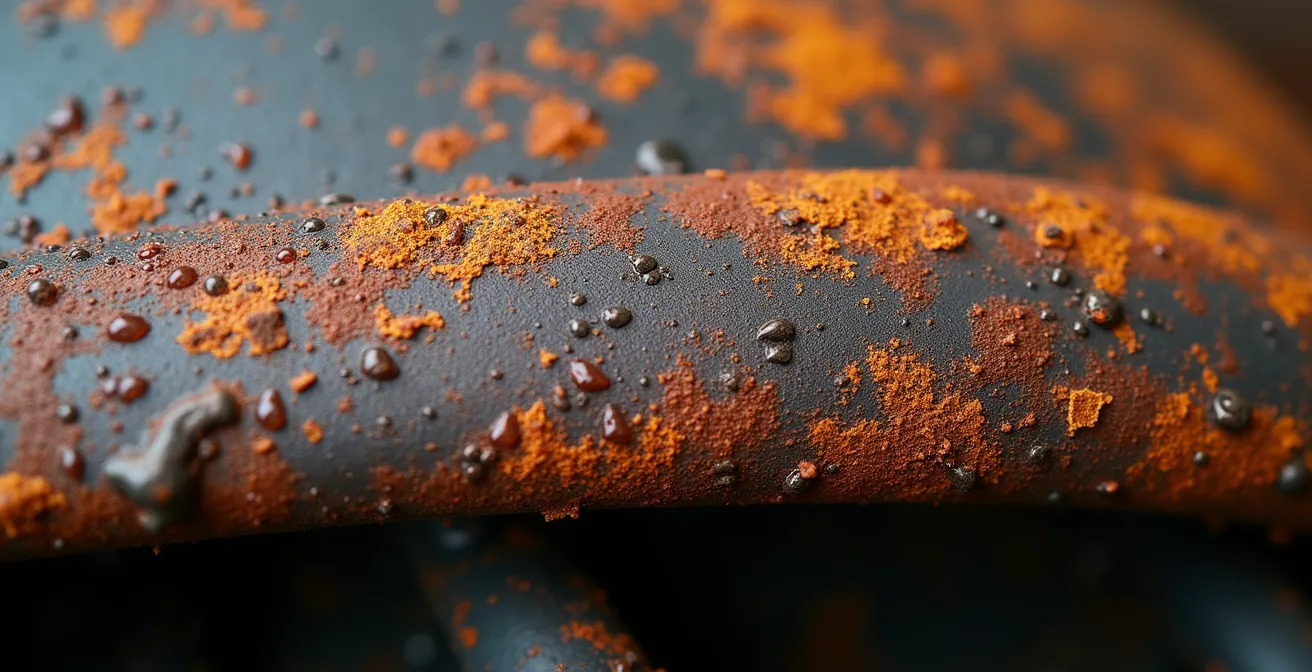
This close-up view reveals the destructive nature of rust on a structural frame rail. What may appear as minor surface corrosion can hide deep, flaking metal that has lost its mechanical strength, rendering the vehicle unsafe. It’s a stark reminder that when it comes to Canadian cars, what you can’t see is often what matters most.
Key Takeaways
- Liability is Final: Proper ownership transfer with a Bill of Sale at your provincial ministry is the only way to end your legal responsibility for a vehicle.
- Value is Variable: Your car’s worth depends on scrap metal prices, part condition, and your choice between scrapping, parting out, or donating for a tax credit.
- Environmental Compliance is Mandatory: Never handle hazardous materials like AC refrigerant yourself. Leave this to certified auto recyclers who are legally required to depollute the vehicle.
Rustproofing 101: How to Preserve Mechanical Strength Against Road Salt?
For Canadian drivers, particularly those in the Rust Belt, rustproofing is not a luxury; it is essential maintenance for preserving a vehicle’s mechanical strength and resale value. The constant assault of road salt during winter months accelerates corrosion, which can compromise critical components like the undercarriage, frame rails, and brake lines. A proactive rustproofing strategy is the most effective defence. There are several methods available, each with its own costs, benefits, and application frequencies. Understanding these options allows you to choose the best protection for your vehicle and driving conditions.
The most common and trusted method in high-salt regions is an annual oil-based spray. This treatment involves applying a light, self-healing oil that creeps into seams and crevices, displacing moisture and neutralizing road salt. Because it remains fluid, it can re-seal itself if scratched, offering continuous protection. Its main drawback is that it needs to be reapplied every year to remain effective. Another popular option is a permanent undercoating, often a tar-based or rubberized sealant. This provides a hard, durable barrier against impacts and abrasion. While it has a higher upfront cost and doesn’t require annual reapplication, it can chip or crack over time, potentially trapping moisture against the metal and accelerating rust if not maintained. Electronic rust inhibitors are also marketed, but most industry experts and studies have found them to be largely ineffective for automotive use.
Effective rustproofing must cover all vulnerable areas. The undercarriage is the most exposed part of the vehicle and requires the most attention. Other critical areas include the wheel wells, which are constantly pelted by road debris; the frame rails, which are the backbone of the vehicle; the exhaust system; and the thin metal of brake and fuel lines. A thorough application by a reputable shop will ensure these hidden spots are protected, preserving the structural integrity of your vehicle against the inevitable corrosion of Canadian winters.
By applying a proactive rustproofing strategy and following the correct legal and environmental procedures at the end of your vehicle’s life, you are taking full responsibility as a Canadian car owner. The next logical step is to assess your current vehicle’s condition and decide on the best course of action, whether it’s preventative maintenance or responsible disposal.