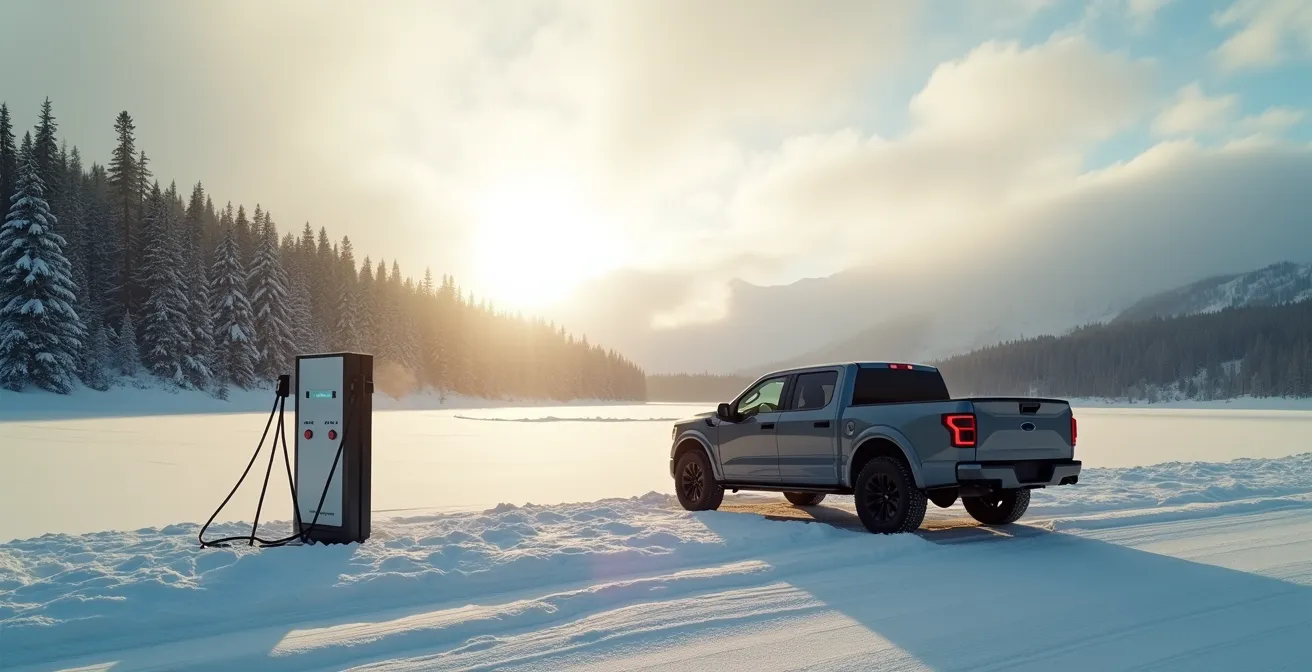
Yes, going fully electric is viable in rural Canada, but only if you abandon the gasoline mindset and adopt a new « energy management » approach to driving.
- Winter range loss is significant but manageable with strategies like preconditioning and localized heating.
- A Level 2 home charger is not a luxury; it’s a fundamental requirement for rural EV ownership.
Recommendation: Prioritize installing a Level 2 charger and choosing an EV with a heat pump before you even think about hitting a remote highway in January.
There’s a unique silence on a rural Canadian road at 6 a.m. in January when it’s -30°C. If you live out here, you know it. You also know the comforting roar of a gasoline engine turning over, promising warmth and the ability to get wherever you need to go. The idea of swapping that certainty for a silent, battery-powered vehicle can feel less like an upgrade and more like a high-stakes gamble. You read the brochures with their impressive range numbers, but you’re haunted by the real questions: What happens when that range is cut in half by the cold, and the nearest « fast charger » is 150 kilometres away and possibly broken?
Many articles will tell you about the growing charging network or give you generic tips. They often gloss over the harsh realities that define life outside major urban centres. As an EV specialist living and driving in Northern Ontario, I’ve seen firsthand what works and what leaves you stranded. The truth is that making an EV work in the Canadian countryside isn’t about the car’s maximum range or 0-60 time. It’s about a fundamental shift in mindset. It’s about becoming a master of your own energy ecosystem, understanding the nuances of cold-weather performance, and planning for the worst-case scenario, not just the ideal one.
This isn’t a guide to convince you that EVs are perfect. It’s a realistic breakdown of what it truly takes to make one a reliable partner in rural and remote Canada. We’ll tackle the biggest concerns head-on, from the real-world range you can expect on a frozen highway to the non-negotiable truths about home charging and the myths that need to be put to rest. This is the conversation the dealership might not have with you, based on hard-won experience.
This article dives deep into the practical challenges and solutions for rural EV owners. Explore the sections below to understand the real-world implications of switching to electric in the Canadian cold.
Summary: Going Fully Electric in Rural Canada
- How much range does an EV really lose at -30°C on the highway?
- Why a standard 120V outlet isn’t enough for rural EV owners?
- Is an electric motor’s traction control better on ice than a mechanical 4WD?
- The risks of relying on public chargers in remote parts of the provinces
- How to use seat heaters to extend your driving range by 15%?
- Why the « free » 10km towing limit is useless in rural Canada?
- Why charging to 100% every night is slowly killing your battery range?
- Extending EV Battery Life: Myths vs Reality in Cold Climates
How much range does an EV really lose at -30°C on the highway?
This is the number one question, and the answer isn’t simple. Forget the official range sticker on the car; in a Canadian winter, it’s a fantasy. The real-world loss depends on a combination of factors: the ambient temperature, your speed, and how you use your climate control. At -30°C on a 100 km/h highway, it’s not uncommon to see a 40-50% reduction in your expected range. This is the figure you must use for your mental calculations, especially on long trips.
Why is the loss so dramatic? First, the chemical reactions inside the lithium-ion battery slow down in extreme cold, reducing its ability to discharge power efficiently. Second, and more significantly, is cabin heating. Unlike a gasoline car that uses waste heat from the engine, an EV has to generate heat from the battery, typically with a power-hungry resistive heater or a more efficient (but still demanding) heat pump. Keeping the cabin at a comfortable 20°C when it’s -30°C outside is a massive energy drain.
Authoritative testing provides a solid baseline. For instance, CAA’s comprehensive winter testing revealed that EVs experience a range loss between 14% and 39% in moderately cold temperatures of -7°C to -15°C. When you push that to -30°C or colder, the losses climb even higher. It’s crucial to understand this isn’t a defect; it’s physics. Your trip planning must account for it, assuming you have roughly half your summer range to be safe.
Why a standard 120V outlet isn’t enough for rural EV owners?
Relying on a standard 120V wall outlet (Level 1 charging) for your EV in rural Canada is a recipe for frustration and failure. While it might suffice for a plug-in hybrid with a small battery or an urban driver with a short commute, it’s completely inadequate out here. A Level 1 charger typically adds only 4 to 8 kilometres of range per hour. If you arrive home with a depleted battery after a long drive in the cold, it could take two to three full days to recharge. This isn’t a viable daily solution.
Investing in a 240V Level 2 charger is not an optional upgrade; it is a fundamental piece of infrastructure for any rural EV owner. A Level 2 charger can replenish 40 to 60 kilometres of range per hour, meaning even a completely drained battery can be fully charged overnight. This transforms the ownership experience from one of constant « range anxiety » to one of confidence, knowing you start every day with a full « tank. »
The cost, however, is a serious consideration that goes beyond the price of the charger itself. While you can find charging units for under $1,000, the installation is where the real costs lie for rural properties. In Canada, homeowners typically spend between $2,000 to $6,800 for a complete Level 2 installation. This can be even higher in rural areas due to specific challenges:
- Electrical Panel Upgrades: Many older farmhouses or rural homes have 60-amp or 100-amp panels that can’t handle the load of a Level 2 charger, requiring a costly upgrade ($2,500+).
- Trenching: If your parking is in a detached garage, barn, or outbuilding, you’ll need to run wiring underground, which can cost $50 or more per foot.
- Travel Costs: Certified electricians may charge extra for service calls to remote locations.
- Permits and Inspections: These fees vary by municipality but add to the bottom line.
Is an electric motor’s traction control better on ice than a mechanical 4WD?
This is a topic of much debate around the woodstove. Many rural drivers are deeply loyal to their mechanical 4-wheel-drive systems, and for good reason—they are a known, trusted technology. However, the traction control in a modern all-wheel-drive (AWD) EV operates on a completely different principle, and in many situations, it is demonstrably superior, especially on sheer ice.
A mechanical 4WD system relies on a transfer case and differentials to distribute power. When a wheel slips, the system has to mechanically detect the slip and react by engaging clutches or brakes to redirect torque. This process, while fast, has inherent latency. An electric AWD system, particularly one with dual motors, has no mechanical linkage between the front and rear axles. Each motor can be controlled independently by a computer that can monitor and adjust wheel speed thousands of times per second. This means it can detect and correct for a slip before a human driver could even perceive it.
This paragraph introduces the concept of EV traction on ice. The illustration below visualizes the precise grip a modern system can achieve.

The result on a patch of black ice is profound. Instead of the lurch or shudder you might feel in a traditional 4×4 as it reacts to slip, the EV system feels unnervingly smooth. It minutely modulates power to maintain traction, often pulling you through a slippery patch with no drama. Paired with a quality set of winter tires (which are non-negotiable), an AWD EV provides a level of confidence on icy roads that can surprise even the most seasoned winter driver. It’s a different kind of control—less about brute force and more about computational precision.
The risks of relying on public chargers in remote parts of the provinces
In the city, a broken public charger is an inconvenience. In rural Canada, it’s a potential survival situation. The public charging network is often marketed as a rapidly expanding safety net, but out on the long, lonely stretches of highways like the Trans-Canada in Northern Ontario or the Yellowhead in the Prairies, that net has massive holes. This is the « Dead Zone » risk: relying on a single charger in a remote town only to find it out of service.
Journalist Mark Richardson from The Globe and Mail experienced this firsthand on a 3,000 km road trip through Ontario. He discovered the Petro-Canada fast charger in Nipigon—a critical link on the north shore of Lake Superior—had been broken for months. This is not an isolated incident. Chargers in remote locations face harsh weather, occasional vandalism, and a lack of on-site technicians, leading to extended downtimes. Unlike a gas station, there isn’t another option just down the road. The next charger could be 200 kilometres away, far beyond your remaining range.
The federal government is aware of these gaps. In its own literature about EV availability standards, The Government of Canada even acknowledges that plug-in hybrids (PHEVs) are a valuable « bridge » technology for Canadians in rural and remote regions until the charging infrastructure is more robust and reliable. This is a tacit admission that for now, relying solely on public chargers for long-distance travel in these areas is a significant gamble. The core of the rural EV mindset is to treat public chargers as a bonus, not a guarantee. Your primary plan should always revolve around starting with a full charge from home and having enough range to reach your destination and return, or at least reach a populated area with multiple charging options.
How to use seat heaters to extend your driving range by 15%?
This isn’t a gimmick; it’s one of the most effective strategies for preserving battery life in the winter. As we’ve established, heating the entire cabin of your vehicle is one of the single biggest energy drains on an EV’s battery in cold weather. Think about it: you’re trying to heat a large, poorly insulated glass and metal box to 20°C while the outside is -20°C. That takes a tremendous amount of power.
The solution is to adopt a « localized heat » strategy. Your body only feels the temperature of the air and surfaces it’s in direct contact with. Heated seats and a heated steering wheel use a fraction of the energy of the main cabin heater because they transfer heat directly to you through conduction. Recurrent’s research confirms that cabin heating is a primary driver of winter range loss. By turning the main cabin heat down to a minimal setting (e.g., 10-15°C, just enough to keep the windows from fogging) and relying on your seat and steering wheel heaters for personal comfort, you can drastically reduce the load on the battery.
Dressing appropriately is part of this strategy. A good winter jacket, gloves, and a hat (or toque, as we say) allow you to be perfectly comfortable with this method. It’s about shifting from the mindset of creating a rolling living room to that of an efficient, comfortable cockpit. The potential savings are significant, often in the range of 10-15% of your total battery capacity over a long drive. That could easily be an extra 30-50 kilometres of range—more than enough to get you to the next town.

Your Winter Range Optimization Checklist
- Precondition: Always warm the cabin and battery while the car is still plugged in. You’ll start your journey with a warm interior and a full battery.
- Clear Snow and Ice: Remove all snow from the vehicle before driving. It reduces weight and improves aerodynamics, both of which save energy.
- Use Localized Heat: Prioritize your heated seats and steering wheel. Set the main cabin thermostat to a lower temperature.
- Park Indoors if Possible: A warmer battery is a more efficient battery. Parking in a garage, even an unheated one, can make a significant difference.
- Check Tire Pressure: Cold air causes tire pressure to drop, increasing rolling resistance. Ensure your tires are inflated to the recommended PSI.
Why the « free » 10km towing limit is useless in rural Canada?
Most standard roadside assistance plans, including those offered by automakers, come with a basic towing package, often covering the first 10 or 15 kilometres. In a city, this is usually enough to get you to a nearby garage. In rural Canada, it’s virtually useless. When you run out of charge on a remote stretch of highway, the nearest town with a charger—let alone a qualified EV technician—could be 100, 200, or even more kilometres away.
Furthermore, most EVs cannot be towed with their drive wheels on the ground using a traditional tow truck. Doing so can damage the electric motors and drivetrain. They require a flatbed tow truck, which is more expensive and can be harder to find in remote areas. A 10km tow limit won’t even cover the distance to get off a major highway in many parts of the country. The cost for a long-distance flatbed tow can be astronomical, easily running into hundreds or even thousands of dollars.
This is where planning and having the right level of roadside assistance becomes a critical part of the rural EV ownership system. Basic plans won’t cut it. You must upgrade to a premium plan that offers long-distance towing.
Case Study: The Northern Ontario Towing Reality
Consider the stretch of Highway 11 between Nakina and Nipigon in Northern Ontario. For hundreds of kilometres, EV charging infrastructure is non-existent. If an EV were to run out of charge or break down here, a flatbed tow would be required to get to the nearest service centre in either Geraldton or Thunder Bay. Both are well over 100km away, far exceeding any standard roadside assistance coverage and resulting in a massive out-of-pocket expense for the driver.
This reality underscores the need for a robust safety net. Before purchasing an EV for rural use, your first calls should be to your insurance provider and organizations like CAA to secure a plan (like CAA Plus or Premier) that provides at least 200-300km of towing coverage. It’s a non-negotiable cost of doing business safely with an EV outside of urban centres.
Why charging to 100% every night is slowly killing your battery range?
One of the biggest mistakes new EV owners make is treating their car like a smartphone, plugging it in every night and charging it to 100%. While this seems logical, it’s one of the fastest ways to accelerate the degradation of your expensive lithium-ion battery. A battery is under the most stress when it is at very high or very low states of charge. Consistently pushing it to 100% and leaving it there overnight puts strain on the battery cells, slowly reducing their ability to hold a charge over time.
The golden rule for daily driving and battery longevity is the 80% rule. For your regular day-to-day use—commuting, running errands, visiting neighbours—you should set your car’s maximum charge limit to 80%. Almost every EV on the market allows you to do this easily through its infotainment screen or a connected app. This simple habit keeps the battery in its happiest, least-stressed state, significantly prolonging its life and preserving its maximum range for years to come.
Of course, you bought your car to use its full range when needed. The key is to only charge to 100% strategically, right before you need it for a long road trip. Plan your charge to finish just before you are scheduled to leave. This minimizes the amount of time the battery sits at a high state of charge. The best practice for optimal battery health in the Canadian winter involves a few key habits:
- Set Daily Limit to 80%: This is your default for all non-trip charging.
- Charge to 100% Only for Long Trips: Time the charge to complete an hour or so before your departure.
- Keep Plugged in During Extreme Cold: Even if not actively charging, leaving the car plugged in allows the battery thermal management system to run off wall power, keeping the battery warm without draining itself.
- Use Scheduled Charging: Set your car to start charging in the early morning hours so it finishes right before you leave for work, ensuring the battery is warm and ready to go.
Key Takeaways
- Winter range loss of 40-50% is realistic; plan your trips using half your car’s advertised range as a safe baseline.
- A Level 2 (240V) home charger is a non-negotiable, fundamental requirement for any rural EV owner in Canada.
- The EV « system of living » requires a mindset shift: prioritize home charging, have premium towing coverage, and treat public chargers as a bonus, not a guarantee.
Extending EV Battery Life: Myths vs Reality in Cold Climates
There are many myths surrounding EVs and cold weather, often used as reasons why they’ll « never work » in Canada. The biggest one is that winter permanently damages the battery. This is false. While cold temperatures temporarily reduce performance and range, they do not cause long-term harm to the battery’s health or capacity. Once the weather warms up, your range will return to normal.
No, any range loss from winter weather is temporary and there is no long term detriment to your battery.
– Recurrent Auto, Winter EV Range Loss Study 2024
Another myth is that cold-climate countries can’t achieve high EV adoption. A quick look at Norway, a country known for its harsh winters, dispels this entirely. In fact, as close to 90% of new car sales in Norway are ZEVs. This proves that with proper infrastructure and consumer adaptation, EVs are perfectly viable in cold climates.
The reality is that manufacturers make different design choices that affect winter performance. For example, some drivers of GM EVs like the Cadillac Lyriq have noted higher-than-expected winter range loss, despite having an efficient heat pump. This is because GM made a conscious decision to optimize for passenger comfort, programming resistive heaters to kick in at warmer temperatures than competitors. This ensures a toasty cabin but uses more energy. It’s not a flaw, but a trade-off—one that highlights the importance of understanding the specific characteristics of your chosen vehicle.
Ultimately, living with an EV in rural Canada is entirely possible and, for many, deeply rewarding. It requires you to be an informed and proactive owner. It means accepting the physics of winter, investing in the right home infrastructure, and adopting a new, more deliberate way of planning your travel. It’s a different system of living, but it’s one that works.
Armed with this realistic knowledge of the challenges and proven strategies, you are now in a much better position to decide if an electric vehicle is the right choice for your specific rural Canadian reality.
Frequently Asked Questions About Going Fully Electric in Rural Canada
What’s the typical cost for long-distance EV towing in rural Canada?
Flatbed towing (required for most EVs) typically costs $4-5 per kilometer plus hookup fees, easily exceeding $500 for remote breakdowns.
Which roadside assistance plans cover extended EV towing?
CAA Plus and Premier plans offer 200-300km coverage, essential for rural EV drivers where the nearest service center may be hours away.
Why is finding a qualified EV technician challenging in rural areas?
Certified EV technicians are concentrated in urban centers, meaning rural breakdowns often require towing to distant dealerships.