
At -40°C, following standard fluid check procedures can actively damage your vehicle; the key isn’t just using ‘winter’ products, but understanding the altered physics governing your car’s liquids.
- Fluids like washer fluid can freeze on your windshield *because* of highway wind-chill, not just the ambient temperature, due to methanol evaporation.
- Reading your oil dipstick when the engine is completely cold gives a dangerously inaccurate reading, leading to potential overfilling and engine damage.
Recommendation: Treat every extreme cold-weather check as a precise scientific measurement, not a routine chore, to ensure your vehicle’s survival.
The sound is unmistakable to any driver on the Canadian Prairies or in the North: the strained, groaning crank of an engine fighting against the bitter cold of a -40° Celsius morning. In these temperatures, your vehicle isn’t just ‘cold’; it has entered a state where the fundamental laws of fluid dynamics are altered. We’re told to check our fluids, use winter-grade products, and hope for the best. But this advice often fails to address the counter-intuitive phenomena that occur at this thermal threshold.
Common wisdom falls short because it treats -40°C as just a lower number on the thermometer. It isn’t. It’s a point where oil can become as thick as honey, where fuel struggles to vaporize, and where even a brand-new battery can lose the majority of its power. The standard checks and maintenance habits you rely on for the rest of the year can become misleading or even destructive. Ignoring these changes isn’t just an inconvenience; it’s a risk to your engine, transmission, and safety systems.
But what if the real key to surviving extreme cold wasn’t just about using the right products, but about understanding the *’why’* behind the failures? This guide abandons the platitudes. Instead, we will delve into the specific physics of what happens to your vehicle’s most critical fluids at -40°C. We will explore the science of viscosity, cavitation, and chemical reactions that standard manuals overlook. This isn’t just another checklist; it’s a new mental model for cold-weather maintenance.
By understanding these principles, you can move from reactive repairs to proactive adaptation, ensuring your vehicle doesn’t just start, but operates safely and reliably through the harshest conditions Canada can offer. This article will break down the specific challenges and provide scientifically-grounded strategies for each major fluid system.
Summary: A Scientific Guide to Vehicle Fluids at -40°C
- Why « -40°C » fluid freezes on your windshield at highway speeds?
- How to prevent gas line freeze-up without using additives?
- Why does your steering whine on cold mornings?
- Hot vs Cold: Reading the dipstick correctly to avoid overfilling
- DOT 3, 4, or 5.1:Why does an ECU remap void your powertrain warranty instantly?
- Green, Orange, Blue: What happens if you mix coolant types?
- Does parking in a heated garage accelerate salt corrosion?
- The « Severe Service » Trap: Why Your Manual Says You Need More Oil Changes
Why « -40°C » fluid freezes on your windshield at highway speeds?
It’s a frustrating and dangerous paradox of Canadian winter driving: you spray your windshield with washer fluid rated for -45°C, only to have it flash-freeze into a sheet of opaque ice. This isn’t a product defect; it’s a lesson in fluid dynamics and thermodynamics. The freezing point on the bottle applies to the fluid in its static, sealed state. Once it hits your windshield at 100 km/h, the physics change dramatically.
Winter washer fluid’s anti-freeze property comes from its alcohol content, typically methanol. Methanol has a much lower freezing point than water, but it also evaporates very quickly, especially when spread into a thin layer and hit by a high-velocity stream of frigid air. This rapid evaporation creates a powerful wind-chill effect on the fluid itself. The methanol « flashes off, » leaving behind a high concentration of water that can no longer resist the ambient -40°C temperature and instantly freezes on the glass.
The problem is exacerbated because the washer nozzles and lines under the hood are exposed to the direct cold. So, even if the fluid in the reservoir is liquid, the fluid in the lines can be near its freezing point before it even gets sprayed. Research confirms that even premium winter washer fluid can freeze when the alcohol component evaporates under highway conditions. To combat this, you must manage both temperature and fluid composition.
The solution is a multi-step approach. First, always use a high-quality, over-spec fluid rated for -49°C if possible, as it contains a higher initial concentration of methanol. Before driving, prime the lines by spraying for a few seconds while stationary; this pushes the colder fluid out and pulls warmer fluid from the reservoir. If freezing does occur on the highway, turn your defroster to its highest heat setting and direct all airflow to the windshield. Then, continuously flood the windshield with fluid. The sheer volume and latent heat from the defroster will eventually overwhelm the freezing effect and clear your view.
How to prevent gas line freeze-up without using additives?
The old advice to add gas line antifreeze (isopropanol or other de-icing agents) to your tank every winter is largely obsolete for most Canadian drivers. Modern gasoline formulations sold in Canada, such as Petro-Canada’s « WinterGas » or Shell’s V-Power, already contain sophisticated detergent and de-icing packages designed to manage moisture in the fuel system. The real enemy isn’t the fuel itself, but the air in your gas tank.
The mechanism for gas line freeze-up is simple thermodynamics. When your vehicle sits overnight in -40°C weather, the metal and plastic of the fuel tank become extremely cold. Any air inside the tank also cools, and its ability to hold moisture plummets. This causes water vapour to condense into liquid droplets on the cold, inner surfaces of the tank. Because water is denser than gasoline, these droplets sink to the bottom and travel into the fuel lines and filter, where they can freeze into an ice plug, starving the engine of fuel.
The image below illustrates how empty space in a fuel tank becomes a « condensation factory » in extreme cold.
As you can see, a fuller tank has significantly less surface area and air volume (headspace) available for condensation to occur. This is the single most effective way to prevent gas line freeze-up without additives. By keeping your tank at least half-full at all times during the deep-freeze, you mechanically limit the amount of water that can form in the first place. This simple habit is far more effective than relying on a small bottle of additive to treat a tankful of water.
For drivers in extreme climates like Manitoba or the territories, this isn’t just a recommendation; it’s a critical survival strategy. While the specialized winter fuel blends provide an excellent layer of chemical protection, the best defence is a physical one: minimize the air, minimize the condensation, and you minimize the risk of being stranded by a frozen fuel line.
Why does your steering whine on cold mornings?
That groaning or whining sound your car makes when you first turn the steering wheel on a -40°C morning is the sound of your power steering pump in distress. This noise is a direct result of a phenomenon called cavitation, and it’s caused by the extreme thickening of your power steering fluid. At these temperatures, conventional fluid can have the consistency of molasses, and the pump simply cannot draw it in fast enough to pressurize the system.
When the pump spins and is unable to pull in the thick fluid, it creates pockets of vacuum. The pressure inside these pockets drops so low that the fluid literally begins to boil at the cold temperature, forming vapour bubbles. As these bubbles travel through the pump to a higher-pressure area, they violently collapse or implode. It is this continuous cycle of bubble formation and collapse that you hear as a loud whine. This isn’t just a noise; it’s a destructive process that aerates the fluid (reducing its hydraulic efficiency) and can cause significant wear on the internal components of the pump and steering rack.
Ignoring this can be a costly mistake. While the noise may fade as the engine warms the fluid, the repeated stress can lead to premature failure of seals and the pump itself. The solution is to switch to a full-synthetic power steering fluid. Synthetic fluids have a much higher viscosity index (VI), meaning their thickness changes far less with temperature fluctuations. They remain more fluid at -40°C, allowing the pump to operate smoothly and quietly from a cold start.
The cost-benefit analysis is clear. A report on cold-weather vehicle effects highlights that investing in a $25 bottle of synthetic fluid can prevent a catastrophic failure of the steering rack and pinion, a repair that can easily exceed $2,000. To prevent cavitation, follow these steps:
- Before winter, check your power steering fluid level and condition. If it’s dark or smells burnt, have it flushed.
- Switch to a full-synthetic power steering fluid that meets your vehicle’s specifications.
- On cold starts, allow the engine to idle for at least 30-60 seconds before you start driving to give all fluids a chance to warm and circulate.
- Avoid sharp, aggressive steering movements for the first few minutes of driving.
Hot vs Cold: Reading the dipstick correctly to avoid overfilling
Checking your engine oil on a frigid Canadian morning seems like a responsible act of winter maintenance, but at -40°C, it can be one of the most misleading things you can do. The common practice of checking the oil on a cold engine is wrong and potentially dangerous in extreme cold. Oil, like all fluids, contracts as it cools. Furthermore, its viscosity increases dramatically, causing it to cling to internal engine surfaces and drain back into the pan extremely slowly.
When you pull the dipstick from a « cold-soaked » engine at -40°C, the reading will be artificially low. This is because a significant amount of oil is still coating the upper parts of the engine or is so thick in the pan that it hasn’t fully settled. Mistaking this for a low oil level and adding more is a critical error. Overfilling the crankcase can lead to the crankshaft whipping the oil into a foam. This aerated oil cannot be properly pumped, leading to oil starvation in critical components like bearings and lifters. The extra stress can also damage seals and gaskets.
The only reliable method to check your oil at these temperatures is on a fully warmed engine. This means driving the vehicle for 15-20 minutes to bring the oil up to its full operating temperature (around 100°C). Once at temperature, park on level ground, shut the engine off, and wait 5-10 minutes. This allows the now-hot, thin oil to drain completely back into the oil pan for an accurate measurement. Choosing the right oil is also critical, as different viscosities are required for optimal cold-flow performance.
| Temperature Range | Recommended Oil Grade | Cold Start Performance |
|---|---|---|
| 0°C to -15°C | 10W-30 | Adequate flow |
| -15°C to -30°C | 5W-30 | Good cold flow |
| Below -30°C | 0W-20 or 0W-30 | Optimal cold flow |
Using a 0W-rated synthetic oil is non-negotiable for consistent starts below -30°C. The ‘0W’ indicates the oil’s viscosity at winter temperatures, and a lower number means it flows better when cold, reducing drag on the engine and ensuring faster lubrication on startup.
DOT 3, 4, or 5.1:Why does an ECU remap void your powertrain warranty instantly?
This title combines two separate, high-stakes topics that are often misunderstood in the context of vehicle performance and maintenance, especially in extreme climates. Let’s deconstruct them: the integrity of your brake fluid system and the risks of engine tuning. Both are critical at -40°C, and a mistake in either can have catastrophic consequences.
First, your brake system. Brake fluids (DOT 3, 4, and 5.1) are hygroscopic, meaning they are designed to absorb moisture from the atmosphere. This is a feature, not a bug; it prevents water from pooling and boiling in the brake lines under heavy use. However, in extreme cold, this absorbed water becomes a liability. If the water content in your brake fluid is too high (typically over 3%), its freezing point rises. At -40°C, this moisture can form ice crystals within the brake lines or, more critically, in the sensitive anti-lock brake system (ABS) module. These ice crystals can damage delicate seals or create a blockage, leading to a spongy pedal or complete brake failure.
Second, the Engine Control Unit (ECU) remap. An ECU remap alters the factory software that controls engine parameters like fuel delivery and ignition timing. While this can increase horsepower, a generic, off-the-shelf « tune » can be disastrous in a Canadian winter. Modern engines have complex ‘cold start enrichment’ maps that precisely adjust the air-fuel ratio to ensure a clean start in frigid temperatures. As gasoline vaporizes very inefficiently at -40°C, the engine needs a much richer mixture to fire. Expert Canadian tuners, particularly in places like Calgary and Edmonton, develop specific ‘cold start maps’ for their tunes. A generic online tune often lacks this crucial programming, which can lead to misfires, engine flooding, or a no-start condition. When a dealer sees a non-factory ECU flash during a warranty claim for a damaged engine, they will instantly void the powertrain warranty, as they cannot guarantee the engine was operating within its designed safe parameters.
In essence, both scenarios involve altering the vehicle’s carefully balanced systems. Neglecting to flush your brake fluid is a passive alteration that allows water contamination. Remapping the ECU is an active alteration that overwrites safety protocols. Both are invisible changes that can lead to sudden, critical failure in the unforgiving environment of a -40°C day.
Green, Orange, Blue: What happens if you mix coolant types?
The colour of your engine coolant is not a style choice; it’s a chemical identifier for the specific corrosion-inhibitor technology used. Mixing different types of coolant is one of the most damaging—and common—maintenance mistakes. It doesn’t just dilute the protection; it can trigger a chemical reaction that creates a thick, gelatinous sludge or solid particles (precipitate) in your cooling system.
There are three main families of coolant technology:
- Inorganic Additive Technology (IAT): The traditional, bright green coolant. It uses silicates and phosphates for fast-acting corrosion protection but has a shorter service life (2-3 years).
- Organic Acid Technology (OAT): Often orange, yellow, or dark green. It uses organic acids for long-lasting protection (5+ years) but is slower to act. It is not compatible with the materials in older cooling systems.
- Hybrid Organic Acid Technology (HOAT): A blend of the two, using organic acids with a small amount of silicates. It comes in various colours like pink, red, blue, or turquoise, and is specific to certain manufacturers (e.g., P-HOAT for Honda, SI-OAT for European makes).
When you mix an IAT (green) coolant with an OAT (orange) coolant, the silicates and phosphates can react with the organic acids. This reaction causes the inhibitors to « drop out » of the solution, forming a gel or abrasive solid particles. This sludge clogs the narrow passages in your radiator, heater core, and engine block, leading to overheating, heater failure, and water pump damage. The table below shows a compatibility guide for common Canadian vehicles.
| Vehicle | Coolant Type | Color | Compatible Brands at Canadian Tire/NAPA |
|---|---|---|---|
| Ford F-150 | OAT | Orange/Yellow | Motorcraft Premium Gold, Prestone Extended Life |
| Honda Civic | P-HOAT | Blue | Honda Type 2, Prestone Asian Vehicle |
| Toyota RAV4 | HOAT | Pink/Red | Toyota Long Life, Prestone All Vehicles |
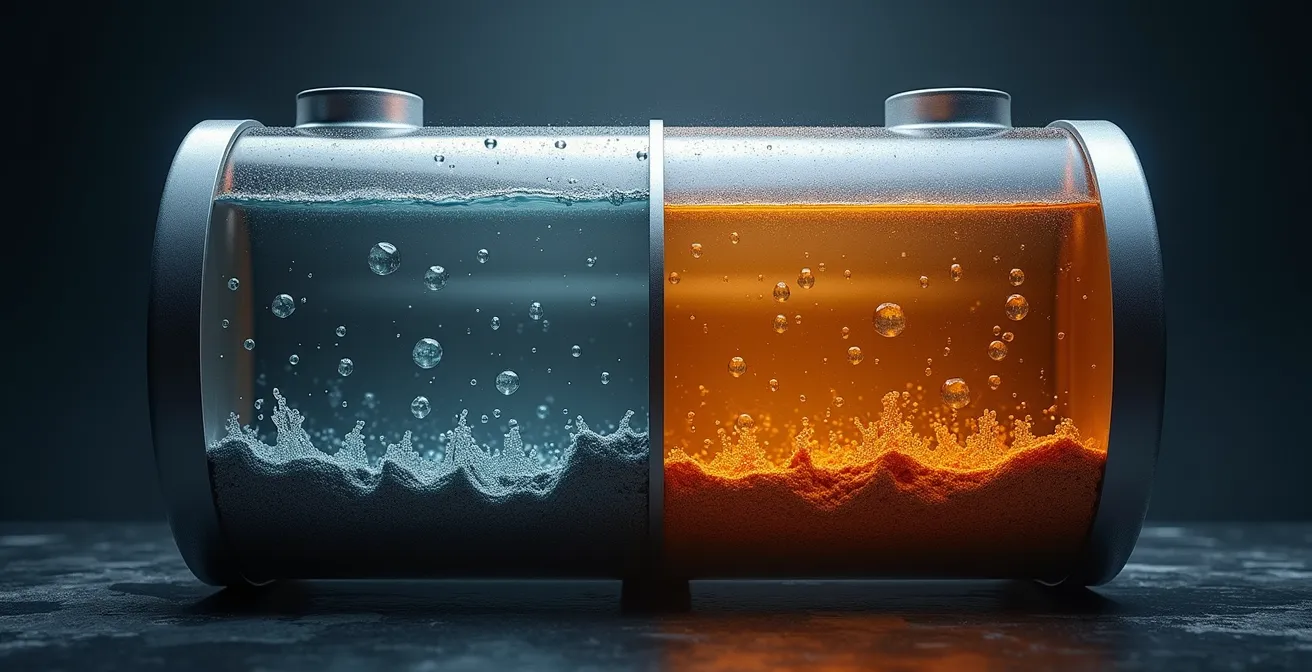
The visual below demonstrates the destructive precipitation that occurs when incompatible coolants are mixed. At -40°C, this chemical sludge can become even thicker, completely blocking flow and leading to rapid engine overheating, even in extreme cold.

The rule is absolute: never mix coolant types or colours. If you need to top up your coolant and are unsure of the type, use distilled water in an emergency for a short period, or purchase an « All Makes, All Models » coolant that uses a compatible chemistry. For a proper fill, always use the specific OAT or HOAT coolant recommended by your vehicle manufacturer.
Does parking in a heated garage accelerate salt corrosion?
It’s one of the great debates of Canadian winter: is a warm garage a saviour or a rust-accelerator for your vehicle? The counter-intuitive truth is that parking a salt-caked car in a heated garage can significantly speed up the corrosion process. While a garage protects your car from snow and makes for comfortable morning starts, it also creates the perfect environment for rust to thrive.
Corrosion is a chemical reaction that requires two main ingredients: an electrolyte (saltwater) and a certain amount of heat. When your car is parked outside in -40°C weather, any accumulated snow, ice, and road salt are frozen solid. In this frozen state, the chemical reaction of rust is slowed to a near-standstill. When you bring that same car into a heated garage (e.g., above 0°C), the snow and ice melt, creating a soupy mixture of water and highly corrosive road salts that covers your car’s undercarriage.
The warmth of the garage then acts as a catalyst, dramatically accelerating the rate of this corrosive reaction. You are essentially creating a perfect, warm, saltwater bath for your vehicle’s frame, floor pans, and brake lines every single night. It’s important to note that many Canadian provinces, especially Ontario, Quebec, and the Maritimes, use particularly aggressive de-icing chemicals like calcium chloride and magnesium chloride, which are far more corrosive than traditional rock salt.
This doesn’t mean you should abandon your heated garage. It means you must adopt a rigorous cleaning regimen to counteract the effect. The key is to wash the undercarriage regularly to remove the salt before it has a chance to do its damage in the warm environment. A proactive defence is the only way to enjoy the comfort of a heated garage without sacrificing your vehicle to rust.
Your 5-Point Winter Corrosion Audit
- Points of Contact: List all areas where salt and slush accumulate: wheel wells, rocker panels, undercarriage, behind bumpers, and inside door sills.
- Collecte/Wash Frequency: During salt season, schedule weekly or bi-weekly visits to a wand-wash facility specifically for an undercarriage wash. Note each wash date.
- Coherence/Protection Layer: Before winter, check the condition of your paint’s protective layer. Is there a coat of polymer or carnauba wax? Has professional rustproofing been applied?
- Memorability/Immediate Action: After driving on heavily salted roads, do you have a plan for an immediate rinse of the undercarriage and wheel wells, even if it’s just with a garden hose in the garage?
- Plan d’intégration/Long-Term: Based on your audit, create a prioritized plan. Priority 1 might be immediate undercarriage washes, while Priority 2 could be scheduling a professional rustproofing treatment before next winter.
Key Takeaways
- Fluid physics change at -40°C; standard procedures for checking oil and other fluids become inaccurate and potentially harmful.
- External factors like wind-chill (for washer fluid) and condensation (in the gas tank) are as important as the ambient temperature.
- Mixing coolant chemistries (e.g., green with orange) creates a destructive gel; never mix types or colours.
- The « Severe Service » maintenance schedule is not an option but a necessity for most Canadian drivers due to cold starts and short trips.
The « Severe Service » Trap: Why Your Manual Says You Need More Oil Changes
Buried in the back of every vehicle’s owner’s manual is a maintenance schedule for « Severe Service » or « Severe Driving Conditions. » Many Canadian drivers glance at this and assume it applies to taxi drivers or off-roaders, not their daily commute. This is a dangerous and costly assumption. In the context of a Canadian winter, almost everyone is a severe-service driver.
Automakers define « severe service » with a clear checklist, which includes:
- Driving in temperatures below 0°C.
- Making frequent short trips (under 10-15 km) where the engine does not reach full operating temperature.
- Extensive idling or stop-and-go driving.
A typical Canadian winter day of starting your car at -20°C, driving 8 km to work, and letting it idle to warm up ticks every single box. These conditions are « severe » because they place extraordinary stress on the engine and its fluids. On short trips, the engine oil never gets hot enough to burn off contaminants like fuel and water condensation that have seeped past the piston rings. This moisture-laden oil forms sludge, loses its lubricating properties, and can freeze in oil passages.
Furthermore, cold starts are brutal on the entire electrical system. As temperatures drop, the chemical reactions inside a car battery slow down significantly. Studies show that car batteries lose around 35% of their power at 0°C and up to 60% at -18°C. Simultaneously, the engine oil has thickened, requiring much more power from the starter motor to crank the engine. The battery is at its weakest precisely when the engine needs the most power to start, placing immense strain on the entire system.
The « Severe Service » schedule—which typically recommends halving your oil change interval (e.g., from 10,000 km to 5,000 km)—is not an upsell from your mechanic. It is an engineering directive designed to save your engine from premature wear and failure under the exact conditions most Canadians face for several months a year. Following this schedule is the single most important maintenance adjustment you can make.
Canadian Severe Service Checklist
- Do you live anywhere in Canada other than coastal BC? (If yes, you likely qualify.)
- Are most of your winter trips under 20 km? (If yes, this is a key indicator.)
- Do you often start your car in temperatures below -15°C? (If yes, this puts extreme stress on fluids and battery.)
- If you answered ‘yes’ to two or more of these questions, you should be following your manufacturer’s severe service schedule, which often means halving your standard oil change interval.
Adopting this mindset means recognizing that for a Canadian driver, « severe » is the new normal. Treating your vehicle accordingly is the final piece of the puzzle for ensuring its longevity and reliability in extreme cold.
Begin applying this scientific approach to your winter maintenance today. By moving beyond outdated advice and understanding the unique physical challenges of -40°C, you ensure your vehicle’s reliability through the harshest Canadian conditions.