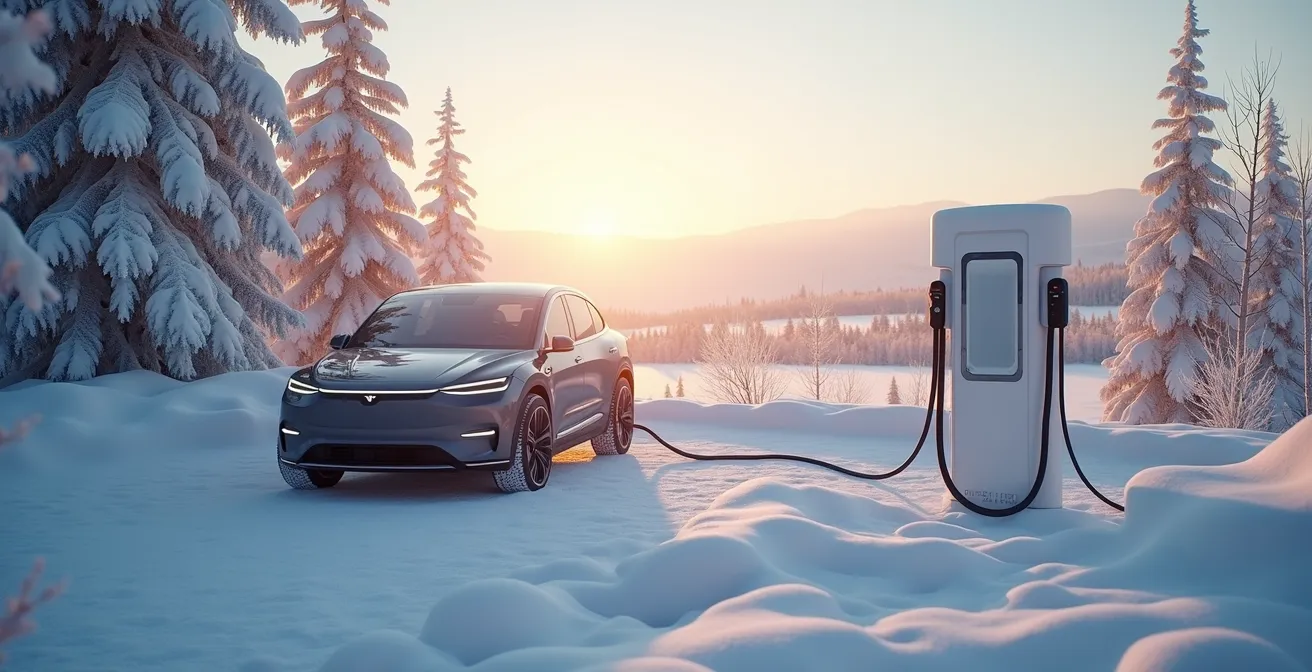
Contrary to popular belief, protecting your EV battery in a Canadian winter isn’t about following rigid rules, but about minimizing its underlying electrochemical stress.
- Charging to 100% or fast-charging are not inherently « bad, » but their impact is amplified by cold, causing irreversible damage like lithium plating.
- Significant range loss when parked isn’t just a leak; it’s your car’s thermal management system actively consuming energy to protect the battery from freezing.
Recommendation: Think like a battery chemist. Instead of just following the « 80% rule, » manage your battery’s State of Charge (SoC) and temperature to keep it in a low-stress state as often as possible.
As an electric vehicle owner in Canada, you’ve likely felt the sting of winter anxiety. You watch your estimated range plummet on the dashboard as temperatures drop, and you hear conflicting advice from every corner: « Never charge to 100%! », « Avoid DC fast chargers! », « Your battery is dying faster in the cold! » For an owner intending to keep their vehicle for the long haul, this noise can be more than confusing; it’s a source of constant worry about the single most expensive component of your car.
Much of the common advice treats the battery like a mysterious black box. But as a battery chemist, I can reassure you that it’s not magic; it’s science. The generic rules of thumb, like the ubiquitous « 80% rule, » are useful starting points, but they often miss the crucial context of chemistry and temperature. They tell you the « what » but rarely the « why. » This lack of deeper understanding can lead to unnecessary stress on your battery, or on you as the owner.
The key to true longevity and peace of mind is not to fear your battery, but to understand its language. The secret lies in managing its electrochemical stress. This guide will move beyond the myths and platitudes. We will explore the chemical reactions happening inside your battery pack during a frigid Manitoba night or a slushy drive through the Rockies. By understanding the science, you can make smarter, more nuanced decisions to genuinely maximize its lifespan and performance for a decade or more.
This comprehensive guide delves into the most pressing questions for Canadian EV owners. We’ll examine charging habits, the truth about fast charging, the causes of winter range loss, and the practical realities of EV ownership in both urban and rural settings. Let’s decode your battery’s behaviour together.
Summary: A Scientific Guide to EV Battery Health in Canadian Winters
- Why charging to 100% every night is slowly killing your battery range?
- Does frequent Supercharging actually degrade the battery significantly?
- Why is your parked EV losing 5% battery per day in the cold?
- The range drop pattern that indicates a warranty claim is needed
- What charge level should you leave your EV at for a month-long trip?
- How much range does an EV really lose at -30°C on the highway?
- Why you should never start an update parked on the street?
- Going Fully Electric in Rural Canada: Is It Viable in 2024?
Why charging to 100% every night is slowly killing your battery range?
Charging to 100% every night isn’t a guaranteed death sentence for your battery, but it does accelerate aging by keeping it in a state of high electrochemical stress. A lithium-ion battery is happiest in the middle of its State of Charge (SoC) window. Think of a full battery like a stretched elastic band; the materials in the anode and cathode are under constant tension. Holding this high-voltage state, especially at high temperatures, promotes side reactions that degrade the electrolyte and reduce the battery’s capacity over time. This is a slow, cumulative process.
However, chemistry matters immensely. Lithium Iron Phosphate (LFP) batteries, increasingly common in standard-range models, are fundamentally more robust than their Nickel Manganese Cobalt (NMC) counterparts. Their chemistry is more stable at high states of charge, and they can endure significantly more charge cycles. In fact, some studies show LFP batteries have a 2 to 4 times longer cycle life than NMC batteries, making them more tolerant of frequent charging to 100%. For LFP owners, a full charge for daily use is less of a concern, though for long-term health, avoiding it when not needed is still best practice.
For owners of NMC batteries, which are common in long-range and performance EVs, consistently charging to 100% and leaving it there overnight is a habit worth breaking. It’s the equivalent of a low-grade, chronic stressor. The most effective strategy for longevity is to set your daily charge limit to 80% or 90%. This simple action keeps the battery out of its highest stress state, significantly slowing down the chemical degradation that permanently robs you of range. Only charge to 100% immediately before you embark on a long trip where you need the full range.
Does frequent Supercharging actually degrade the battery significantly?
Frequent DC fast charging, or Supercharging, is another source of anxiety, but the reality is more nuanced than the myth. The primary degradation mechanisms from fast charging are heat (thermal stress) and high current (physical stress). Pushing a large amount of energy into the battery quickly generates significant heat. Your vehicle’s Battery Management System (BMS) works hard to cool the pack, but repeated exposure to high temperatures will inevitably accelerate the aging of battery components. This is why you hear the cooling fans ramp up aggressively during a fast-charging session, especially on a warm day.
The second factor is physical stress on the anode. During high-current charging, lithium ions can accumulate on the surface of the anode faster than they can be absorbed, a phenomenon known as lithium plating. This is particularly dangerous in the cold, as the chemical reactions slow down dramatically. Lithium plating is irreversible; it permanently removes lithium from the cycle, reducing capacity, and can even grow into dendrites that pose a safety risk. This is the single biggest reason why fast-charging a very cold battery is a terrible idea—the BMS will severely limit the speed anyway to prevent exactly this from happening.

As the image of the frosted connector vividly shows, the intersection of cold and charging is a critical moment. Modern EVs have sophisticated thermal management to mitigate these risks. When you navigate to a DC fast charger, the car automatically begins to « precondition »—warming the battery to an optimal temperature so it can accept a high-speed charge safely and efficiently. Bypassing this step by arriving with a cold-soaked battery will result in painfully slow charging speeds as the BMS protects itself. Therefore, while occasional fast charging is perfectly fine and a necessary part of EV ownership, relying on it daily, especially in winter without proper preconditioning, is a surefire way to induce unnecessary electrochemical stress and accelerate degradation.
Why is your parked EV losing 5% battery per day in the cold?
Waking up to find your EV has lost several percentage points of charge overnight in the dead of winter can be alarming. This « phantom » or parasitic drain isn’t a sign of a faulty battery; it’s the car actively protecting itself. Unlike an internal combustion engine, an EV battery’s performance and health are critically dependent on its temperature. Below freezing, the electrochemical reactions that allow charging and discharging slow down dramatically. To prevent the battery from becoming a frozen, unresponsive brick, the thermal management system kicks in.
This system uses a small amount of energy from the high-voltage battery itself to circulate fluid and run heaters or a heat pump to keep the battery pack within a safe, albeit cold, operational temperature range. This is not a bug; it’s a crucial feature. The energy consumed depends directly on the ambient temperature—the colder it gets, the more energy the car uses to stay warm. A loss of 1-2% on a cool night is normal, but at -20°C or below, a loss of 5% or even more per 24 hours is entirely plausible as the system works overtime.
As a leading industry group notes, modern EVs make it easy to manage cold-weather comfort without draining the main battery. According to Albert Gore III of the Zero Emission Transportation Association, as cited by CBC News:
A great feature of nearly every EV on the market now is that it’s very easy to use your phone to turn on the heat five minutes before you get in the car.
– Albert Gore III, Zero Emission Transportation Association
This pre-heating, or preconditioning, while the car is still plugged in, uses power from the grid, not your battery, to warm both the cabin and the battery. This means you get into a warm car with a nearly full battery that’s already at a more efficient operating temperature. The key takeaway is that parasitic drain in the cold is a sign of a healthy, self-protecting system, not a defect.
The range drop pattern that indicates a warranty claim is needed
It’s crucial to distinguish between normal winter range loss and a genuine battery defect. A significant drop in available range during a Canadian winter is expected and not a warranty issue. The key is to look for the right degradation signature. Normal, temperature-induced range loss is temporary. Your full range should return as the weather warms up in the spring. Analysis of thousands of vehicles confirms this pattern.
For example, a comprehensive analysis of 18 popular EV models by Recurrent found that even at temperatures between -7°C and -1°C, vehicles retained an average of 70% of their rated range. This temporary reduction is due to the cold’s impact on battery chemistry and the increased use of cabin heating. This is the baseline you should expect. A 30-40% drop in deep cold is normal. A sudden, sharp drop in capacity that does not recover as temperatures rise, however, could be a sign of a problem.
A pattern that may warrant a warranty claim is an abrupt loss of a significant percentage of range that persists in all temperatures, or a « bricked » battery that won’t accept a charge at all. Another red flag is a specific error message on your dashboard indicating a battery fault. Most manufacturers’ battery warranties cover degradation below a certain threshold, typically 70% of original capacity, within an 8-10 year or specific mileage window. If you suspect a problem, the first step is to document everything. Track your range and state of charge over several weeks across different temperatures. Note any error codes. Then, contact your dealership’s service center. They have diagnostic tools that can assess the State of Health (SoH) of individual cell modules within the pack and determine if the degradation is abnormal and covered under warranty.
What charge level should you leave your EV at for a month-long trip?
Leaving your EV parked for an extended period, like a month-long vacation, requires a different strategy than daily driving, especially in a Canadian winter. The worst thing you can do is leave it fully charged to 100% or nearly empty at 10%. As we’ve discussed, a high state of charge creates chemical stress, while a very low state of charge risks draining the battery completely as the thermal management system works to keep it from freezing, potentially damaging the battery.
The ideal approach is to leave the vehicle plugged in. This allows the car to draw power directly from the wall to run its thermal management system, rather than depleting the main traction battery. This is the single most effective way to protect your battery during long-term winter storage. If you have access to a garage, even a standard 120V outlet is perfectly sufficient for this maintenance purpose.
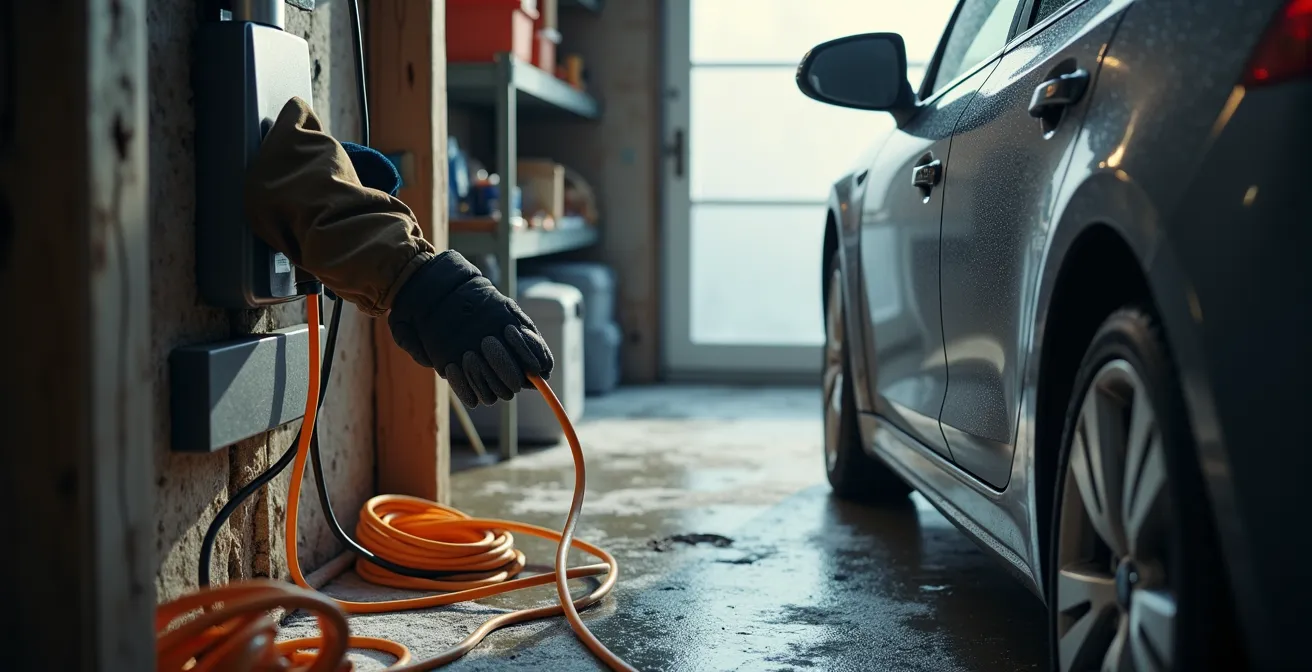
When plugged in for storage, you should adjust the charge limit in your vehicle’s settings. As EV battery research firm Recurrent Auto advises, you should store the EV plugged in with a maximum charge setting of 70 or 80 per cent. This keeps the battery in a low-stress state while ensuring it has enough buffer to handle its self-heating duties if a power outage occurs. If leaving it plugged in is absolutely not an option, you should aim for a similar state of charge—around 70%—to provide a large buffer against parasitic drain. Avoid Sentry Mode or other features that consume extra power, and be prepared to lose a significant amount of charge, depending on the severity of the cold during your absence.
How much range does an EV really lose at -30°C on the highway?
At an extreme temperature of -30°C, the range loss on a highway is not just noticeable; it is severe, often approaching or exceeding 50% of the vehicle’s rated range. This dramatic reduction is a product of two main factors: the battery’s reduced efficiency and the massive energy consumption required for cabin heating. The cold slows the battery’s internal chemistry, increasing its internal resistance. This means more energy is lost as heat simply trying to deliver power to the motors. Secondly, unlike an internal combustion engine that generates abundant waste heat, an EV must produce all its cabin heat from the battery, a power-intensive task in extreme cold.
Real-World Canadian Winter Range Loss
The experience of Canadian EV owners with LFP batteries highlights this reality. In one documented case, a driver’s rated range of 440 km plummeted to just 250 km in extreme cold. Another owner reported an even more drastic decrease, going from over 400 km in summer to a mere 160 km at -35°C. This represents a functional range of only 40% of the vehicle’s ideal capacity, making long-distance travel a significant planning challenge.
This is not a theoretical problem; it’s a practical reality for Canadian drivers. Technology can make a significant difference, however. The presence of a heat pump is a game-changer. A heat pump works like an air conditioner in reverse, scavenging heat from the ambient air and drivetrain components to warm the cabin. It is far more efficient than traditional resistive heaters. In fact, comprehensive testing from Consumer Reports shows that at -7°C, EVs with a heat pump typically see a range reduction of around 25%, compared to a much larger 35-50% loss for those without one. For anyone considering an EV for a Canadian climate, a heat pump should be considered a non-negotiable feature, as it directly translates to more usable range when you need it most.
Why you should never start an update parked on the street?
Starting an over-the-air (OTA) software update while parked on the street, especially in winter, is an unnecessary and significant risk. A major software update is akin to performing brain surgery on your vehicle. During the process, many of the car’s essential modules, including those controlling the doors, windows, and even the entire powertrain, can be temporarily disabled. The update process can take anywhere from 20 minutes to over an hour, during which time the vehicle is effectively immobilized and vulnerable.
If the update fails midway due to a lost cellular connection—a common occurrence in underground parking or even on a city street with patchy service—the car can be « bricked. » This means it becomes completely unresponsive, unable to be driven, or even unlocked. This would necessitate a flatbed tow to a service center, a complicated and expensive process for a vehicle that can’t be put into « neutral. » Furthermore, initiating an update with a low state of charge is a recipe for disaster, as the process itself consumes energy, and a depleted battery could cause the update to fail.
The safest protocol is to treat every software update with care. Always perform them in a secure location where the car will not be disturbed and has a stable connection to power and the internet. A home garage with Wi-Fi and a Level 2 charger provides the perfect environment. This ensures a stable power supply and a robust data connection, minimizing the risk of failure.
Your Pre-Update Readiness Checklist: Securing Your EV’s Brain Surgery
- Location & Connectivity Audit: Confirm your parking spot. Is it a secure private garage with a stable Wi-Fi signal, not an exposed public street or underground parkade with unreliable cellular service?
- Power & Health Inventory: Assess your vehicle’s vitals. Is it actively connected to a Level 2 charger? Is the main battery’s State of Charge well above 50%? Have you recently checked the health of the 12V accessory battery?
- Environmental Cross-Reference: Check external factors. Have you reviewed the weather forecast to ensure the update won’t be happening during a blizzard or a period with high risk of power outages?
- Time & Interruption Risk Assessment: Define the « do not disturb » window. Can you guarantee a 30-60 minute period where the vehicle will remain completely untouched and locked, free from any interruptions?
- Go/No-Go Execution Plan: Make the final decision. If all previous checks are green, proceed with initiating the update. If any point is a « no, » you must postpone the update until all conditions are optimal.
Key Takeaways
- Your EV battery’s primary enemy in winter is not the cold itself, but electrochemical stress caused by charging at high states of charge or with high currents when the battery is cold.
- Significant range loss (30-50%) in deep cold is normal and temporary; your full range will return in the spring. A sudden, permanent drop is the real red flag for a warranty issue.
- Always precondition your EV while plugged in before driving and navigate to fast chargers to allow the battery to warm up, ensuring faster, safer charging and preserving long-term health.
Going Fully Electric in Rural Canada: Is It Viable in 2024?
For residents of rural or small-town Canada, the question of EV viability is less about battery chemistry and more about stark logistics. While home charging can cover the vast majority of daily driving needs, the sparse public charging infrastructure for long-distance travel remains the single largest barrier. The reality is that the network is not yet built out to provide the same level of convenience as the gas station on the corner of the Trans-Canada Highway. This « charging anxiety » is a legitimate concern for anyone living outside of major urban corridors.
The numbers paint a clear picture of the challenge ahead. According to a 2024 legal outlook from Osler, as of February 2024, Canada has approximately 30,000 public charging ports. This is a fraction of the estimated 679,000 ports the country will need by 2040 to support the federal government’s zero-emission vehicle targets. This gap is felt most acutely in rural and northern communities, where a single non-functional DC fast charger can derail an entire trip.
Despite these challenges, the situation is improving, and viability is increasing year by year. Federal and provincial rebates are encouraging charger installation, and initiatives are specifically targeting underserved areas. As Valérie Mallamo, a representative for Earth Day Canada, stated about their « Charged for Change » program, the goal is clear:
Charged for Change hopes to level that playing field so that Canadians who want to make the climate-conscious decision to switch to an EV feel confident that it can meet their needs.
– Valérie Mallamo, Earth Day Canada
So, is it viable in 2024? The answer is a qualified « yes, with planning. » It requires a shift in mindset from spontaneous road-tripping to deliberate journey planning using apps like PlugShare or A Better Routeplanner. It means having a Level 2 charger at home is non-negotiable. It may mean choosing a vehicle with a larger battery pack and a heat pump for a greater winter range buffer. It is a commitment, but for many rural Canadians, the benefits of lower running costs and a better driving experience are proving to be worth the extra planning involved.
By understanding the science behind your EV’s battery, you transform anxiety into agency. You are no longer just a driver following rules, but an informed manager of a sophisticated energy system. The next logical step is to apply this knowledge by consciously observing and adjusting your own charging and driving habits to minimize stress on your battery, ensuring it serves you reliably for many Canadian winters to come.