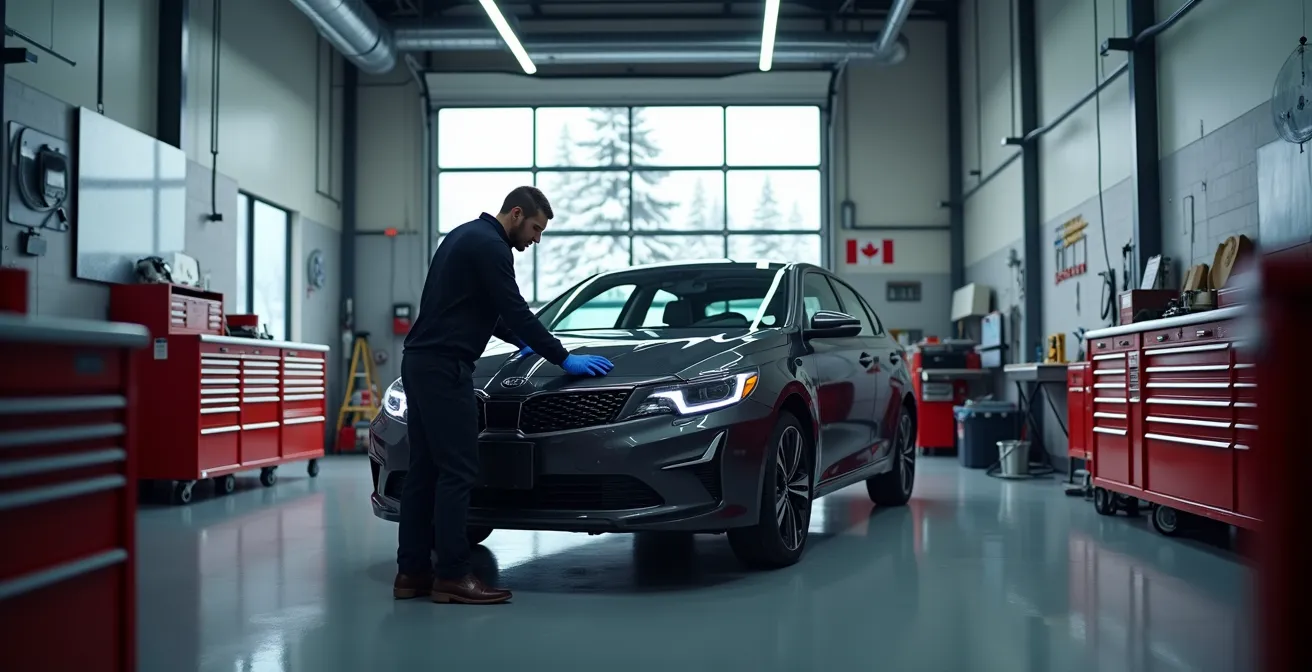
True vehicle longevity isn’t about following a maintenance schedule; it’s about developing « mechanical empathy » to minimize the physical stresses your driving imposes on components.
- Short trips of less than 5km are one of the worst things for an engine, as they prevent oil from reaching operating temperature, leading to chemical degradation.
- For both gasoline and electric cars, specific habits—like how you park, brake, and charge—dramatically affect the lifespan of critical and expensive components.
Recommendation: Shift your mindset from a simple driver to a system operator who actively manages thermal shock, component fatigue, and chemical stress, especially in the harsh Canadian climate.
Every car owner wants their vehicle to last longer. The common advice is predictable: follow the maintenance schedule, wash off the road salt, and check your fluids. While essential, this advice only scratches the surface. It treats a vehicle like a black box where inputs (oil, gas) and scheduled servicing are the only factors that matter. This approach completely misses the single most significant variable in a car’s lifespan: the driver’s understanding of the physical forces at play during every single trip.
This isn’t about simply « driving smoothly. » It’s about developing what can be called mechanical empathy. This is the practice of understanding the physics and engineering principles behind your vehicle’s operation—the thermal shocks, the stress cycles, the chemical reactions—and adjusting your habits to minimize component fatigue. It’s about knowing *why* a short trip in a Canadian winter is considered severe abuse, or *why* the way you engage the « Park » gear can slowly destroy a critical transmission part. Most longevity guides focus on the *what*; this one focuses on the *why* from a mechanical engineering perspective.
But what if the real secret to doubling your car’s life wasn’t found in the owner’s manual, but in a deeper understanding of the machine itself? This guide moves beyond the platitudes to deconstruct eight specific driving habits. We will explore the underlying physics of each, providing a clear rationale for why these changes can dramatically reduce wear and tear, save you thousands in repairs, and help you achieve the « million-kilometre » potential hidden in modern vehicles, even in the face of Canada’s demanding climate.
This article will provide an engineer’s perspective on extending your vehicle’s life by examining the specific physical consequences of common driving habits. Explore the topics below to learn how to operate your vehicle with mechanical empathy.
Summary: An Engineer’s Secrets to Vehicle Longevity
- Does revving your engine high actually clean out carbon deposits?
- Why driving less than 5km is considered « severe abuse » for an engine?
- Why relying on the « Park » gear alone damages your transmission pawl?
- Does braking lightly actually warp rotors faster than firm braking?
- Why you need to idle for 30 seconds before turning off a turbo car?
- The driving habit that increases consumption by 35% in city traffic
- Why charging to 100% every night is slowly killing your battery range?
- The « Million Kilometer » Mindset: Fighting Salt and Thermal Shock
Does Revving Your Engine High Actually Clean Out Carbon Deposits?
The idea of an « Italian tune-up »—revving the engine to high RPMs to burn off carbon deposits—is a persistent myth rooted in the era of carbureted engines. In modern vehicles with Gasoline Direct Injection (GDI) systems, this practice is not only ineffective but can also be misleading. The core of the problem lies in the design of GDI engines themselves. Unlike older port injection systems where fuel was sprayed onto the intake valves, cleaning them in the process, GDI injects fuel directly into the combustion chamber. This means the intake valves are never washed by fuel detergents, leaving them susceptible to significant carbon buildup from oil vapours and exhaust gases recirculated by the PCV and EGR systems.
This buildup can restrict airflow, causing poor performance, misfires, and reduced fuel efficiency. High-RPM driving does not generate enough heat or airflow in the right places to scrub these baked-on deposits from the back of the valves. In reality, the solution is professional maintenance, not aggressive driving. In fact, many manufacturers like BMW recommend carbon cleaning services professionally every 50,000 to 80,000 kilometres to restore engine performance. These services involve media blasting the valves with materials like walnut shells to physically remove the deposits without damaging the engine.
Instead of relying on an outdated myth, the best approach is prevention. Using high-quality gasoline with robust detergent packages can help keep the injection system clean, but it won’t affect the intake valves. The most effective strategies are adhering to the manufacturer’s recommended oil change intervals with the correct, low-volatility synthetic oil to reduce oil vapour, and periodically using a fuel system cleaner specifically designed for GDI engines that is introduced through the air intake system. This is a clear case where mechanical empathy means understanding the engine’s design limitations and relying on proper maintenance, not folklore.
Why Driving Less Than 5km Is Considered « Severe Abuse » for an Engine?
To a mechanical engineer, a short trip is one of the most damaging things you can do to an internal combustion engine. This is because the engine and its fluids are designed to operate within a specific, high-temperature window. A trip of less than 5-10 kilometres, especially in a cold Canadian winter, is often not long enough for the engine oil to reach its optimal operating temperature of around 100°C (212°F). When the oil remains cold, it doesn’t effectively perform its primary functions, leading to a cascade of negative effects that constitute « severe use. »
The most critical issue is moisture contamination. Combustion is a chemical reaction that produces water as a byproduct. In a fully warmed-up engine, this water turns to steam and is evacuated through the PCV (Positive Crankcase Ventilation) system. On a short trip, the crankcase doesn’t get hot enough to boil off this water. Instead, the water condenses and mixes with the engine oil, forming a thick, milky sludge. This sludge is a poor lubricant and accelerates the chemical degradation of the oil, while also promoting rust on internal steel components.
This contaminated oil can’t properly protect vital engine parts, leading to accelerated wear on bearings, camshafts, and cylinder walls. The problem is so prevalent that many owner’s manuals define driving primarily short trips as « severe service, » requiring oil changes twice as frequently. This isn’t just a suggestion; it’s a critical directive based on the physics of fluid dynamics and chemistry. For context, while the average Canadian drives around 15,200 kilometres per year according to Natural Resources Canada, a vehicle used exclusively for 3km commutes could suffer more wear than one driven 30,000 highway kilometres in the same period.
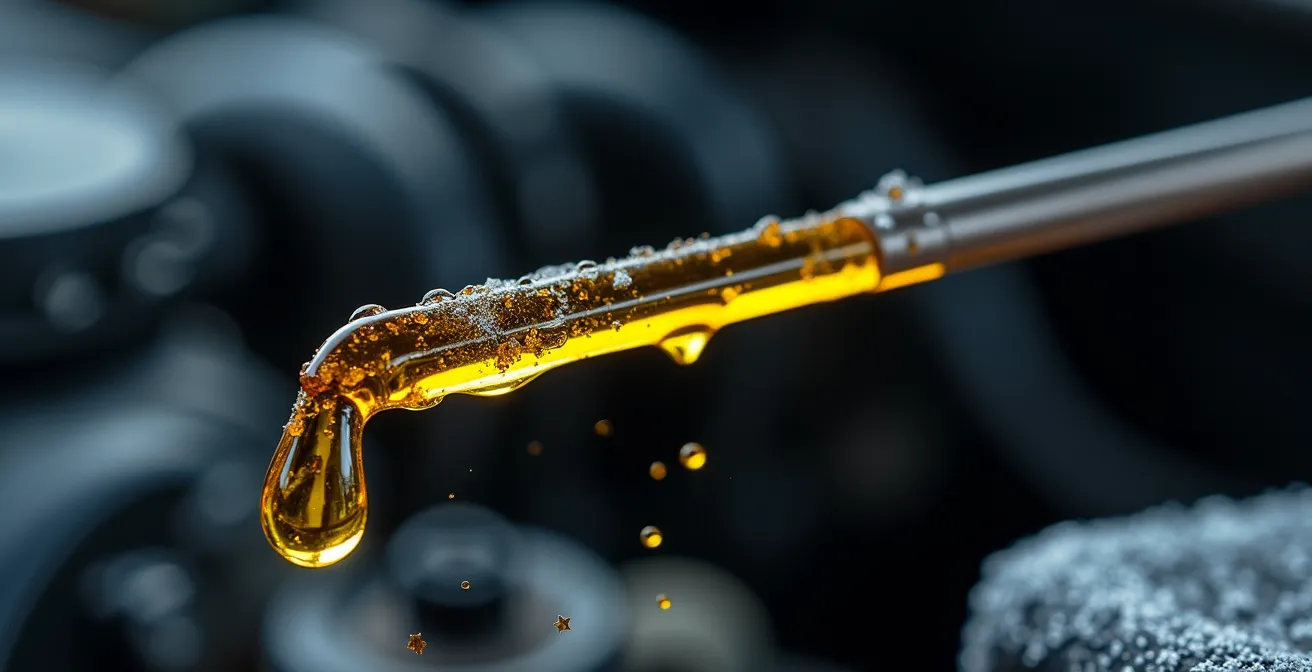
As you can see in the illustration, the milky patterns are a visual representation of water emulsified in the oil, a direct result of the engine not reaching temperature. To practice mechanical empathy, combine errands into longer trips whenever possible. If your driving is exclusively short-distance, you must follow the severe service maintenance schedule to preserve your engine’s life.
Why Relying on the « Park » Gear Alone Damages Your Transmission Pawl?
When you shift an automatic transmission into « Park, » you’re engaging a small metal pin called a parking pawl. This pawl slots into a toothed wheel connected to the transmission’s output shaft, physically locking the drivetrain and preventing the wheels from turning. The critical thing to understand is the scale: this single, relatively small pin is often tasked with holding the entire 1,500-2,500 kg weight of your vehicle, especially when parked on an incline. Relying on this pawl alone puts immense, constant stress on it and the teeth of the parking gear.
This repeated stress leads to component fatigue. Every time you park on a hill and the car rolls back slightly to rest on the pawl, you are completing a stress cycle. Over thousands of cycles, microscopic cracks can form and propagate, eventually leading to failure. When the pawl breaks, the transmission can no longer be held in park, creating a serious safety hazard. Furthermore, the constant pressure can make it difficult to shift out of park, often accompanied by a loud, unsettling « clunk » as the stressed pawl violently disengages. This is a clear audible signal of mechanical distress.
The correct, mechanically empathetic procedure is to use the parking brake (also known as the handbrake or e-brake) every single time you park. The sequence is crucial:
- Come to a complete stop with your foot on the brake pedal.
- While still holding the brake pedal, firmly engage the parking brake.
- Release the brake pedal, allowing the car’s weight to rest on the parking brake system, not the transmission.
- Shift the transmission into « Park ».
This method ensures the vehicle’s weight is held by the robust braking system, which is designed for this purpose, leaving the parking pawl to act as a simple, unstressed safety backup. With vehicles in Canada lasting longer than ever, this habit is essential for transmission health.
As modern vehicles are expected to last for many years and hundreds of thousands of kilometres, preserving the transmission is paramount. An analysis of Canadian vehicle longevity shows a dramatic increase in expected lifespan over the decades.
| Era | Average Lifespan | Average Kilometres |
|---|---|---|
| 1970s | 5 years | 160,000 km |
| Early 2000s | 10-12 years | 250,000 km |
| 2024 | 11-15 years | 322,000 km |
Does Braking Lightly Actually Warp Rotors Faster Than Firm Braking?
It seems counter-intuitive, but consistently braking very lightly can be more damaging to your brake rotors than occasional firm braking. The common term « warped rotors, » which causes a pulsating sensation in the brake pedal, is a misnomer. In most cases, the rotor isn’t physically bent; rather, it has developed uneven deposits of friction material from the brake pads, leading to thickness variation. This phenomenon, known as cementite deposition, is a direct result of heat management.
Brake systems work by converting kinetic energy into thermal energy (heat). Light, prolonged braking—such as dragging the brakes down a long hill—keeps the pads and rotors in a state of high friction and moderate heat for an extended period. This temperature is often not high enough to properly burnish the pads, but it is high enough to cause the resin in the pad material to break down and transfer unevenly onto the rotor’s surface. These small, hardened deposits create high spots, which cause the brake pedal to pulsate as the pads pass over them. In Canada’s climate, the combination of road salt and moisture can also accelerate corrosion on the rotor surface, which is then scraped off unevenly by light braking, exacerbating the thickness variation.
In contrast, a firm, decisive stop from speed generates a quick, intense burst of heat. This helps to properly bed-in the brake pads and can even clean off minor, existing deposits from the rotor surface, maintaining a uniform finish. The system is designed for these high-energy conversion events. The key is to avoid « riding » the brakes. Instead of light, constant pressure, it’s better for the brake system’s health to use shorter, firmer applications and then let off to allow the components to cool. This is especially true in severe Canadian weather, where clear and functional brakes are a critical safety component. This approach demonstrates mechanical empathy by using the system as it was engineered to function.
Why You Need to Idle for 30 Seconds Before Turning Off a Turbo Car?
For any vehicle equipped with a turbocharger, the final 30 seconds of any trip are arguably the most critical for the engine’s long-term health. This isn’t an old habit that has died out; it’s a practice rooted in the fundamental physics of heat transfer and fluid dynamics. A turbocharger uses exhaust gases to spin a turbine, which can reach rotational speeds of over 250,000 RPM and temperatures exceeding 800°C (1,500°F). The entire rotating assembly is supported by a thin film of engine oil, which acts as both a lubricant and a crucial coolant.
When you drive your car, especially with enthusiasm, the turbo gets extremely hot. If you shut the engine off immediately after a hard run, the oil pump stops instantly. The oil that remains in the turbo’s centre bearing housing is no longer circulating and is subjected to the immense « heat soak » from the turbine. This stagnant oil essentially gets cooked, breaking down and forming hard carbon deposits—a process known as oil coking. These deposits act like sandpaper, destroying the delicate bearings and seals the next time the turbo spools up. This is a primary cause of premature turbo failure.
By allowing the engine to idle for 30 to 60 seconds before shutdown, you allow the oil to continue circulating, drawing heat away from the turbo’s core and allowing the turbine to cool down to a safe temperature. This simple act of patience prevents oil coking and can add tens of thousands of kilometres to the life of your turbocharger. For drivers aiming for high mileage, which many Canadian mechanics consider to be over 20,000 kilometres per year of use, preserving an expensive component like a turbo is paramount. It’s a perfect example of mechanical empathy: giving the machine a moment to stabilize before shutting it down.
The Driving Habit That Increases Consumption by 35% in City Traffic
The single most wasteful driving habit in urban environments is aggressive acceleration followed by hard braking. From a physics perspective, this « jackrabbit » style of driving is an exercise in generating and then immediately destroying energy. Your car’s engine burns fuel to convert chemical energy into kinetic energy (the energy of motion), defined by the formula E = ½mv². When you accelerate rapidly, you build up a large amount of kinetic energy. When you then slam on the brakes just before the next red light, the brake system converts that kinetic energy back into heat, which dissipates uselessly into the atmosphere. You’ve essentially paid for fuel just to heat up your brake rotors.
Studies have consistently shown that this aggressive driving style can increase fuel consumption by up to 35% or more in stop-and-go city traffic compared to a smooth driving style. The mechanically empathetic approach involves looking far ahead, anticipating traffic flow, and managing your momentum. Instead of rushing to the next red light, ease off the accelerator early and coast. Let the car’s momentum do the work. By maintaining a greater following distance, you can often avoid braking entirely, modulating your speed with small throttle adjustments instead.
This smooth approach not only saves a significant amount of fuel but also dramatically reduces wear on your entire drivetrain. Your engine, transmission, and especially your brakes are subjected to far fewer high-stress cycles. This is particularly relevant as the average vehicle on Canadian roads is nearly 10 years old with 200,000 km on the odometer; minimizing wear on aging components is crucial for longevity. Driving smoothly is the ultimate win-win: it saves you money at the pump, extends the life of your vehicle, and even contributes to a safer, less stressful driving environment for everyone.

The tense hands and red taillights in this image capture the high-stress, low-efficiency nature of aggressive city driving. By adopting a calmer, more forward-thinking approach, you are not just driving better—you are actively managing your vehicle’s energy and preserving its mechanical integrity.
Why Charging to 100% Every Night Is Slowly Killing Your Battery Range?
For electric vehicle (EV) owners, the instinct to « top up » the battery to 100% every night is understandable, but it’s a habit that accelerates the degradation of the most expensive component in the car: the lithium-ion battery. From a chemical engineering standpoint, a lithium-ion battery is under the most stress at very high and very low states of charge. When charged to 100%, the voltage is at its peak, which puts significant strain on the cathode materials, causing them to degrade more quickly. Leaving a battery at this high state of charge for extended periods (e.g., overnight, every night) is a primary contributor to irreversible capacity loss.
Think of a battery like a spring. It’s most comfortable in the middle of its range. Keeping it fully compressed (100% charge) or fully stretched (0% charge) for long periods will cause it to lose its elasticity over time. Most EV manufacturers implicitly acknowledge this by recommending a daily charging limit of 80% or 90% for normal use, reserving the full 100% charge only for long trips when maximum range is necessary. Following this single piece of advice is the most effective thing an owner can do to maximize their battery’s lifespan. Recent studies from Geotab confirm that EV batteries degrade slowly, but factors like charging habits and climate play a huge role. Canada’s harsh winters, in particular, can accelerate wear if proper procedures are not followed.
Deep discharging the battery to near 0% is similarly stressful. The ideal practice is to keep the battery’s state of charge operating within a « happy zone, » typically between 20% and 80%. This simple habit of setting a daily charge limit in your vehicle’s infotainment system or charging app is a powerful act of mechanical (or in this case, chemical) empathy that will pay dividends in retained range and resale value for years to come.
Your Action Plan: EV Battery Best Practices for Canadian Winters
- Target a daily charge level between 20% and 80% to avoid stressing the battery at its extremes.
- Where possible, park in a garage to shield the battery from the most extreme sub-zero temperatures.
- Use the vehicle’s pre-conditioning feature to warm the battery while still plugged into the charger before you drive.
- Limit the use of DC fast chargers, especially in very cold weather, as they generate significant heat and stress on a cold battery.
Key Takeaways
- True vehicle longevity stems from « mechanical empathy »—understanding and minimizing the physical stresses of driving, not just following a maintenance schedule.
- Many common driving habits, such as short trips, aggressive braking, and improper parking, cause hidden damage through thermal shock, component fatigue, and chemical degradation.
- Canadian-specific conditions like extreme cold and road salt amplify the negative effects of these habits, making mindful driving even more critical.
The « Million Kilometer » Mindset: Fighting Salt and Thermal Shock
Achieving truly exceptional longevity from a vehicle—reaching 500,000 or even a million kilometres—requires transcending the role of a mere operator to become a proactive systems manager. It means adopting a mindset focused on mitigating the two greatest enemies of a vehicle in Canada: corrosion from road salt and component fatigue from thermal shock. These two forces work together to relentlessly attack your vehicle’s structure and mechanical parts. The « million-kilometre mindset » is the practical application of mechanical empathy against these specific, relentless threats.
Fighting salt is more than just the occasional car wash. It requires a targeted, systematic approach. This means frequent undercarriage washes throughout the winter, not just at the end of the season, to prevent corrosive brine from sitting on brake lines, fuel lines, subframes, and electrical connectors. It also means considering professional rust-proofing services, which create a physical barrier between vulnerable metal and the elements. As one auto service in a city known for harsh winters notes, driving conditions are a primary factor in a car’s lifespan.
The average vehicle in Canada has a ten-year lifespan. Driving conditions in and around Hamilton, Canada, are often rough, especially in winter.
– CRS Automotive, Hamilton Auto Service Shop Report
Fighting thermal shock involves applying the principles we’ve discussed throughout this guide. It means understanding that every cold start is a stress event and that allowing the engine to warm up gently before demanding full power is crucial. It means combining trips to avoid the damaging effects of short journeys. It means allowing a turbo to cool down and letting the parking brake, not the transmission, take the load. Each of these habits reduces the cumulative stress cycles that wear components out. By actively managing these forces, you are no longer just driving; you are preserving your investment and engineering your vehicle towards a remarkably long and reliable life.
Start applying these engineering-based habits today. By driving with mechanical empathy, you are actively participating in your vehicle’s preservation, ensuring it serves you reliably and economically for many years and kilometres to come.