Encountering an aggressive driver is a tactical situation, not an emotional dispute. This guide moves beyond common advice, providing a strategic framework based on law enforcement principles to manage the environment, de-escalate the aggressor’s emotional state, and ensure your safe passage. The goal is not to win a confrontation, but to strategically remove yourself from danger with minimal risk.
The sudden glare of high beams in your rearview mirror, the angry blare of a horn, the unnerving sight of a vehicle aggressively weaving through traffic to get behind you. Every Canadian driver recognizes this scenario and the cold knot of anxiety it causes. It’s a moment where the ordinary commute becomes a high-stakes encounter. The common advice— »don’t engage, » « stay calm, » « just let them pass »—is well-intentioned but often feels inadequate when you feel targeted and trapped.
These reactions are understandable, but they are reactive, not strategic. What if the goal wasn’t simply to avoid a fight, but to tactically manage the situation from the moment it begins? This guide provides a different perspective: one from a conflict resolution specialist. It’s a framework for de-escalation that focuses on controlling your environment, understanding the aggressor’s psychology, and using specific actions to defuse tension before it can escalate into a dangerous confrontation or physical violence.
This approach moves beyond simple tips and into a strategic mindset. We will analyze the psychological triggers that initiate most highway aggression and the specific, non-confrontational gestures that can instantly signal non-threat. We will cover the tactical protocols for documenting an incident without inflaming it, the critical importance of maintaining environmental control through buffer zones, and the severe legal consequences of letting your own emotions take the wheel. This isn’t about pride or winning; it’s about a professional approach to your personal safety on the road.
This article provides a detailed roadmap for navigating these tense situations. The following sections break down the specific strategies and knowledge you need to transform a potentially dangerous encounter into a managed, controlled disengagement.
Summary: De-escalation on the Highway: Handling Road Rage in Canada
- Why blocking the passing lane triggers 80% of highway aggression?
- How a simple hand gesture can diffuse a dangerous situation instantly?
- How to record road rage without provoking the aggressor further?
- How to leave a buffer zone so you aren’t trapped by an angry driver?
- Why braking checking a tailgater is legally dangerous for you?
- How to use audiobooks and lighting to lower cortisol while driving?
- The driving habit that increases consumption by 35% in city traffic
- When can you sue the at-fault driver despite « No-Fault » laws?
Why blocking the passing lane triggers 80% of highway aggression?
The left-most lane on a multi-lane highway is more than just a strip of pavement; in the collective driver psyche, it’s the « passing lane. » Driving in it without actively passing violates a deeply ingrained, unwritten rule of the road. This act is often perceived not as a simple mistake, but as a deliberate act of disrespect or obstruction. This perceived slight triggers a disproportionate emotional response because it violates a social contract and creates a feeling of being unfairly impeded. An aggressor feels their time is being stolen and their right of way challenged, leading to frustration and anger.
This frustration isn’t limited to the passing lane. It’s part of a broader pattern of driver anger toward those who break established norms. For example, a staggering 89% of Canadians report feeling angry or annoyed by drivers running red lights and stop signs. Blocking the passing lane falls into this same category of behaviour that signals a disregard for others on the road. From a tactical standpoint, understanding this trigger is the first step in proactive de-escalation: avoiding the trigger altogether.
To prevent becoming a trigger for highway aggression, a driver must adopt a defensive and socially aware driving style. This isn’t about submission; it’s about strategic positioning to minimize conflict. The key is to be predictable, courteous, and aware of your position relative to others. Adhering to lane discipline is the most effective way to remain anonymous and unremarkable to potential aggressors, which is the primary goal for safe travel.
- Stay in the right lane except when actively passing on multi-lane highways.
- Signal your intentions early and clearly when changing lanes or merging.
- Avoid behaviours that are known to frustrate others, such as tailgating, changing lanes abruptly, or blocking merging traffic.
- Use your horn sparingly and only when necessary for safety, not to express frustration.
- Allow plenty of time to reach your destination to reduce your own stress and impatience, which can lead to poor decisions.
By consciously avoiding these common triggers, you remove yourself as a target and significantly reduce your chances of being the focus of a road rage incident.
How a simple hand gesture can diffuse a dangerous situation instantly?
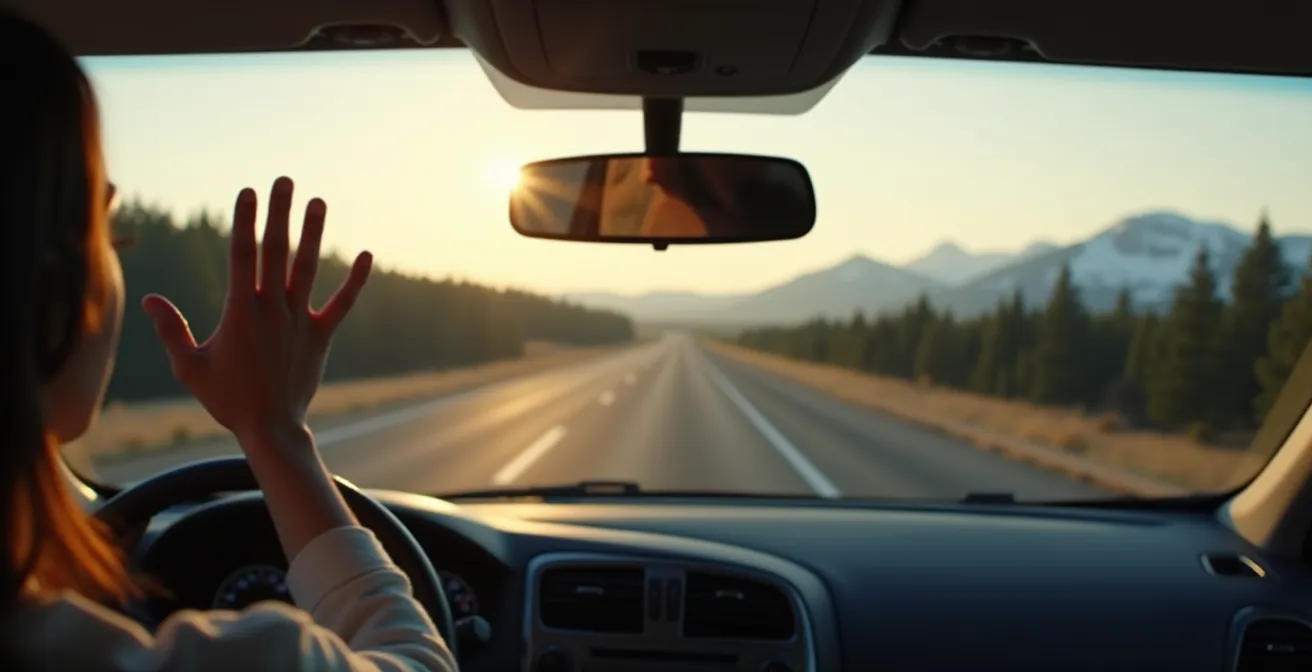
In a tense highway encounter, the aggressor operates on the assumption that your actions were intentional and malicious. A simple, universally understood hand gesture can instantly shatter this assumption and break the aggression cycle. The most effective tool is the « apology wave »: an open palm, raised briefly and calmly. This gesture communicates a powerful, non-verbal message: « My apologies, » « I see you, » or « I made a mistake. » It is a strategic act of de-escalation, not an admission of fault.
The psychology behind its effectiveness is profound. It validates the other driver’s frustration without escalating the conflict. By offering a gesture of acknowledgement, you shift from being an antagonist to being a fellow human who may have made an error. This can instantly lower the emotional temperature, as the aggressor’s narrative of being intentionally wronged is disrupted. It’s crucial that the gesture is calm and non-threatening—a quick, jerky motion can be misinterpreted as aggressive. A slow, deliberate, open-palmed wave is key.

This principle of verbal and non-verbal de-escalation is a core tenet of law enforcement training. A real-world example from Toronto demonstrated this perfectly. During a live news interview about a fatal collision, a road rage incident erupted on the road below. The camera captured two drivers arguing heatedly outside their vehicles.
Case Study: The Officer Williamson Intervention
While being interviewed by CBC News, Police Officer Graham Williamson noticed the escalating argument. He instinctively whistled and yelled from his vantage point to intervene. His authoritative but calm intervention immediately broke the participants’ focus on each other. The confrontation ended without any physical contact, and both drivers returned to their cars and drove away. This shows how a timely and strategic intervention—even a simple verbal one—can redirect aggressive energy and prevent escalation.
By using a strategic apology, you are not losing; you are taking control of the narrative and guiding the situation toward a safe and peaceful resolution.
How to record road rage without provoking the aggressor further?
When a road rage incident escalates, your priority is safety. However, gathering evidence for a police report can be a crucial secondary objective. The challenge is to do so without further provoking the aggressor, as the act of being recorded can be perceived as a major escalation. A recent survey for RATESDOTCA reveals that while 83% of Canadian drivers witnessed road rage in 2024, far fewer admit to engaging in it. This gap highlights the need for objective evidence.
The key is discreet and passive recording. An overtly pointed phone can be interpreted as a challenge, potentially turning a verbal altercation into a physical one. Instead, the goal is to create an environment where recording appears incidental or non-existent. A dashboard-mounted phone running a dashcam app is the ideal tool, as its presence is normalized for navigation. If you must use your phone manually, voice commands are a powerful feature, allowing you to start a video recording without fumbling with the device.
If you are a passenger, your role in evidence collection is even safer and more effective. You can record more discreetly from a lower angle, focusing on capturing the essential information: the other vehicle’s make, model, colour, and most importantly, its license plate. Capturing the aggressive driving behaviour itself—such as dangerous lane changes, tailgating, or attempts to block your vehicle—provides context for law enforcement. Avoid any gestures that signal you are recording; your focus should be on quiet documentation, not confrontation.
Action Plan: Discreet Evidence Collection Protocol
- Mount for Ambiguity: Mount your phone in a standard dashboard holder so it appears to be a navigation device.
- Use Voice Commands: Activate video recording using voice commands (e.g., « Hey Siri, start recording a video ») to avoid suspicious movements.
- Leverage the Passenger: If you have a passenger, task them with discreetly recording the incident, focusing on the license plate and aggressive actions.
- Narrate for the Record: Verbally state the date, time, location (highway number, nearest exit, city), and a brief description of events. This audio will be part of the evidence.
- Prioritize Key Information: The primary goal is to capture the license plate and the dangerous driving behaviour. A clear shot of the driver is secondary and often riskier to obtain.
Remember, the video is for a potential police report later. It is not a tool to be brandished during the encounter. Your immediate safety always comes first.
How to leave a buffer zone so you aren’t trapped by an angry driver?
In any tactical situation, controlling your environment is paramount. On the highway, your environment is the space around your vehicle. A buffer zone is not just a safety cushion for braking; it is your primary tactical asset. It provides you with time to react, space to maneuver, and—most critically—escape routes. Being trapped by an aggressive driver, with no path for egress, is one of the most dangerous positions you can be in. This is why maintaining a significant following distance and being aware of the space beside you is a non-negotiable rule of defensive driving.
An angry driver may try to control your movement by boxing you in, tailgating you to prevent lane changes, or even pulling in front to initiate a « brake check. » A proper buffer zone neutralizes these threats. It allows you to slow down gradually to let a tailgater pass, or to smoothly change lanes into an open space if a driver ahead becomes erratic. Always be scanning for your « out. » Is the shoulder clear? Is the adjacent lane open? Thinking two steps ahead is not paranoia; it is strategic awareness.

The potential for extreme violence when an escape route is cut off is terrifyingly real. A recent incident in Ontario serves as a stark reminder of why environmental control is a life-saving skill.
Case Study: The Temiskaming Shores Highway Ramming
Dashcam footage captured a harrowing incident where a driver, James Benjamin Turner, was followed by an aggressive vehicle. After pulling over, the aggressor’s vehicle attempted to back into his. Turner managed to drive away toward a nearby Tim Horton’s for safety, but the other vehicle pursued and intentionally rammed the side of his car. The Ontario Provincial Police (OPP) were eventually forced to use a spike belt to stop the suspect, who was then arrested. This incident demonstrates the extreme lengths an enraged driver will go to and the absolute necessity of using any available space to move toward a safe, public location.
Space equals options. Options equal safety. Never willingly give up your space, as it may be the only thing that stands between you and a dangerous, unpredictable aggressor.
Why braking checking a tailgater is legally dangerous for you?
When a vehicle is dangerously close to your rear bumper, the instinct to tap your brakes—a « brake check »—can be overwhelming. It feels like a justifiable way to warn the other driver and reclaim your space. However, from a tactical and legal standpoint, it is one of the worst decisions you can make. A brake check is an act of escalation, not de-escalation. You are intentionally creating a dangerous situation and introducing a sudden, unpredictable element into an already volatile mix. It turns a case of another driver’s aggression into a conflict where you are now an active participant.
More importantly, in Canada, this action can shift legal liability directly onto you. In many jurisdictions, brake checking is explicitly illegal. For example, under section 172 of Ontario’s Highway Traffic Act, brake checking is classified as stunt driving. The legal consequences are severe. Drivers who engage in this behaviour can face fines between $2,000 and $10,000, plus a license suspension of 1-3 years. If your brake check causes a collision, you could be held at least partially, if not fully, liable for the damages, even if the other person was tailgating.
The legal system’s view is that every driver has a duty to operate their vehicle safely and avoid causing collisions. By intentionally and unnecessarily applying your brakes, you are violating that duty. Even if a tailgater is driving recklessly, your retaliatory action can be seen as a contributing cause of any subsequent crash. Insurance companies also take a dim view of brake checking. If it can be proven—through dashcam footage or witness testimony—that you brake-checked, your claim could be denied, and your premiums will almost certainly skyrocket. The aggressor’s insurance could even sue you for the damages to their vehicle.
The strategic alternative is always de-escalation. Instead of braking, maintain your speed, create space ahead of you if possible, and allow the tailgater to pass at the first safe opportunity. Your goal is to remove the threat, not to confront it.
How to use audiobooks and lighting to lower cortisol while driving?
The act of driving, especially in congested or challenging conditions, is a low-grade-stress-inducer that elevates cortisol levels in the body. Cortisol is the primary stress hormone; it sharpens focus in short bursts but leads to irritability, anxiety, and poor decision-making when chronically elevated. A driver with high cortisol is more likely to perceive neutral events as aggressive and to react emotionally rather than strategically. Proactively managing your own physiological state is a core component of defensive driving. As registered psychotherapist Julie Christiansen notes, external factors play a huge role.
There is an inherent increase in frustration while driving in the summer. It’s hot, people are tired. It’s taking longer to get to their desired destination.
– Julie Christiansen, The Rise of Rage
Two powerful but often overlooked tools for managing this stress are auditory engagement and ambient lighting. The human brain cannot easily focus on two complex narrative tasks at once. Listening to a compelling audiobook or a narrative podcast occupies the storytelling part of your brain, making it more difficult to create and dwell on angry narratives about other drivers. Instead of stewing in frustration over traffic, your mind is engaged in a different world, which can keep your heart rate and cortisol levels down.
Similarly, interior lighting has a documented effect on mood. The harsh, blue-white light of screens and some modern dashboards can increase alertness but also anxiety. Conversely, warm, low-intensity ambient lighting (in the yellow-to-orange spectrum) can have a calming effect, especially during dark winter commutes or night driving. It creates a cozier, less sterile cabin environment, which can subconsciously lower your stress response. Combining these two sensory inputs—a calming story and warm light—creates a personal bubble of tranquility that acts as a shield against the external chaos of the road.
- Install warm yellow or orange ambient interior lighting for a calming atmosphere on dark drives.
- Choose calming audiobooks or narrative podcasts over aggressive music or confrontational talk radio.
- Practice deep, slow breathing, counting from 1 to 10 before reacting to a stressful event on the road.
- On long trips, take regular breaks from driving every few hours to reset mentally and physically.
- Maintain perspective by focusing on your ultimate goal: arriving safely to see your loved ones.
A calm driver is a strategic driver, better equipped to handle any challenge the road presents.
The driving habit that increases consumption by 35% in city traffic
The single most wasteful driving habit, which can increase fuel consumption by as much as 30-40% in stop-and-go city traffic, is a pattern of aggressive acceleration followed by hard braking. This « jackrabbit » style of driving does little to reduce overall travel time but dramatically increases fuel burn, brake wear, and, most importantly, the risk of conflict and collision. Each time you press hard on the accelerator, you’re converting fuel into kinetic energy. When you then slam on the brakes, that energy is converted into wasted heat instead of forward momentum.
This aggressive driving pattern is not just inefficient; it is a leading indicator and contributor to road rage and accidents. It signals impatience and hostility to other drivers, creating a tense environment. According to Transport Canada, aggressive driving contributes to over 25% of serious crashes nationwide. The erratic speeds and sudden stops make your vehicle unpredictable and a hazard to everyone around you. A smooth driver, by contrast, anticipates traffic flow, coasts toward red lights, and accelerates gently, presenting a calm and predictable presence on the road.

In fact, research is increasingly showing a direct link between fuel-efficient driving habits and a reduction in collision risk. A 2022 project by the Traffic Injury Research Foundation (TIRF) set out to explore this very connection, hypothesizing that the smooth inputs required for fuel efficiency naturally lead to safer driving outcomes. By aiming for a smooth ride, you not only save a significant amount of money on gas and maintenance, but you also reduce your stress levels and make the road safer for everyone.
The most strategic choice is to adopt a driving style focused on smoothness. Look far ahead to anticipate changes, leave ample following distance to avoid sudden braking, and imagine you have a full glass of water on your dashboard that you don’t want to spill. This mindset shift has a triple benefit: it lowers your fuel costs, reduces your stress, and makes you a much harder target for road rage.
It’s a simple change that pays dividends in both safety and savings, proving that calm, efficient driving is also smart driving.
Key Takeaways
- De-escalation is Tactical: The primary goal is not to win or retaliate, but to strategically manage the situation using non-confrontational techniques to ensure your safety.
- Space is Your Greatest Asset: Maintaining a buffer zone and being aware of escape routes (environmental control) is the most critical defensive tactic against an aggressive driver.
- Retaliation Carries Severe Risk: Actions like brake checking are not only escalatory but are illegal in jurisdictions like Ontario, carrying heavy fines, license suspension, and legal liability.
When can you sue the at-fault driver despite « No-Fault » laws?
Many Canadian provinces, including Ontario, operate under a « no-fault » auto insurance system. This term is widely misunderstood. It does not mean that no one is at fault in an accident. Rather, it means that you typically deal with your own insurance company for benefits and compensation, regardless of who caused the crash. However, this system does not provide a blanket immunity for at-fault drivers, especially in cases of extreme negligence or intentional harm, such as a road rage incident.
There are two primary avenues for legal action against an at-fault driver outside the basic no-fault framework. First, you can sue the at-fault driver in civil court for damages that go beyond your standard accident benefits. This typically includes compensation for pain and suffering and economic losses. However, to be successful, the injuries sustained must meet a legal threshold, which usually means they must be « serious and permanent. » A fender-bender caused by an angry driver is unlikely to meet this threshold, but a collision resulting in chronic injury, disfigurement, or significant psychological trauma might.
The second, and often more severe, avenue involves criminal charges. Egregious acts of road rage are not just traffic violations; they are crimes. As seen in the Temiskaming Shores ramming incident, an aggressive driver can face a battery of charges. This is especially true for confrontational behaviour, which is more common among certain demographics; a Leger survey shows that 7% of young drivers aged 18 to 34 admitted to leaving their vehicle to confront someone, compared to just 2% of older drivers.
Criminal Consequences in the Ontario Ramming Incident
The driver responsible for the ramming in Temiskaming Shores was not merely given a traffic ticket. According to news reports, the suspect was charged with a dozen counts, including assault with a weapon (the vehicle), criminal harassment, mischief endangering life, dangerous driving, and fleeing police. These criminal proceedings are entirely separate from any insurance claims and carry the potential for a criminal record, significant fines, and jail time.
Armed with this strategic knowledge, your next step is to consciously practice these de-escalation and awareness techniques on every drive, turning theory into instinct and ensuring your safety on the road.