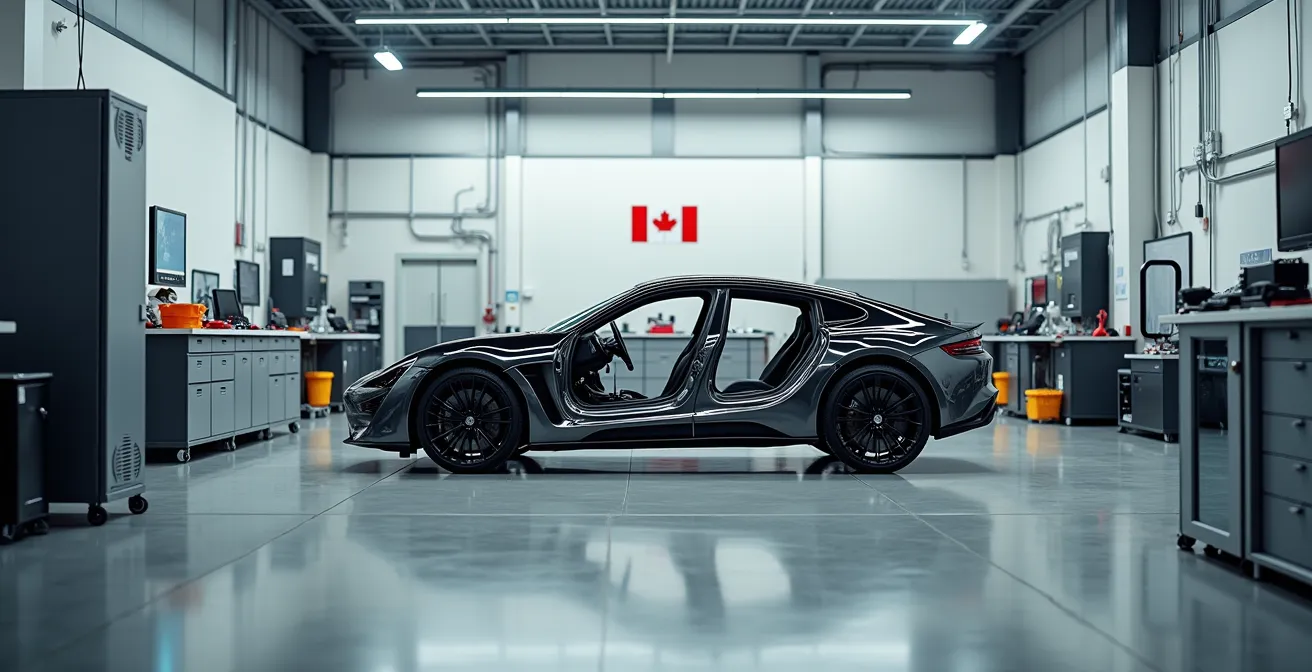
The shocking 40% premium on your « minor » repair bill for a car with advanced materials isn’t just for the part; it’s financing a hidden, mandatory ecosystem of specialized tools, isolated work environments, and complex insurance protocols unique to the Canadian auto industry.
- Repairing aluminum and carbon fiber requires separate, contaminant-free facilities and proprietary equipment that most shops don’t have.
- Canadian insurers often require CAPA-certified parts, but the ultimate decision impacts your vehicle’s safety and value, leading to legal disputes.
Recommendation: Before accepting any repair estimate, understand if your shop is manufacturer-certified for your vehicle’s specific materials and discuss the use of OEM versus aftermarket parts with your insurer to protect your car’s resale value.
The call from the body shop delivers a shock. A minor fender bender in your new luxury vehicle, the one with the lightweight aluminum body and carbon fiber accents, requires a repair estimate that seems astronomically high. You’re looking at a figure that’s easily 40% more than what a similar repair on a steel-bodied car would cost. Your mind races: Is this a mistake? Am I being taken for a ride? The frustration is understandable, and it’s a scenario playing out in collision centers across Canada for owners of premium and electric vehicles.
The common explanations you’ll hear are that the materials are expensive and the labour is specialized. While true, this only scratches the surface. It fails to explain the systemic reasons behind the staggering cost difference. The reality is that repairing advanced materials like aluminum and carbon fiber isn’t just a different task; it’s a different world. This world operates under a rigid set of rules involving dedicated infrastructure, manufacturer certifications that cost shops tens of thousands of dollars, and a constant battle between structural integrity and insurance cost-cutting measures.
But here’s the perspective most owners are missing: the high cost is a direct reflection of the high stakes. An improper repair on a steel panel might lead to rust and cosmetic issues. An improper repair on an aluminum subframe or a carbon fiber chassis can lead to catastrophic structural failure. This article, from the perspective of a certified estimator, will pull back the curtain on this hidden repair ecosystem. We won’t just tell you it’s expensive; we’ll show you precisely where every dollar of that 40% premium goes—from the quarantined repair bays to the long-term devastation a « Rebuilt » title can wreak on your car’s value in the Canadian market.
This guide breaks down the complex factors that inflate your repair bill. By understanding the unique challenges these materials present, from their behaviour in a Canadian winter to the intricacies of insurance negotiations, you can better navigate the repair process and protect your investment.
Summary: The Real Reasons Your Advanced Material Repair Bill is So High
- Why can’t your local neighborhood mechanic fix an aluminum hood?
- How does a carbon fiber chassis impact your collision deductible?
- Steel vs Composite: Which material cracks faster in -30°C temperatures?
- The patching mistake that ruins the structural integrity of carbon fiber
- How to protect expensive composite bumpers from winter road gravel?
- Why CAPA certification matters for aftermarket bumpers and hoods?
- Why a « Rebuilt » title destroys 40% of your car’s future resale value?
- Total Loss Assessment: How to Negotiate Your Payout in Canada?
Why can’t your local neighborhood mechanic fix an aluminum hood?
The primary reason your trusted local mechanic likely can’t touch an aluminum panel is a concept we in the industry call material contamination. Steel and aluminum are mortal enemies in a body shop. When steel dust from grinding comes into contact with raw aluminum, it embeds in the softer metal and causes galvanic corrosion—a rapid, destructive process that compromises the material’s integrity from the inside out. To prevent this, manufacturer-certified shops must invest in a completely separate, quarantined repair environment.
This isn’t just a suggestion; it’s a requirement for certification. This dedicated aluminum repair bay must have its own ventilation system, its own set of specialized tools (which can’t be used on steel), and specific welding equipment like pulse MIG systems designed for aluminum’s lower melting point. The investment to create just one of these bays can exceed $100,000. This high barrier to entry is a major factor in the cost, as only a select number of shops are qualified to perform the work, reducing competition.
Furthermore, the techniques are entirely different. Aluminum has no « memory » like steel; you can’t simply hammer out a dent. It requires slow, deliberate reshaping with specialized tools. Technicians must undergo extensive, manufacturer-specific training to learn these methods and become certified. This combination of dedicated infrastructure and mandatory specialized training forms the base of the cost premium before a single part is even ordered.
Your Shop’s Aluminum Certification Checklist: What to Ask
- Ask if the shop has a dedicated, separated aluminum repair bay to prevent cross-contamination with steel.
- Inquire if they own specialized equipment like a pulse MIG welder and aluminum-specific rivet guns.
- Verify their technicians have manufacturer-specific training and certification for your vehicle’s brand.
- Check if they are on your vehicle manufacturer’s official list of certified collision repair centers in Canada.
- Confirm they follow a documented process for aluminum repair that aligns with manufacturer guidelines.
How does a carbon fiber chassis impact your collision deductible?
While aluminum repair is complex, carbon fiber is in another league entirely. Its impact on your deductible is often indirect but severe: it dramatically increases the likelihood of your vehicle being declared a total loss, even from what appears to be moderate damage. Unlike metal, which bends and deforms to absorb impact, carbon fiber is designed to shatter and delaminate to dissipate energy. This makes it incredibly safe in a crash but exceptionally difficult and expensive to repair.
The intricate weave of a carbon fiber monocoque or chassis is its strength. When that weave is broken, its structural integrity is gone. A surface-level patch might look cosmetically perfect, but it does nothing to restore the load-bearing capabilities of the original structure. Because of this, many vehicle manufacturers simply do not authorize structural repairs on carbon fiber components. If a key structural part like a chassis tub is cracked, replacement is the only safe option, and the cost of that single part can easily exceed 50-60% of the vehicle’s total value, triggering an automatic total loss from your insurer.
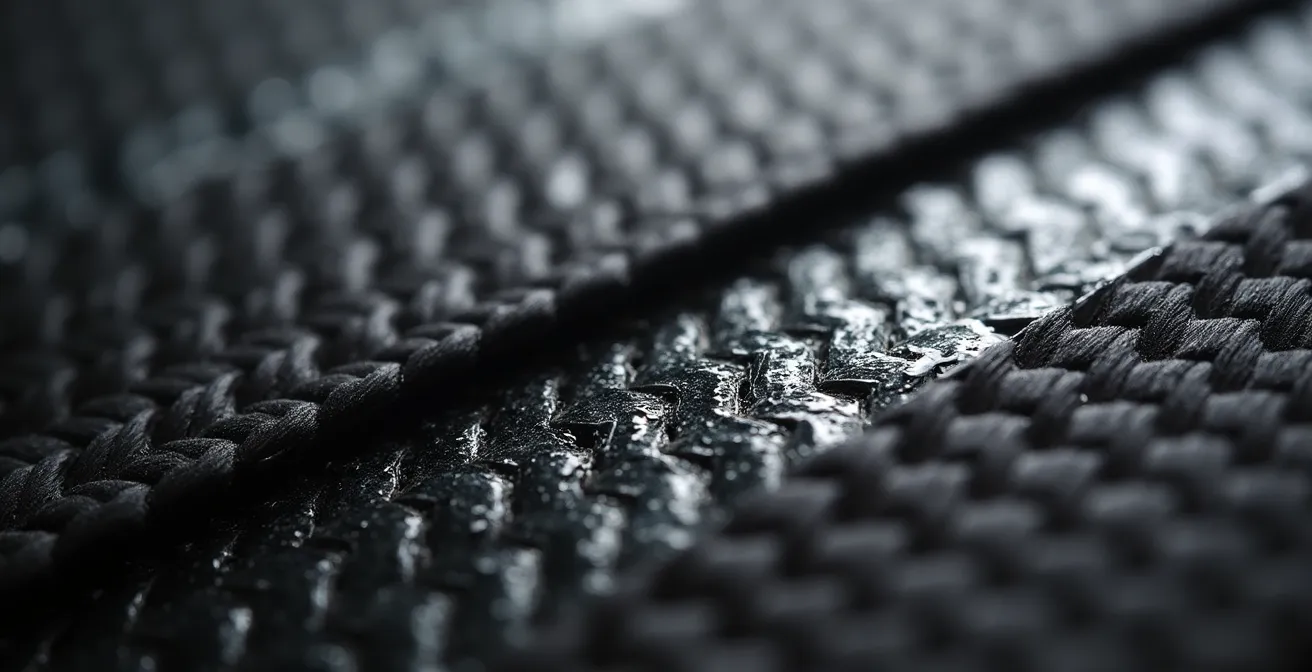
As the image above illustrates, the complexity is at a microscopic level. An analysis of the industry shows that for heavily damaged carbon fiber structures, insurers frequently write off the vehicle due to the lack of certified repair facilities and the immense liability of a failed repair. While repair techniques from the aviation industry are slowly being adapted for automotive use, they require an even higher level of expertise and equipment—like ultrasonic scanners to detect hidden damage—that few collision centers possess. Consequently, your deductible becomes the gateway to either a massive repair bill or the complete write-off of your vehicle.
Steel vs Composite: Which material cracks faster in -30°C temperatures?
For Canadian drivers, a material’s performance isn’t just about weight and strength; it’s about its resilience in the face of extreme cold. This is where the differences between steel, aluminum, and carbon fiber become starkly apparent and directly impact repair frequency and cost. At -30°C, traditional steel maintains most of its ductility, meaning it can still absorb an impact by bending. Composites, however, tell a different story.
Carbon fiber, in particular, becomes significantly more rigid and brittle in deep cold. This means that an impact from a piece of road ice or a minor parking lot bump that might only dent a steel bumper could cause a composite bumper to crack. This heightened risk of fracture in cold temperatures is a critical factor for Canadian owners. While carbon fiber is immune to salt corrosion—a major advantage over steel—its poor impact resistance in the cold is a significant trade-off. Aluminum also sees a slight increase in brittleness, but not to the same degree as carbon fiber.
The following table, based on material science principles, breaks down how these materials cope with the unique challenges of a Canadian winter. As an estimator, this data helps explain why we see a spike in cracked composite bumpers and panels during cold snaps.
This comparison is critical for understanding vehicle durability in a climate like Canada’s, as highlighted by a detailed analysis of composite repair challenges.
| Material Property | Steel | Aluminum | Carbon Fiber |
|---|---|---|---|
| Cold Temperature Flexibility | Maintains ductility | Slight brittleness increase | Becomes more rigid |
| Salt Corrosion Resistance | Susceptible without coating | Forms protective oxide | Immune to corrosion |
| Thermal Expansion | Moderate | High | Very low |
| Impact Resistance at -30°C | Good energy absorption | Moderate | Poor – prone to cracking |
The patching mistake that ruins the structural integrity of carbon fiber
The single most dangerous mistake in carbon fiber repair is focusing on the cosmetic finish while ignoring the layup schedule and fiber orientation. This isn’t just a mistake; it’s a critical failure that renders the part unsafe. Carbon fiber’s incredible strength comes from layers of woven fabric, precisely oriented in different directions to handle specific load paths—tension, compression, and torsion. A simple cosmetic patch with a generic piece of carbon cloth and epoxy resin does nothing to replicate this engineered structure.
A proper, structural repair requires a process of reverse engineering. A certified technician must first determine the original layup schedule—how many layers were used and the angle of each layer (e.g., 0°, 45°, 90°). The damaged area is then carefully ground away in a stepped or scarfed pattern to create a large surface area for bonding. New layers of carbon fiber cloth are then applied, one by one, matching the original fiber orientation of each layer. Using the wrong resin or failing to match the material’s thermal expansion coefficient is another common error, especially critical in Canada where temperature swings can cause improper repairs to delaminate.
Finally, the repair must be cured under specific heat and pressure conditions, often using vacuum bagging to eliminate all air voids that could compromise strength. Skipping any of these steps—especially failing to match the original fiber direction—is the cardinal sin of carbon repair. It creates a weak spot that will fail under load, turning a marvel of engineering into a liability. This is why « cheap » carbon fiber repair doesn’t exist; there is only safe, structural repair or a dangerous cosmetic illusion.
How to protect expensive composite bumpers from winter road gravel?
Given the high cost of repairing or replacing composite and carbon fiber bumpers, proactive protection is the most cost-effective strategy for any Canadian owner. The single best defense against winter road gravel, salt, and debris is the professional application of Paint Protection Film (PPF). This transparent, self-healing urethane film acts as a sacrificial barrier, absorbing the impacts from small stones and debris that would otherwise chip, scratch, or even crack an expensive composite panel.
While the upfront cost might seem high, the financial case for PPF is compelling. A professional installation covering a front bumper can cost around $500-$800 CAD, while full front-end coverage (bumper, hood, fenders, mirrors) may be closer to $2,500. However, a single significant rock chip repair on a carbon fiber bumper can easily cost $500, and a full repaint can run into the thousands. If the impact causes a crack, you could be looking at a full bumper replacement costing $6,000 or more.
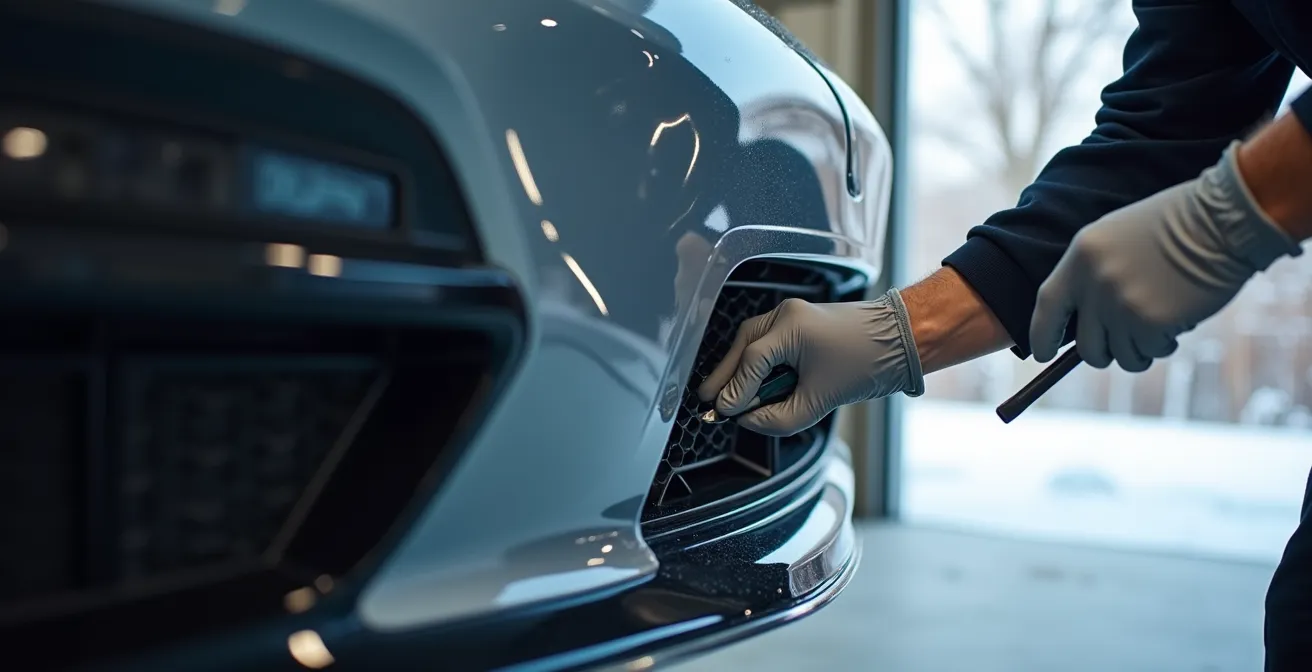
Case Study: The ROI of PPF in Canada
A recent cost analysis for the Canadian market demonstrates the clear return on investment for PPF. With professional installation for comprehensive bumper protection costing approximately $2,500 CAD, and individual rock chip repairs averaging $300-$500 each, the PPF investment often pays for itself within one to two harsh winter seasons. For vehicles with expensive composite or carbon fiber bumpers valued at $6,000 CAD or more, the protection is considered an essential ownership cost to preserve the vehicle’s value and avoid costly insurance claims.
Think of PPF not as an accessory, but as an insurance policy with a one-time premium. It maintains the factory finish, prevents the need for costly and often imperfect cosmetic repairs, and ultimately protects the resale value of your vehicle. For any premium car driven through a Canadian winter, it’s the smartest money you can spend.
Why CAPA certification matters for aftermarket bumpers and hoods?
When your insurer reviews your repair estimate, you’ll likely encounter the terms OEM and aftermarket. OEM (Original Equipment Manufacturer) parts are made by the car company. Aftermarket parts are made by third-party companies. To control costs, insurers often push for the use of aftermarket parts. This is where the Certified Automotive Parts Association (CAPA) becomes critically important for consumer protection.
CAPA is an independent, non-profit organization that tests and certifies aftermarket parts to ensure their quality, fit, and safety are comparable to OEM parts. A CAPA-certified bumper isn’t just a piece of plastic; it has been subjected to rigorous evaluations, including material property tests and, for some, even dynamic crash tests. Using a non-certified aftermarket part is a gamble. It may not fit correctly, the finish may be poor, and most importantly, it may not perform as designed in a subsequent collision, potentially compromising airbag sensor timing or crash energy absorption.
In Canada, the situation is complex. Major insurers often have agreements with their « Direct Repair Program » (DRP) shops to use CAPA-certified parts to keep claim costs down. However, as the vehicle owner, you generally have the right to insist on OEM parts, though you may have to pay the difference in cost. The debate is contentious, leading to multiple class-action lawsuits in Ontario and Quebec over allegations that consumers were not adequately informed about the quality of parts used. For any safety-related component, insisting on either an OEM or CAPA-certified part is a non-negotiable baseline for a safe repair.
Key Takeaways
- The high cost of aluminum/carbon fiber repair is driven by a required « ecosystem » of separate facilities, specialized tools, and mandatory technician training.
- Carbon fiber’s brittleness in extreme cold makes it more prone to cracking from minor impacts, a key concern for Canadian winters.
- A « Rebuilt » title in Canada can reduce a car’s resale value by 20-50% and create significant hurdles for obtaining insurance and financing.
Why a « Rebuilt » title destroys 40% of your car’s future resale value?
Perhaps the most devastating financial outcome of a major repair is having your vehicle branded with a « Rebuilt » title. In Canada, when a vehicle is declared a total loss by an insurer (meaning the cost of repair exceeds a certain percentage of its value), it is typically given a « Salvage » title. If the vehicle is then repaired and passes a stringent structural integrity inspection, it can be re-registered with a « Rebuilt » title. While this makes the car legally drivable, it permanently stigmatizes the vehicle in the marketplace.
The impact on value is immediate and severe. Studies and market data consistently show that in Canada, rebuilt title vehicles sell for 20-50% less than an identical model with a clean title. A 40% reduction is a realistic average. This « value destruction » stems from a deep-seated lack of trust from potential buyers. There is no way for a future buyer to be certain of the quality of the repairs performed. Was the work done at a manufacturer-certified shop, or was it a quick patch-up to get it back on the road?
The problem is compounded by the insurance and financing industries. As a case study on Ontario’s Mandatory Vehicle Branding Program highlights, many insurance companies in Canada will refuse to provide comprehensive or collision coverage for a rebuilt vehicle, offering only basic liability. Banks are equally hesitant, often declining to provide financing for rebuilt cars. This drastically shrinks the pool of potential buyers to those who can pay in cash and are willing to accept the insurance risk. This combination of buyer skepticism and institutional roadblocks is what effectively destroys a significant portion of your car’s value, regardless of how well it was repaired.
Total Loss Assessment: How to Negotiate Your Payout in Canada?
When the repair costs for your advanced-material vehicle approach its actual cash value (ACV), you enter the realm of a total loss negotiation. This can be an intimidating process, but you are not powerless. Your goal is to ensure the insurer’s payout offer accurately reflects the true market value of your specific vehicle *before* the accident. The insurer’s first offer is often based on generic data and may not account for your car’s specific condition, options, or the local market dynamics in your part of Canada.
As the Financial Consumer Agency of Canada states, the settlement is based on pre-accident value. To negotiate effectively, you must do your homework. Start by researching comparable vehicles for sale in your area (same year, make, model, trim, and similar mileage). Use sources like AutoTrader, Kijiji Autos, and dealer listings. Document at least 3-5 examples. Did you recently install new premium tires or have a high-end PPF application? Provide receipts. Was your vehicle in immaculate, low-mileage condition? Provide photos and service records. Present this information to the insurance adjuster in a clear, organized report.
Your insurance company will review your claim and decide how it will settle it. They base the settlement on the value of your car before the accident
– Financial Consumer Agency of Canada, Government of Canada Insurance Guide
If you still feel the offer is too low, you have the right to hire an independent, third-party appraiser. While this comes at your own cost, a professional appraisal report carries significant weight in a dispute. Remember, the negotiation is a business transaction. Be polite, be persistent, and back up your position with verifiable evidence. Your objective is not to make a profit, but to be made whole for the fair market value of the asset you lost.
Armed with this insider knowledge of the repair ecosystem, your next step is to confidently review your current insurance policy. Pay close attention to clauses regarding OEM parts and the total loss threshold, and be prepared to open a clear, informed dialogue with your body shop and adjuster should the need ever arise.
Frequently Asked Questions About Aftermarket Parts in Canada
Do Canadian insurers require CAPA-certified parts?
Major Canadian insurers often mandate or strongly prefer CAPA-certified parts in their Direct Repair Program agreements with body shops to control costs. However, it’s important to know that consumers typically maintain the right to choose OEM parts, though they may have to cover the cost difference. This is a crucial point to discuss with your adjuster.
What’s the safety concern with non-CAPA aftermarket parts?
According to industry experts cited in a Canadian Underwriter report, the primary concern with non-certified aftermarket parts is a lack of verified performance and fit. While they are not typically used for primary structural components, a poor fit on a part like a bumper cover could interfere with the function of parking sensors or radar systems, and it may not absorb impact energy as designed, affecting safety systems.
How prevalent are aftermarket parts lawsuits in Canada?
The use of aftermarket parts in insurance claims is a contentious issue. Currently, there are five class action aftermarket parts lawsuits in Ontario and four in Quebec. These lawsuits generally stem from concerns about inadequate disclosure to consumers regarding the quality and origin of the parts being used for their vehicle repairs.