Navigating Canada’s vehicle compliance landscape is fraught with complex and often contradictory provincial rules. Many owners focus on avoiding simple noise tickets, but the real risks are far more severe, ranging from immediate vehicle impoundment and voided insurance to significant environmental liability. This guide provides the necessary clarity to understand not just the rules, but the high-stakes consequences of non-compliance for your catalytic converter, exhaust system, and emissions components.
The metallic scraping sound of a saw under your vehicle in the middle of the night is an increasingly common and violating experience for Canadian car owners. Elsewhere, the thrill of a modified, rumbling exhaust is met with the flashing blue and red lights of a traffic stop. In both scenarios, the owner is thrust into the complex world of vehicle compliance. Many believe the consequences are limited to the cost of a replacement part or a simple noise ticket. This is a dangerous misconception.
The common advice is often generic: « Don’t make your car too loud, » or « Make sure you pass your emissions test. » This surface-level understanding misses the critical details of what is a true provincial patchwork of regulations. The reality is that the legal and financial liability extends far beyond a fine. It involves fundamental issues of road safety, environmental protection, insurance validity, and the potential for your vehicle to be seized on the spot.
The key to staying legal is not simply to be quiet, but to understand the principle of system integrity. A modern vehicle’s exhaust and emissions system is an integrated whole. Tampering with one component doesn’t just risk a ticket; it compromises the entire vehicle’s compliance certificate, with consequences that vary drastically from British Columbia to Quebec. This is not about punishing enthusiasts; it is about upholding federal and provincial safety and environmental mandates.
This document will provide a clear, firm breakdown of the most common compliance pitfalls. We will dissect the risks associated with catalytic converter theft and replacement, the legalities of diesel particulate filter (DPF) removal, the methods of noise enforcement, and the critical differences between a safety inspection and an emissions test. The objective is to equip you with the knowledge to make informed decisions and avoid severe, costly penalties.
The following sections break down the essential compliance areas you must understand. This guide will serve as your reference for navigating the specific regulations and enforcement realities across Canada.
Summary: A Guide to Canadian Exhaust & Noise Law Compliance
- Why hybrids are targeted for theft and how to protect yours?
- The legal and resale risks of removing DPF/DEF on diesel trucks
- Decibel Limits: How police are testing loud exhausts in cities?
- How to know if your high-flow cat is actually road legal?
- How to drive before an emissions test to ensure a « Pass »?
- The exhaust modification that can get your car impounded in Quebec
- Why you should never drain AC refrigerant yourself before scrapping?
- Why a « Check Engine » light might not fail a safety, but an exhaust leak will?
Why hybrids are targeted for theft and how to protect yours?
The primary driver behind the epidemic of catalytic converter theft is the precious metals contained within: platinum, palladium, and rhodium. The value of these metals has skyrocketed, turning these essential emissions devices into targets. According to one insurer, catalytic converter theft in Canada saw a staggering 1,700% increase between 2018 and 2022. This is not a random crime; it is a targeted enterprise.
Hybrid vehicles, such as the Toyota Prius, are disproportionately targeted for two reasons. First, their internal combustion engines run less frequently and at lower temperatures, resulting in less corrosion and degradation of the precious metals inside the converter. This makes them more valuable to recyclers. Second, the converters on many popular hybrid models are easily accessible to thieves, who can remove them in under a minute with a portable saw.
The problem is acute in urban centres. For example, in Calgary, police reported a jump from 300 incidents in 2020 to over 1,000 in just the first eight months of 2021. Edmonton saw similar spikes. The financial burden falls squarely on the vehicle owner, who faces not only the replacement cost but also potential damage to other underbody components and a vehicle that is undrivable and illegal to operate until repaired.
Protecting your vehicle requires a multi-layered approach. While no single method is foolproof, combining several strategies significantly increases the difficulty and risk for a potential thief. You must consider both physical deterrents and preventative measures.
- Control your environment: Whenever possible, park in a locked garage. If you must park outside, choose well-lit, high-traffic areas. Thieves prefer darkness and isolation.
- Install physical anti-theft devices: Several products are available, including steel shields that cover the converter or heavy-duty steel cables that are welded to the vehicle’s frame and wrapped around the converter.
- Enhance your alarm system: A standard car alarm may not be triggered. Consider installing a more sensitive alarm with a vibration or tilt sensor that will react to the sawing or lifting of the vehicle.
- Mark your converter: Some police services and local mechanics offer programs to engrave your Vehicle Identification Number (VIN) onto the catalytic converter, making it harder for thieves to sell to reputable recyclers.
- Verify your insurance: Ensure your automotive policy includes comprehensive coverage, which typically covers theft. Without it, you will be responsible for the entire replacement cost.
The legal and resale risks of removing DPF/DEF on diesel trucks
In the world of diesel trucks, the removal of the Diesel Particulate Filter (DPF) and Diesel Exhaust Fluid (DEF) systems, commonly known as a « delete, » is often promoted as a way to increase horsepower, improve fuel economy, and reduce maintenance issues. However, from a compliance standpoint, this modification is one of the most high-risk changes you can make to a modern vehicle in Canada. It directly contravenes federal and provincial environmental laws.
These systems are not optional accessories; they are federally mandated emissions control devices crucial for trapping and burning off harmful soot and reducing nitrogen oxide (NOx) emissions. Removing them is an act of tampering that renders the vehicle non-compliant with the emissions standards it was built to meet. This creates significant legal and financial liability for the owner.
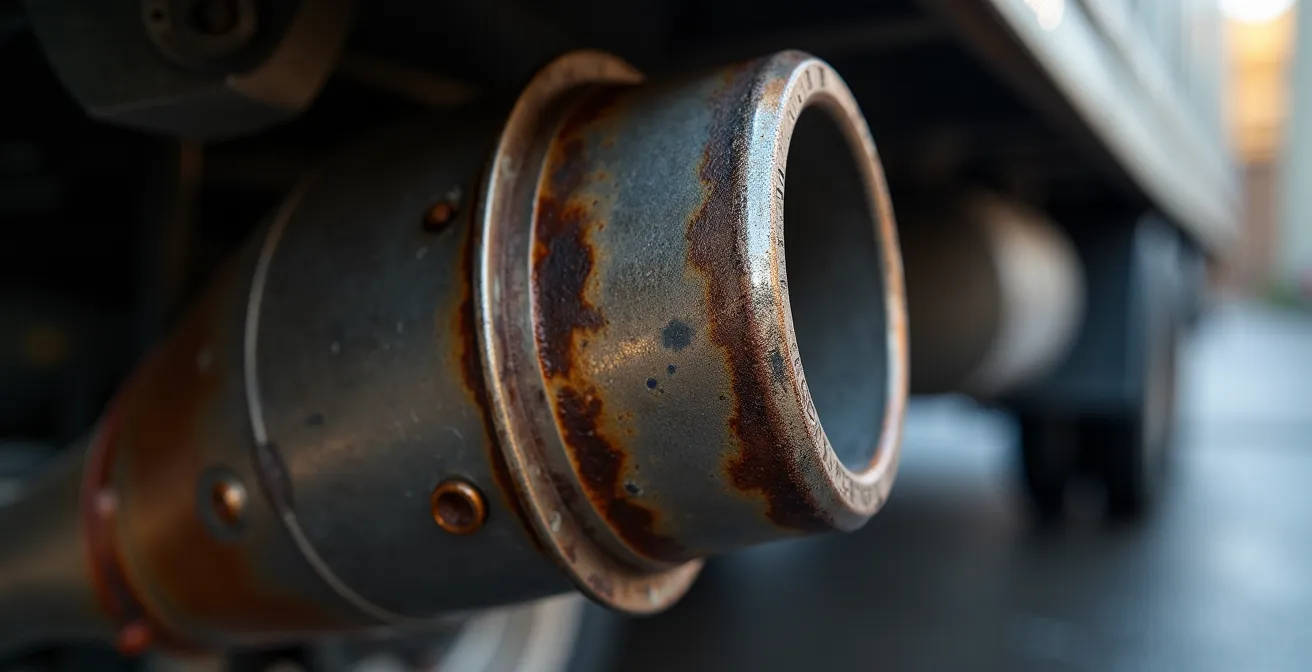
The enforcement of DPF delete laws is a prime example of Canada’s provincial patchwork. While illegal everywhere, the level of active enforcement varies, creating a dangerous sense of security for some owners. Provinces like Ontario and Quebec have implemented strict enforcement programs, including roadside inspections and targeted blitzes, that can lead to substantial fines and orders to restore the vehicle to its original factory condition at the owner’s expense.
The resale risk is equally severe. Selling a deleted truck privately without disclosing the modification can expose you to civil liability if the new owner discovers the illegal changes. Furthermore, a knowledgeable buyer or dealership will likely refuse the vehicle or drastically reduce its value, as they would have to bear the significant cost of reinstalling a compliant emissions system, which can run into thousands of dollars.
The following table provides a general overview of the legal landscape, but it’s crucial to understand that even in « grey area » provinces, the modification remains illegal and enforcement can be implemented at any time.
| Province | Legal Status | Enforcement Level |
|---|---|---|
| British Columbia | Illegal | Active enforcement |
| Ontario | Illegal | High enforcement |
| Quebec | Illegal | Strict enforcement |
| Alberta | Grey area | Limited enforcement |
| Saskatchewan | Grey area | Limited enforcement |
Decibel Limits: How police are testing loud exhausts in cities?
One of the most common points of friction between vehicle owners and law enforcement is exhaust noise. The complaint of an « unnecessarily loud muffler » is a frequent cause for traffic stops across Canada. A common misconception is that noise enforcement is purely subjective, but police forces are increasingly adopting more objective methods to support an officer’s judgment.
Historically, enforcement has relied on the officer’s discretion. The language in many provincial Highway Traffic Acts prohibits noise that is « excessive » or « unusual, » leaving the interpretation up to the officer on the scene. If an officer determines your exhaust is significantly louder than the original factory equipment, they have grounds to issue a ticket. This principle of enforcement discretion remains the primary method of enforcement in most jurisdictions.
However, to combat the subjectivity, major Canadian municipalities are implementing standardized testing procedures based on specific decibel limits. For instance, the City of Toronto has established a 92 dB(A) limit for motorcycles at idle, measured with a certified sound level meter positioned 50 centimetres from the exhaust pipe. This provides a clear, objective standard that removes guesswork. Similar programs for all vehicle types are being piloted and adopted in cities from Edmonton to Vancouver.
An officer suspecting a noise violation may conduct a roadside test if they are equipped with the proper device. This typically involves placing the meter at a regulated distance from the exhaust outlet and measuring the sound level at both idle and a specified higher RPM (e.g., 2,000 RPM). If the measurement exceeds the local bylaw or provincial standard, it serves as undeniable evidence for a fine and potentially a vehicle inspection order. Drivers must understand that both subjective judgment and objective measurement are valid tools for enforcement.
How to know if your high-flow cat is actually road legal?
For enthusiasts looking to improve exhaust flow, a « high-flow » catalytic converter seems like a compliant compromise. Unlike a complete « test pipe » or « cat delete, » it retains an emissions-cleaning function. However, the Canadian market for these components is a significant regulatory grey area, and many products sold online are not legal for road use, even if they are marketed as such.
The core of the problem is a lack of a unified Canadian certification standard. As one industry analysis notes, Canada largely defers to American emission regulations for cross-border sales. Unlike California, which has the stringent California Air Resources Board (CARB) certification process, there is no equivalent federal or provincial body in Canada that certifies aftermarket catalytic converters for road legality. This leaves consumers vulnerable to purchasing non-compliant parts.
A part labeled « for off-road use only » or « racing use only » is an immediate red flag; it is explicitly not legal for public roads. These units often lack the required loading of precious metals to effectively reduce emissions to the level required by your vehicle’s original certification. While it may not trigger a check engine light immediately, it will cause your vehicle to fail any modern, OBD-II-based emissions test. Fines for using these parts can be substantial, and you will be required to replace the illegal component with a compliant one.
Given the lack of a clear « Made for Canada » legal stamp, the onus is on the consumer to identify potentially non-compliant products. You must be a vigilant and informed buyer, as ignorance of the law is not a defence.
Your Checklist to Spot an Illegal Aftermarket Converter
- Price and Platform: Be extremely wary of suspiciously low prices on peer-to-peer marketplaces like Kijiji or Facebook Marketplace. A compliant converter contains expensive precious metals; a price that seems too good to be true usually is.
- Vehicle Specificity: Question « universal fit » claims. A compliant converter is designed for the specific emissions profile of your vehicle’s make, model, and year. Look for parts that specify exact vehicle fitment.
- Hardware and Documentation: A legitimate part will come with proper heat shields and mounting hardware. Critically, ask the seller if they can provide any documentation proving it meets EPA (U.S. Environmental Protection Agency) or other recognized emissions standards. An inability to do so is a major red flag.
- Performance Claims: Be skeptical of promises of significant horsepower gains (e.g., more than a few percent). The primary job of a converter is emissions control, not power enhancement. Exaggerated claims often mask a non-compliant, hollowed-out design.
- Product Labeling: Any product explicitly labeled « for off-road use only » or « racing part » is confirming its illegal status for public road use. This is not a suggestion; it is a legal disclaimer to protect the seller, not you.
How to drive before an emissions test to ensure a « Pass »?
For drivers in provinces with emissions testing programs, such as Ontario’s DriveOn, a « Pass » is not just about having a clean-burning engine. It is about your vehicle’s onboard computer, the OBD-II system, confirming that all its emissions-related sensors and components are functioning correctly. This confirmation is achieved through a series of internal self-tests known as « Readiness Monitors. »
If you have recently disconnected your battery, cleared a check engine light, or had certain repairs done, these Readiness Monitors will be reset to a « Not Ready » state. An emissions test centre cannot complete your test if too many monitors are not ready, resulting in an automatic « Not Ready » rejection. You will be told to go drive your car and come back. This is where a specific « drive cycle » becomes necessary.
A drive cycle is a sequence of driving conditions—including cold starts, steady-state cruising, and acceleration/deceleration phases—that allows the OBD-II system to run its diagnostic checks. The exact procedure can vary by manufacturer, but a general-purpose drive cycle is effective for most vehicles.
The Canadian climate, particularly in winter, can complicate this. A proper cold start is often the first step, requiring the engine to be off for at least 8 hours. The subsequent driving must be done smoothly, without aggressive acceleration, to allow the sensors to gather stable data. A generic but effective drive cycle includes these key steps:
- Cold Start: With the car off for at least 8 hours, start the engine and let it idle in Park or Neutral for 2-3 minutes. This allows the oxygen sensor heater and other components to activate.
- Steady State City Driving: Drive the car for about 10 minutes in city traffic, including some stop-and-go conditions, at speeds between 40-60 km/h.
- Steady State Highway Driving: Drive for 15-20 minutes on a highway at a steady speed between 80-100 km/h. Avoid using cruise control if possible, as slight variations in throttle can help the system run its tests.
- Deceleration: Let the vehicle coast down (without braking, if safe to do so) from highway speeds to around 30 km/h.
Performing this cycle once or twice is usually sufficient to set the necessary monitors. Many auto parts stores offer free OBD-II scans, which can tell you if your monitors are in a « Ready » state before you go for the official test.
The exhaust modification that can get your car impounded in Quebec
While exhaust modification laws are a provincial matter across Canada, Quebec stands out for its particularly strict enforcement and severe penalties. The province’s Highway Safety Code gives police officers significant authority to remove non-compliant vehicles from the road immediately. The one modification that is a near-guaranteed path to this outcome is a « muffler delete. »
Removing the muffler and replacing it with a straight pipe is unequivocally illegal in Quebec. It is not a matter of subjective noise level; it is the act of removing a required piece of safety and emissions equipment. As one user on a Canadian automotive forum starkly puts it, this is not a simple ticket:
Muffler delete is 100% illegal here. You will have to tow the car back or they can even impound it. All is at the discretion of the cop, some don’t care some will impound the car.
– Quebec automotive forum member, RedFlagDeals Forum
This highlights the critical element of enforcement discretion. While some officers may issue a warning or a standard fine, others are fully authorized to have the vehicle seized. According to the Société de l’assurance automobile du Québec (SAAQ), a vehicle that is seized is towed and impounded at the owner’s expense. The fees for towing and daily storage accumulate quickly.
To reclaim the vehicle, the owner must not only pay all outstanding fines and fees but also provide proof that the vehicle has been brought back into compliance. This means having the original muffler or a compliant aftermarket equivalent reinstalled. The vehicle will then need to pass a technical inspection by an authorized agent before it can be legally driven again. This process is time-consuming, expensive, and a significant escalation from a simple noise violation ticket in other provinces.
Why you should never drain AC refrigerant yourself before scrapping?
When preparing a vehicle for scrap, some owners may consider draining fluids to maximize its scrap metal value. While draining oil or coolant is standard practice, attempting to drain the air conditioning refrigerant yourself is a serious violation of federal environmental law. This is not a maintenance task; it is an act with significant compliance liability.
Automotive refrigerants, such as R-134a and the newer HFO-1234yf, are potent greenhouse gases. When released into the atmosphere, they contribute to climate change. Older refrigerants, like R-12, are also ozone-depleting substances. Because of this environmental impact, their handling is strictly regulated.
The intentional release of these substances is prohibited under the Canadian Environmental Protection Act, 1999 (CEPA). The regulations under this act are clear: only a certified technician using specialized recovery equipment is permitted to remove refrigerant from a system. Cutting an AC line or opening a valve to let the gas escape is a federal offense.
Violating these regulations is not a minor infraction. While specific fines can vary, the act stipulates that significant penalties can be imposed for intentionally releasing refrigerants. This liability falls on the individual who performs the act. Licensed scrap yards and automotive recycling facilities are required by law to ensure refrigerants are properly recovered before a vehicle is crushed. They will not accept a vehicle with a knowingly vented AC system, and may even be obligated to report it.
Beyond the legal and environmental consequences, there is a direct safety risk. Refrigerants are under high pressure and can cause severe freeze burns (frostbite) upon contact with skin. It is a hazardous material that must be handled with professional care.
Key Takeaways
- Provincial laws are not uniform; what is tolerated in one province can lead to vehicle impoundment in another.
- The risks go far beyond fines, including voided insurance, catastrophic loss of resale value, and federal environmental liability.
- System integrity is non-negotiable; an exhaust leak or tampered emissions device compromises safety and legality, regardless of what a dashboard light says.
Why a « Check Engine » light might not fail a safety, but an exhaust leak will?
A common point of confusion for vehicle owners is the distinction between a safety inspection (or Safety Standards Certificate) and an emissions test. Many assume that any dashboard warning light, particularly the « Check Engine » light (CEL), means their car is unsafe. This is not necessarily true. The two tests evaluate entirely different aspects of your vehicle’s health, and an exhaust leak is a failure of system integrity that poses a direct threat, unlike many CEL triggers.
As one Canadian automotive safety inspector clarified, the logic is based on immediate risk: « An exhaust leak poses a direct risk of carbon monoxide poisoning to occupants and is an immediate failure. » Carbon monoxide is a colourless, odourless gas that can be lethal. If an exhaust leak exists under the passenger cabin, this gas can easily seep inside, creating a life-threatening situation. Therefore, any detectable leak in the exhaust system from the engine to the tailpipe is an automatic failure on a provincial safety inspection.
A Check Engine Light, on the other hand, is a signal from the OBD-II system that a fault has been detected within the powertrain or emissions systems. While it automatically fails an emissions test, the underlying fault may not pose an immediate safety risk. For example, a CEL could be triggered by a loose gas cap or a failing oxygen sensor. While these issues need to be addressed for emissions compliance and optimal performance, they do not make the car inherently dangerous to operate in the same way a carbon monoxide leak does.
The following table clarifies the different criteria for these two critical vehicle assessments. It is crucial to note that while a missing catalytic converter may pass a visual safety check in some provinces, it is an automatic failure on any emissions test.
| Issue | Safety Inspection (SSC) | Emissions Test |
|---|---|---|
| Check Engine Light (emissions-related) | May Pass | Automatic Failure |
| Exhaust Leak | Automatic Failure | Likely Failure |
| Missing Catalytic Converter | May Pass (varies by province) | Automatic Failure |
| Excessive Noise | May Fail | Not Tested |
Maintaining vehicle compliance in Canada requires a proactive and informed approach. It is not enough to simply react to a ticket or a failed test. You must understand that your vehicle’s exhaust and emissions systems are integral to its safety, environmental legality, and financial value. Upholding their integrity is your responsibility. For a personalized assessment of your vehicle’s compliance status, consult a licensed technician who understands your province’s specific regulations.