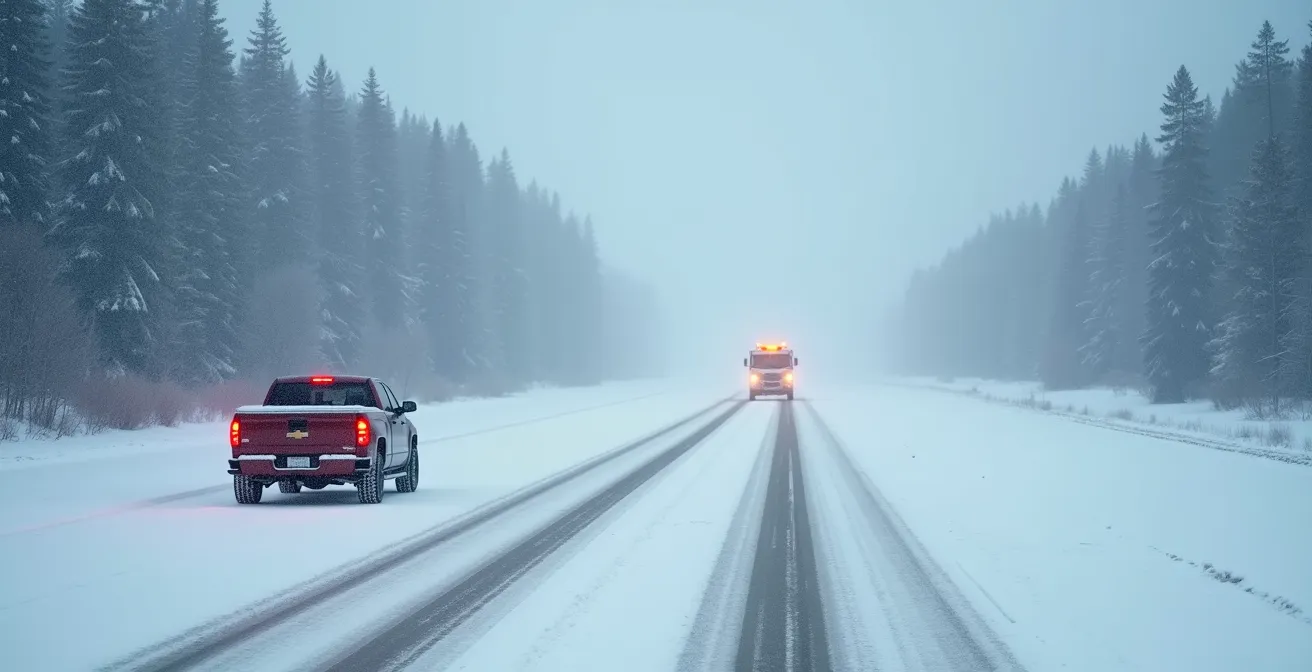
Your car’s « free » roadside assistance is designed for urban convenience, not for surviving a breakdown in the Canadian winter.
- Manufacturer plans offer minimal towing distances that are functionally useless in most of rural Canada.
- Critical services like winching your vehicle out of a snowbank are often excluded from free or credit card plans.
Recommendation: Evaluate your roadside assistance plan based on a worst-case winter scenario, not just the annual fee.
Picture this: the temperature is dropping past -25°C, the snow is blowing sideways, and your car just died on a dark, lonely stretch of a Canadian highway. You reach for your phone, but who do you call for help that will actually arrive and get you to safety? You remember your new car came with « free » roadside assistance from the manufacturer. It’s a comforting thought, a standard feature often bundled with heated seats and a remote starter. Many drivers assume this service is all they’ll ever need, perhaps comparing it to a basic credit card perk and calling it a day.
But what if that « free » service is a promise built for a mild inconvenience, not a high-stakes Canadian winter emergency? I’ve been in this business a long time, and I can tell you the real difference between manufacturer assistance and a dedicated service like the Canadian Automobile Association (CAA) isn’t about the annual fee—it’s about closing the « survival gap » when you’re most vulnerable. This isn’t just about getting a tow; it’s about having a plan that accounts for the harsh realities of our climate. It’s about getting you, your family, and your vehicle to safety without surprise costs or dangerous delays.
In this practical guide, we’ll move beyond the simple marketing checklists. We will dissect the real-world winter scenarios that test the limits of any roadside plan. We’ll expose the critical gaps in « free » coverage—from useless towing limits in rural areas and crippling wait times in a blizzard to the fine print that leaves you literally stuck in a snowbank. By the end, you’ll have a clear framework for deciding which service truly wins when a Canadian winter does its worst.
Summary: CAA vs Manufacturer Assistance in Canadian Winters
- Why the « free » 10km towing limit is useless in rural Canada?
- Why you might wait 8 hours for a tow truck during a blizzard?
- The fine print that excludes winching services from your credit card plan
- Which roadside plan actually covers a dual-axle trailer?
- The 3 tools to keep in your trunk to avoid calling a tow truck?
- The risks of relying on public chargers in remote parts of the provinces
- The dashboard light that means you must stop highway driving immediately
- The 60-Second « Circle Check » That Saves Canadians from Morning Breakdowns
Why the « free » 10km towing limit is useless in rural Canada?
The most common feature touted by manufacturer and credit card roadside assistance plans is the « free » tow. On paper, it sounds sufficient. But the devil is in the details, and in Canada, that detail is distance. Most basic plans cap this service at a mere 10 kilometres. In a dense urban centre like Toronto or Vancouver, 10km might get you to a handful of dealerships or repair shops. But outside of our major cities, it’s a dangerously inadequate distance that creates a false sense of security.
This isn’t just an opinion; it’s a statistical reality. According to a 2024 report from Statistics Canada, only 2 in 5 households in rural and small-town Canada have access to basic services within 15 km of their home. If you break down on a provincial highway, there’s a strong chance the nearest qualified service centre—let alone your preferred mechanic or dealership—is 30, 50, or even 100 kilometres away. This creates a « logistical black hole » where your « free » assistance runs out long before you reach safety, leaving you to pay the hefty per-kilometre overage charge out of pocket.
This table clearly illustrates the massive gap between the coverage offered by basic plans and the distances required for true peace of mind in most of the country.
| Service Provider | Basic Coverage | Premium Coverage | Cost Per Year |
|---|---|---|---|
| Manufacturer Assistance | 10 km | Nearest dealer only | Free (3-5 years) |
| CAA Basic | 10 km | N/A | $75-100 |
| CAA Plus | 200 km | Your choice destination | $120 |
| CAA Premier | 320 km | Your choice destination | $150 |
When your free tow ends in the middle of nowhere, you’re suddenly negotiating with a tow operator for the remaining distance, a cost that can quickly run into hundreds of dollars. A premium plan like CAA Plus or Premier, with its 200km+ range, transforms a potential financial and safety crisis into a managed inconvenience. It’s the difference between being dropped at the nearest (and possibly closed) gas station and being taken all the way home.
Why you might wait 8 hours for a tow truck during a blizzard?
Every Canadian driver knows the feeling: the first major blizzard of the season hits, and the entire region slows to a crawl. It’s precisely when you’re most likely to need help that assistance is hardest to get. A promised 60-minute response time can easily stretch to six, seven, or even eight hours. This isn’t because companies are incompetent; it’s due to a logistical nightmare I call the « blizzard bottleneck. » During a severe weather event, the system is overwhelmed. The number of calls for spinouts, collisions, and dead batteries skyrockets all at once.
Simultaneously, the resources to respond are severely hampered. Tow trucks must navigate treacherous, often unplowed roads. Major highways may be closed, forcing long detours. A single jack-knifed tractor-trailer can shut down an artery for hours, preventing recovery vehicles from reaching anyone beyond the blockage. Furthermore, dispatchers must triage calls, prioritizing life-and-death situations reported by police or ambulance services. Your car stuck in a snowbank, while stressful, may not be at the top of the list.

This is where the structure of the assistance provider matters. Many manufacturer plans subcontract to the lowest-bidding local tow companies. During a storm, these fleets are serving everyone—dealerships, private callers, and police. In contrast, a member-based organization like CAA has a dedicated network and a vested interest in serving its members first. While no one is immune to extreme delays, a dedicated service often has better systems for managing the surge and providing more realistic ETAs. Waiting in a freezing car for hours is a serious safety risk; understanding why it happens is the first step to choosing a plan that might mitigate it.
The fine print that excludes winching services from your credit card plan
You’ve done everything right. You have winter tires, you drove for the conditions, but you hit a patch of black ice and slid gracefully into a snow-filled ditch. Your car is undamaged, but the wheels are spinning uselessly. This is a job for a winch, not a tow. You call your credit card’s « premium » roadside assistance, confident you’re covered. This is often where the « paper vs. pavement reality » hits hard. Many drivers are shocked to learn that being pulled out of snow, mud, or a ditch is considered « extrication » or « winching, » a service frequently excluded from basic and credit card plans.
These plans are designed to cover mechanical breakdowns on a flat, paved surface. The fine print is your enemy here. It may state that the vehicle must be « accessible from a normally travelled roadway » or that it excludes « recovery. » To them, your car in a ditch is a recovery situation, not a standard tow. A manufacturer’s plan might send a truck, but the operator will inform you the winching service is an extra charge—often a steep one, starting at $100 or more just to hook up the cable. This is one of the most common and frustrating « gotchas » in Canadian winter driving.
In contrast, premium plans are built for these scenarios. CAA Plus, for example, typically includes one hour of winching service with a standard truck. As the CAA South Central Ontario guide clarifies, their coverage extends beyond simple towing. For instance, they address other common frustrations with specific financial backing:
If your keys are locked in the vehicle, service will be sent to gain entry. CAA provides up to $50 for locksmith service for Basic Members and up to $100 for Plus Members.
– CAA South Central Ontario, Complete Guide to CAA Roadside Assistance
Before you rely on a « free » plan, you must become a fine print detective. Understanding these exclusions before you’re stuck is critical.
Your Action Plan: Auditing Your Roadside Assistance Fine Print
- Winching/Extrication: Check the policy for the specific words « winching » or « extrication. » If they aren’t mentioned as included, assume they are not. Most credit card plans exclude this entirely.
- « Recovery » vs. « Towing »: Scrutinize the definitions. Does it cover « recovery » for a vehicle that is stuck but not mechanically broken? This is a key exclusion.
- Coverage Area: Confirm the service area. Some plans are limited to publicly maintained roads, excluding private lanes or unassumed rural roads.
- Service Call Limits: Verify the maximum number of service calls allowed per year. This is typically 4 to 6 for most plans; a bad winter could exhaust that quickly.
- Towing Distance: Re-confirm the distance limit. As we’ve seen, credit cards often only cover 10km, a stark contrast to the 200km+ offered by premium CAA plans.
Which roadside plan actually covers a dual-axle trailer?
Imagine you’re towing your snowmobile trailer or a camper for a winter getaway and your truck breaks down. A standard tow truck arrives, sent by your manufacturer’s roadside assistance. They can tow your truck, but what about the trailer? In most cases, the answer is simple and brutal: they will leave it on the side of the road. Manufacturer and basic assistance plans cover the vehicle, period. The trailer is your problem.
This failure to provide « continuity of service » for your entire setup can turn a breakdown into a logistical nightmare. You’re now faced with abandoning valuable property on a highway shoulder to be dealt with later, or trying to arrange for a separate, specialized tow for the trailer at a moment’s notice, all at your own expense. It requires a heavy-duty wrecker and an operator skilled in handling combined loads, which is far beyond the scope of a basic service call.
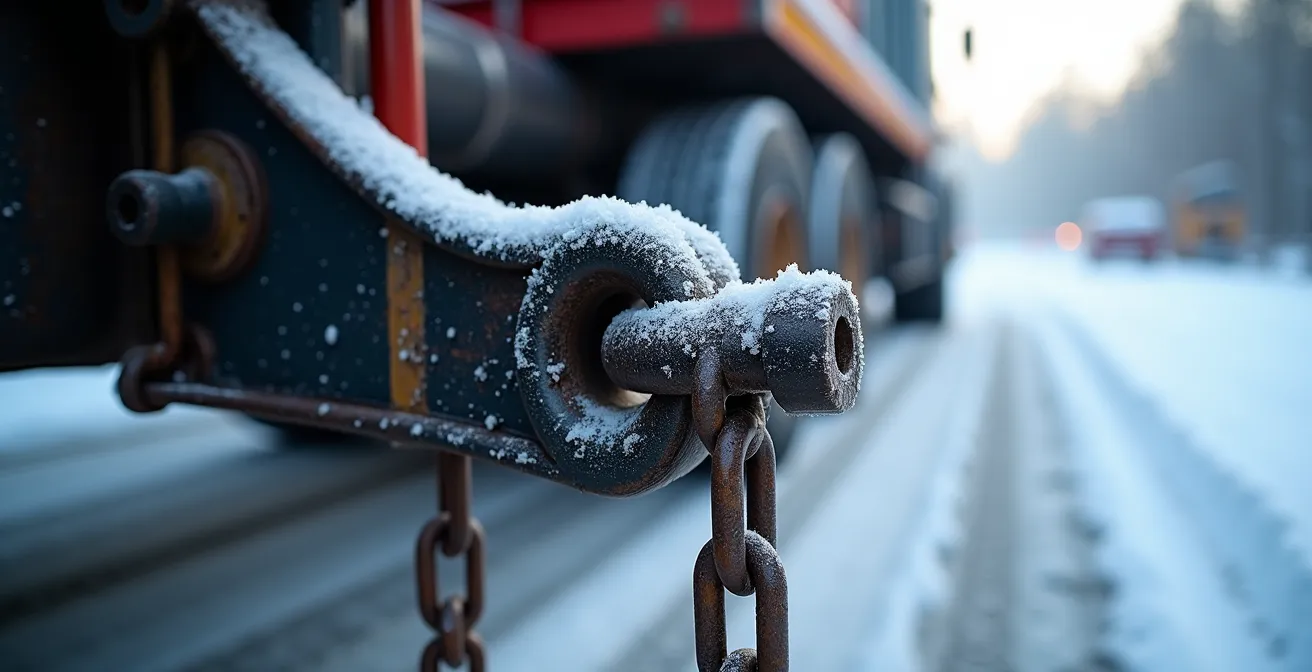
This is a specialized need that only premium, RV-inclusive plans are designed to handle. CAA Premier RV coverage, for example, is specifically built to cover not just your primary vehicle but also the trailer it’s towing. They will dispatch the correct equipment to handle both, ensuring your entire rig gets to safety. This type of coverage even extends to issues with the trailer itself, like flat tires or bearing failures.
The different approaches to trailer coverage clearly show how plans are designed for different types of drivers and their needs.
| Provider | Trailer Coverage | Special Requirements |
|---|---|---|
| Manufacturer Plans | Vehicle only | Trailer abandoned if towing required |
| CAA Basic | No | N/A |
| CAA Plus | Limited | Motorcycle coverage included |
| CAA Premier RV | Full coverage | Covers trailer tires, bearings, dual towing |
Even if you don’t tow a trailer, this example is telling. It demonstrates that higher-tier plans are designed to handle complex, real-world situations beyond a simple car breakdown. For example, CAA’s Plus and Premier plans also extend coverage to motorcycles, a vehicle type completely ignored by manufacturer plans. If your needs go beyond a single, standard passenger car, a basic plan is almost certainly insufficient.
The 3 tools to keep in your trunk to avoid calling a tow truck?
As a veteran of the roadside, I can tell you that the best service call is the one you never have to make. While having a great assistance plan is crucial, being prepared can often solve the problem yourself, saving you time and a service call entitlement. Especially in winter, a few basic tools can be the difference between getting back on the road in minutes and waiting hours for help. Forget fancy gadgets; these are the three most practical items you should have.
First, a portable jump starter/power pack. A dead battery is the number one cause of winter service calls. Cold weather drastically reduces a battery’s cranking power. A modern lithium-ion jump starter is a compact and powerful device that can start your car multiple times on a single charge. It’s far safer and easier than fumbling with booster cables and hoping for a kind stranger to offer their car. Many models also double as a power bank to charge your phone—an essential function when you’re stranded.
Second, a folding metal shovel and a bag of traction aid (cat litter or sand works perfectly). If you slide into a snowbank or get stuck in an unplowed parking spot, this combination is your best friend. A small shovel allows you to dig out snow from around your tires and under the car’s frame. Once cleared, throwing traction aid in front of your drive wheels can provide the extra grip needed to pull yourself out. This simple act can save you from a costly winching call.
Third, a basic 12-volt tire inflator. Cold temperatures cause air pressure in tires to drop significantly, often triggering the tire pressure monitoring system (TPMS) light. While a slow leak needs a proper repair, a tire that’s just low on pressure due to the cold can be safely re-inflated to the recommended PSI. An inflator that plugs into your car’s power outlet can get you safely to the nearest service station, preventing you from having to change a tire in a blizzard or ruin a perfectly good rim by driving on it flat.
The risks of relying on public chargers in remote parts of the provinces
The electric vehicle (EV) revolution is here, but in the vast, cold expanse of Canada, it comes with a unique set of challenges. For EV drivers, « range anxiety » is amplified tenfold in the winter. Relying solely on the public charging network, especially in remote or rural areas, is a high-risk strategy. The official range of your EV is a best-case scenario achieved in optimal temperatures. In the Canadian winter, that number is pure fiction.
Cold temperatures cripple battery performance in two ways: the battery itself holds less effective charge, and you must use a significant amount of energy to heat the cabin and the battery pack. This can reduce your real-world range by 30-50%. This reality makes trip planning a life-or-death calculation. A charging station that seems comfortably within reach on paper can become an impossible goal. A recent CAA winter EV test revealed that a vehicle could only add about 100 km of range in 15 minutes of DC fast charging—a fraction of what’s possible in the summer.
This creates logistical black holes even on popular routes. For instance, an analysis of the iconic Banff-Jasper National Parks route in Alberta found a critical issue. One study published by MDPI concluded that in winter, the 233 km gap between chargers becomes impossible for some EVs to cross safely due to range reduction. What’s more, you can’t assume a charger will be working when you get there. Vandalism, software glitches, or simply being occupied can leave you stranded with no backup. Unlike a gas car that can be brought a canister of fuel, a dead EV needs a flatbed tow truck, a more specialized and sometimes more expensive service. For EV drivers, a roadside assistance plan with extensive towing range isn’t just a good idea; it’s an essential piece of safety equipment.
The dashboard light that means you must stop highway driving immediately
Your vehicle’s dashboard is a vital communication tool, but we’ve become accustomed to ignoring some lights. The « check engine » light might stay on for weeks. However, certain warnings, especially in the unforgiving context of a Canadian highway in winter, are non-negotiable signals to pull over immediately and safely. Ignoring them can turn a minor issue into a catastrophic failure or a life-threatening situation.
Some lights indicate an immediate and severe mechanical problem that requires you to stop the engine as soon as it is safe to do so. Driving even one more kilometre can mean the difference between a simple repair and a complete engine replacement. Here are the critical warnings that demand your instant attention:
- Oil Pressure Light (Red Oil Can): This is arguably the most critical light. It means the engine is losing oil pressure, and its internal components are no longer being lubricated. Continuing to drive can seize the engine in minutes, turning a $50 sensor fix into an $8,000 engine replacement.
- Engine Temperature Light (Red Thermometer): This indicates the engine is overheating. Even at -25°C, this can happen if a snow-packed grille blocks airflow to the radiator. An overheating engine can warp heads and cause permanent damage. Pull over and let it cool.
- Flashing Check Engine Light: A solid check engine light is a warning; a flashing one is an emergency. It typically indicates a severe engine misfire that is dumping unburnt fuel into the hot catalytic converter, creating a significant fire risk.
- Brake System Warning (Red « BRAKE » or Circle with « ! »): This could signal something as simple as the parking brake being on, but it could also mean a critical loss of brake fluid or a hydraulic system failure. You cannot risk brake failure at highway speeds.
- Battery/Charging System Light: This means your vehicle’s alternator has likely failed and you are running on battery power alone. You have a very limited amount of time—often less than 30 minutes—before the battery is completely drained and the vehicle shuts down entirely. Find a safe place to stop immediately.
Knowing which lights are simple advisories and which are critical alarms is a fundamental part of safe winter driving. When one of these red lights appears, your only job is to get off the road safely and call for help.
Key Takeaways
- The 10km towing limit on free plans is insufficient for most of Canada, creating a « logistical black hole » in rural areas.
- Wait times for assistance can exceed 8 hours during a blizzard due to overwhelming call volumes and hazardous road conditions.
- Essential winter services like winching a car from a ditch are often excluded from manufacturer and credit card plans.
The 60-Second « Circle Check » That Saves Canadians from Morning Breakdowns
The best way to deal with a roadside emergency is to prevent it from happening in the first place. Many winter breakdowns are avoidable and can be caught before you even leave your driveway. Adopting the habit of a quick, 60-second « circle check » every morning is one of the most effective strategies a Canadian driver can employ. It’s a simple walk-around of your vehicle to spot potential problems that have developed overnight in the cold.
This isn’t a detailed mechanical inspection; it’s a fast, visual scan for common winter culprits. Start at the rear of your car and walk a full circle, paying attention to specific areas that are vulnerable to the cold. Look at your tires to see if one appears significantly flatter than the others. Check under the car for any new puddles of fluid. Ensure your wiper blades aren’t frozen solid to the windshield. This simple routine helps you move from a reactive to a proactive mindset, catching issues when they are a minor inconvenience at home, not a major crisis on the highway.
Here is a practical checklist tailored for the harsh realities of a Canadian winter morning. Performing these six checks can save you from a breakdown, a costly repair, or a dangerous situation.
- Exhaust Pipe Check: Before starting your car, ensure the exhaust pipe is not blocked by snow or ice. A blocked pipe can cause toxic carbon monoxide to fill the cabin while the car is idling.
- Wiper Blade Check: Gently lift your wipers to verify they are not frozen to the windshield. Turning on frozen wipers can strip the wiper motor gear, a surprisingly costly repair.
- Washer Fluid: Confirm you are using a winter-rated washer fluid (rated to -40°C or lower). Summer fluid will freeze instantly, rendering it useless when you get sprayed by a transport truck on the highway.
- Block Heater Cord: If you use a block heater, inspect the cord for any cracks or fraying before you unplug it. A damaged cord is a serious fire hazard.
- Tire Pressure: Visually inspect all four tires. The cold causes pressure to drop by about 1-2 PSI for every 5.6°C drop in temperature, which can trigger warnings or affect handling.
- Battery Terminals: A quick glance under the hood to look for heavy corrosion (a fuzzy white or blue substance) on the battery terminals can help identify a poor connection, which is exaggerated by the cold.
Don’t wait for an emergency to discover the gaps in your coverage. Take a few minutes now to review your current plan against these real-world winter scenarios and decide if it truly provides the peace of mind you need on a frozen Canadian highway.