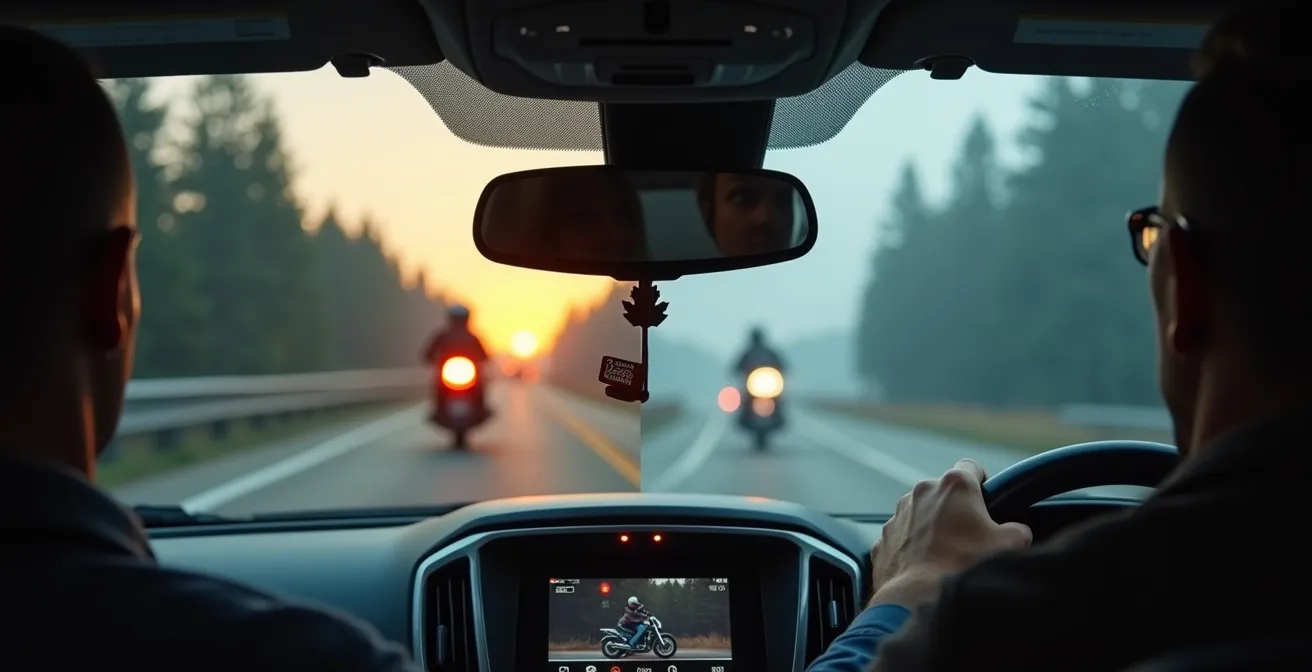
Contrary to the growing belief that blind spot monitors make the shoulder check obsolete, the opposite is true. These electronic systems have inherent, predictable failure modes, especially in challenging Canadian driving conditions. This guide establishes the non-negotiable hierarchy of safety: your vehicle’s technology is a supplemental aid, while your physical observation skills—head check, mirror setup, and situational awareness—remain the primary, life-saving procedure.
You see the yellow light on your dashboard. Nothing is there. You begin your lane change, confident that technology has your back. This is the modern driving promise: that sensors, cameras, and software can replace the perceived hassle of a physical head turn. Many drivers now operate under the assumption that these systems are infallible, a digital co-pilot that has eliminated the analog risks of the road. They see the shoulder check as a redundant, old-fashioned habit.
This assumption is fundamentally incorrect and dangerous. While Advanced Driver Assistance Systems (ADAS) have undoubtedly improved vehicle safety, they are not a replacement for driver discipline and foundational skills. These systems are tools, not guardians. They operate within specific parameters and are susceptible to failure from weather, speed differentials, and even routine vehicle maintenance. Believing they provide a complete picture of your surroundings is a critical error in judgment.
The true key to safety is not in choosing between technology and technique, but in understanding their correct operational order. The technology is supplemental; the driver is primary. This guide is not a debate on which is better. It is an instructional manual on why the physical shoulder check is, and will remain, a non-negotiable requirement. We will dissect the precise scenarios where your blind spot monitor will fail you and reinforce the procedures that will not.
This article will provide a systematic examination of the relationship between electronic aids and driver skill. The following sections break down the specific limitations of technology and codify the essential manual procedures required for safe operation on Canadian roads.
Summary: Blind Spot Monitors vs. The Shoulder Check: A Non-Negotiable Rule for Canadian Drivers
- Why a speeding motorcycle might not trigger your blind spot light in time?
- How to adjust mirrors to eliminate blind spots without electronics?
- Are stick-on blind spot sensors worth the money?
- Why your blind spot monitor beeps when turning with two lanes?
- The « Chin to Shoulder » movement that saves lives
- How to set your lumbar support correctly in 3 simple steps?
- Did a wheel alignment knock your radar sensors out of sync?
- How to adjust the warning timing to be less annoying but still safe?
Why a speeding motorcycle might not trigger your blind spot light in time?
Your vehicle’s blind spot monitoring (BSM) system is not all-seeing. It operates based on radar, and its effectiveness is dictated by the principles of physics, specifically the target’s size and speed. A motorcycle, having a much smaller radar cross-section than a car, is inherently more difficult to detect. When that motorcycle is also travelling at a significantly higher speed than you, it presents a critical system failure mode. The object can enter and exit the detection zone faster than the system’s processing cycle can register it and alert you.

Even advanced systems have their limits. For example, some of the latest aftermarket 77GHz radar systems detect targets up to 50 meters away with a 150° field of view. While impressive, this is a finite bubble. A motorcycle travelling 30 km/h faster than you covers nearly 8.4 meters per second. It can close that 50-meter gap in under 6 seconds. If your system’s refresh rate or alert logic isn’t instantaneous, the warning will come too late, or not at all. This kinetic reality is why you cannot afford to outsource your awareness to a sensor. The human eye and a deliberate head check remain the only definitive way to confirm the space is clear of small, fast-moving threats.
How to adjust mirrors to eliminate blind spots without electronics?
Before any reliance on technology, your primary safety system must be calibrated: your mirrors. The common practice of adjusting side mirrors to see the flanks of your own car is incorrect. This creates significant blind spots on both sides. The correct method, often called the B-pillar or SAE method, positions the mirrors to extend your field of vision outward, eliminating the blind spot for any vehicle of standard size. Proper adjustment is a non-negotiable foundational skill.
As documented in a 1995 paper for the Society of Automotive Engineers (SAE), George Platzer outlined the definitive procedure:
This method was first documented by George Platzer in a 1995 paper presented to the Society of Automotive Engineers, but the method is frequently overlooked in driver’s education classes
– Wikipedia – Blind Spot Monitor, Historical documentation of the SAE method
The procedure is precise and must be followed exactly:
- Position your driver’s seat: First, set your seat for optimal control and visibility. This is your baseline.
- Adjust the rearview mirror: Frame the entire rear window. This is your view of what’s directly behind.
- Adjust the left mirror: Lean your head to the left until it touches the driver’s side window. From this position, adjust the left mirror so you can just barely see the side of your car.
- Adjust the right mirror: Lean an equal distance to the right, over the center console. Adjust the right mirror so you can just barely see the right side of your car.
- Return and verify: When you return to your normal driving position, you should not see your own car in either side mirror. A passing vehicle should now appear to move seamlessly from your rearview mirror, into the side mirror, and then into your peripheral vision, without ever disappearing.
Mastering this technique renders the traditional « blind spot » for cars and trucks virtually non-existent. It is the first layer of a proper defense-in-depth safety strategy.
Are stick-on blind spot sensors worth the money?
Aftermarket blind spot sensors can be a tempting, low-cost addition to an older vehicle. However, their value is directly proportional to their underlying technology and price. The market is divided into two main categories: basic ultrasonic systems and more advanced radar systems. For Canadian drivers, this choice is critical. Basic ultrasonic sensors, while cheap, perform poorly in the very conditions where you need them most. Snow, ice, or even heavy rain can easily obstruct the sensors or cause constant false alerts, rendering them useless.
Advanced radar-based aftermarket systems offer significantly better performance, but at a higher cost for both the unit and professional installation. It is imperative to understand the trade-offs before investing. A cheap system that cannot be trusted is not a safety feature; it is a distraction. An analysis of available systems on the Canadian market reveals a clear hierarchy of performance and cost, as shown in a recent comparison from automotive experts.
| Feature | Basic Ultrasonic | Advanced Radar | OEM Factory |
|---|---|---|---|
| Price Range (CAD) | $50-150 | $300-600 | $500-1500 (option) |
| Weather Performance | Poor in snow/ice | Good all-weather | Excellent |
| Installation | DIY possible | Professional recommended | Factory integrated |
| Detection Range | 2-3 meters | Up to 50 meters | Variable by model |
| False Alerts | Common | Moderate | Minimal |
While some data suggests a 23% reduction in injuries from lane-changing accidents with BSM systems, this figure primarily reflects reliable, factory-installed OEM systems. An improperly installed or low-quality aftermarket unit will not provide this level of safety. If you choose to invest, you must invest in a quality, all-weather radar system and budget for professional installation and calibration. Anything less is a false economy.
Why your blind spot monitor beeps when turning with two lanes?
One of the most common complaints about BSM systems is false alerts, particularly during double-lane turns. When you are in the inside lane of a two-lane turn, your monitor will often beep, flagging the vehicle in the outside lane as a threat. This is not a malfunction. It is a perfect example of the system’s literal, programmed logic overriding contextual human understanding. The radar sensor detects an object—the adjacent car—that is alongside your vehicle and moving at a similar speed. According to its programming, this is a potential collision risk, so it triggers an alert.

The system has no concept of painted lanes or the shared intention of drivers in a coordinated turn. It only sees proximity and velocity vectors. It cannot differentiate between a car maintaining its path in the adjacent turning lane and one that is about to swerve into you. This is a fundamental limitation. You, the driver, must provide the context. You know you are in a double-lane turn and expect a car to be there. The system does not. This is why you must treat the alert as a piece of raw data, not as a definitive judgment. The beep means « an object is present. » It is your job, via a quick mirror check and shoulder glance, to identify that object and assess its actual threat level based on the situation.
The « Chin to Shoulder » movement that saves lives
The shoulder check is not a casual glance. It is a precise, practiced, and economical movement designed to cover the final area your mirrors cannot, without compromising control of the vehicle. The defining characteristic of a correct shoulder check is that you turn only your head, not your shoulders or torso. Steering follows your shoulders; turning them risks unintentionally swerving the car. The movement is a quick, 90-degree rotation of the neck, bringing your chin in line with your shoulder. It should take no more than one to two seconds.
This is not an optional maneuver. It is a mandatory action to be performed before every lateral move your vehicle makes. This includes every lane change, every merge, every turn onto a major street, and every time you pull away from a curb. The frequency builds muscle memory, turning a conscious action into an automatic, ingrained safety reflex. The goal is procedural discipline.
Your Action Plan: Mastering the Shoulder Check
- Position: Maintain a correct driving posture with your torso straight and arms steady on the wheel. Initiate the turn using only your neck muscles.
- Movement: Execute a crisp, 90-degree turn, moving your chin directly toward the shoulder corresponding to your intended direction of travel.
- Duration: The entire check, from the start of the head turn to its return to a forward-facing position, must be completed in 1-2 seconds maximum.
- Timing: Perform the check as the absolute last action immediately before you initiate the turn of the steering wheel. A check done too early is invalid.
- Frequency: Perform the check without fail for every single lane change, merge, significant turn, and when leaving a parked position. There are no exceptions.
This physical action is your final, definitive confirmation that the space you intend to occupy is clear. It compensates for the limitations of mirrors and the failure modes of all electronic systems. It is, without exaggeration, the single most important life-saving habit in your driving skillset.
How to set your lumbar support correctly in 3 simple steps?
Correct seating posture is not just about comfort; it is a critical component of vehicle control and driver awareness. Improper posture can lead to fatigue on long drives and, more importantly, can physically restrict your ability to perform a proper shoulder check. Your seat’s lumbar support must be adjusted to support the natural curve of your spine, which allows your upper body to remain flexible and mobile. For the average Canadian driving 15,200 km annually, much of it on highways, fighting fatigue through proper posture is a primary safety concern.
An over-inflated lumbar support will push your torso forward and away from the seatback, creating tension in your back and shoulders. An under-inflated one will cause you to slouch, putting strain on your lower back and making it difficult to pivot your head and neck freely. The goal is to achieve a neutral, supported spine that allows for a full, unimpeded 90-degree head rotation. The adjustment process is simple and should be performed every time you get in the car.
Follow this three-step procedure for optimal safety and comfort:
- Step 1: Sit fully back. Ensure your back is flush against the seat, with your shoulders touching the backrest. Do not leave a gap.
- Step 2: Adjust the support. Activate the lumbar control until you feel the support gently fill the natural inward curve of your lower back. It should feel supportive, not pushy. You are filling a void, not creating a bulge.
- Step 3: Test your mobility. Remain in your driving position and attempt a full « chin to shoulder » check to both the left and right. You should be able to complete the 90-degree turn comfortably, without feeling any strain or restriction from your seat.
This simple calibration ensures you are comfortable, alert, and physically capable of executing the safety maneuvers this vehicle requires.
Did a wheel alignment knock your radar sensors out of sync?
The advanced radar systems used for blind spot monitoring are not independent components. They are precisely integrated into your vehicle’s chassis and aligned with its central « thrust line. » Any service that alters this alignment, most commonly a four-wheel alignment, can knock these sensors out of calibration. A misaligned sensor may fail to detect vehicles, or worse, detect them in the wrong location, providing a false sense of security or creating confusing alerts. This is a critical system failure mode that most drivers are completely unaware of.
Case Study: The Link Between Alignment and ADAS Calibration
Leading automotive systems supplier Bosch clarifies that the corner radar sensors located in the rear bumper are calibrated to a high degree of precision relative to the vehicle’s geometric thrust line. A four-wheel alignment service fundamentally changes this thrust line. Consequently, the vehicle’s ADAS, including the blind spot detection system, requires a full recalibration to ensure its detection angles and distances are accurate. Failure to perform this recalibration invalidates the system’s reliability.
After any alignment, suspension work, or even minor rear-end collision repair, you must ask the service provider if an ADAS recalibration is required. It is not always included by default. The cost of this service in Canada varies, but skipping it means your safety systems cannot be trusted. A reputable service provider will be able to perform this crucial step.
| Service Provider | Basic Calibration | Full ADAS Suite | Warranty |
|---|---|---|---|
| Dealership | $300-500 CAD | $600-1200 CAD | Full warranty maintained |
| National Chains | $200-350 CAD | $400-800 CAD | Limited warranty |
| Independent Shops | $150-300 CAD | $300-600 CAD | Shop warranty only |
Your BSM is only as reliable as its last calibration. Never assume it is working correctly after chassis service. Always verify.
Key Takeaways
- Technology Failure is Predictable: BSM systems have known limitations with speed, target size, and weather. They are not infallible.
- The Shoulder Check is Primary: The physical « chin to shoulder » movement is the mandatory, final verification before any lateral move.
- Calibration is Critical: Proper mirror adjustment and post-service ADAS recalibration are foundational procedures for a safe system.
How to adjust the warning timing to be less annoying but still safe?
Many modern vehicles allow you to adjust the sensitivity or timing of your BSM alerts, typically with settings like ‘Early,’ ‘Normal,’ and ‘Late.’ This is not a comfort feature; it is a strategic tool for adapting the system to your current driving environment. The wrong setting can lead to « alert fatigue, » where you become conditioned to ignore the warnings, or to a delayed alert that fails to provide sufficient reaction time. The goal is to select the setting that provides the most accurate warnings with the fewest false positives for your specific context.
For Canadian drivers, this means actively managing the settings based on your route. High-density, high-speed environments demand maximum sensitivity, while slower urban environments may require you to reduce it to filter out non-threats. The « set it and forget it » approach is incorrect. You must be an active manager of your vehicle’s systems.
Consider this a baseline for Canadian driving conditions:
- High-Speed Highways (e.g., 401, QEW): The ‘Early’ setting is mandatory. The high closing speeds mean you need the maximum possible warning time.
- Downtown Urban Cores (e.g., Toronto, Vancouver): ‘Normal’ or ‘Late’ can reduce false alerts from cyclists, pedestrians, and adjacent traffic in tight quarters.
- Winter/Low-Visibility Driving: Revert to ‘Early’ regardless of speed. The reduced visibility shortens your own reaction time, so the system’s advance warning becomes more critical.
- Rural Routes: The ‘Normal’ setting generally provides a good balance, offering timely alerts for other vehicles without being overly sensitive to roadside objects.
The increasing importance of these systems is being recognized at a regulatory level. These features are no longer just conveniences but are becoming integral to safety ratings. Your ability to correctly operate them is now a core driving competency.
The conclusion is clear: technology is a valuable supplement, but it is not, and never will be, a substitute for a disciplined, aware, and well-practiced driver. The responsibility for safety begins and ends with you. The next step is not to acquire more technology, but to master your fundamental skills. Practice these procedures until they are an ingrained, automatic part of every drive.