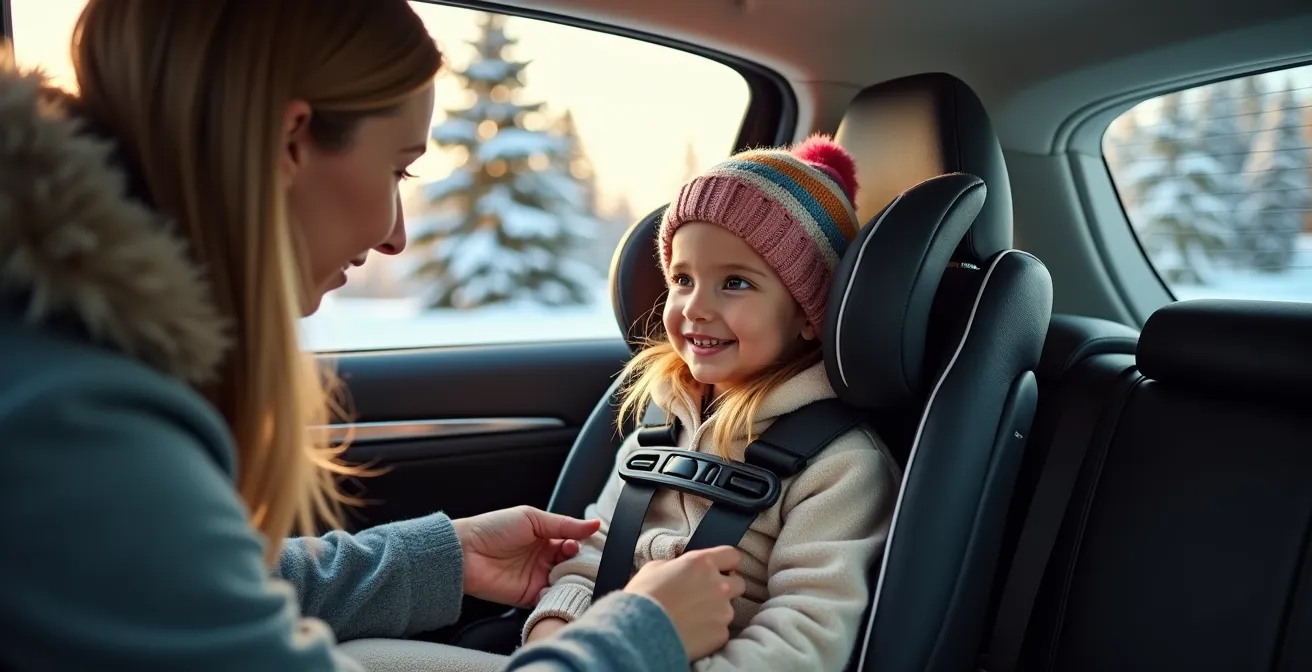
Following car seat ‘rules’ is not enough; you must understand the physics of a crash to truly protect your child in the Canadian winter.
- A bulky snowsuit creates a fatal gap between the harness and your child, leading to ejection.
- A loose 1.5 lb tablet becomes a 100 lb projectile at highway speeds, nullifying the protection of the best car seat.
Recommendation: Treat your vehicle as a complete safety system where every element—from clothing to loose items—is a critical component in crash force management.
As a certified Child Passenger Safety Technician (CPST) in Canada, I don’t deal in opinions. I deal in physics, biomechanics, and the devastating outcomes of mismanaged crash forces. The parental instinct to keep a child warm in our harsh winters is strong, but it can lead to fatal mistakes. Many parents believe that buying an expensive car seat and following the basic instructions is enough. It is not. The reality is that the safety of your child doesn’t just depend on the seat itself, but on a complete system of choices you make every time you get in the car.
You’ve probably heard the common advice: don’t use a puffy snowsuit. But do you understand why? Do you know the forces that a loose water bottle can exert on your child’s skull in a collision? This guide is not another checklist of generic tips. It is a direct, uncompromising look at the science behind child passenger safety in a Canadian winter. We will move beyond the what and dive deep into the why. We will dissect the integrity of the materials, the fallacies of installation methods, and the deadly potential of an untidy car. My tone is strict because the laws of physics are unforgiving. Your child’s life is non-negotiable, and understanding these principles is your most powerful tool to protect it.
This article provides a rigorous, science-based examination of the most critical and often misunderstood aspects of winter car safety. The following sections will equip you with the knowledge to think like a safety engineer, ensuring your child is protected against the unique dangers of Canadian driving conditions.
Summary: Beyond the Seat: Keeping Children Safe in Canadian Winters
- Why wearing a snowsuit in a car seat can be fatal for a child?
- Do car seats really expire or is it just a marketing scam?
- Is the latch system actually safer than using the seat belt?
- Why a loose tablet becomes a deadly weapon in a rollover?
- Why keeping your child rear-facing until age 4 is safer for their spine?
- Why does sitting too low cause sciatica during long drives?
- Why does the sensor turn off the airbag when a light adult sits there?
- Where to mount an emergency cutter so you can actually reach it?
Why wearing a snowsuit in a car seat can be fatal for a child?
This is the most critical, non-negotiable rule of winter car seat safety. A bulky snowsuit creates a false sense of security. In a crash, the immense forces cause the fluffy padding of the suit to compress instantly. This introduces a catastrophic amount of slack into the harness system. In fact, crash testing reveals that a bulky coat can create up to 4 inches of dangerous slack in the harness. This gap is often enough for a child to be partially or fully ejected from the car seat, resulting in severe injury or death. The harness must be snug against the child’s solid body, not against compressible air and fabric.
As Katherine Hutka, President of the Child Passenger Safety Association of Canada (CPSAC), states with absolute clarity:
For the best protection in a car seat, the harness must be snug on the child’s body. In the force of a crash, extra padding and fluff can compress and the straps may become suddenly loose.
– Katherine Hutka, Child Passenger Safety Association of Canada
To verify proper tightness, you must perform the « pinch test » after buckling your child in. At the collarbone, if you can pinch a horizontal fold of the harness webbing, it is too loose. You should not be able to pinch any excess webbing. For warmth, place coats and blankets over the top of the buckled harness, never underneath. This provides warmth without compromising the integrity of the safety system.
Follow this procedure without deviation:
- Warm up your vehicle for 5-10 minutes before you plan to leave.
- Dress your child indoors in thin, warm layers, such as fleece or thermal underwear.
- Place the child in the car seat without their bulky outer coat. Buckle the harness and perform the pinch test.
- For warmth, you can place the child’s coat on them backwards, over the buckled harness, or use a car seat-safe poncho.
- Add a blanket over the buckled harness for additional warmth if necessary.
Do car seats really expire or is it just a marketing scam?
This is not a marketing scam; it is a matter of material science. Car seats have an expiry date for the same reason a hockey helmet does: over time, the materials degrade. The plastic shell is subjected to a brutal cycle of temperature extremes in Canada—from -30°C in a cold-soaked car to +40°C in the summer sun. This constant expansion and contraction causes the plastic to become brittle and develop micro-fractures that are often invisible to the naked eye. In a crash, a seat made of this degraded plastic may not manage the forces as designed; it could shatter instead of absorbing the impact.
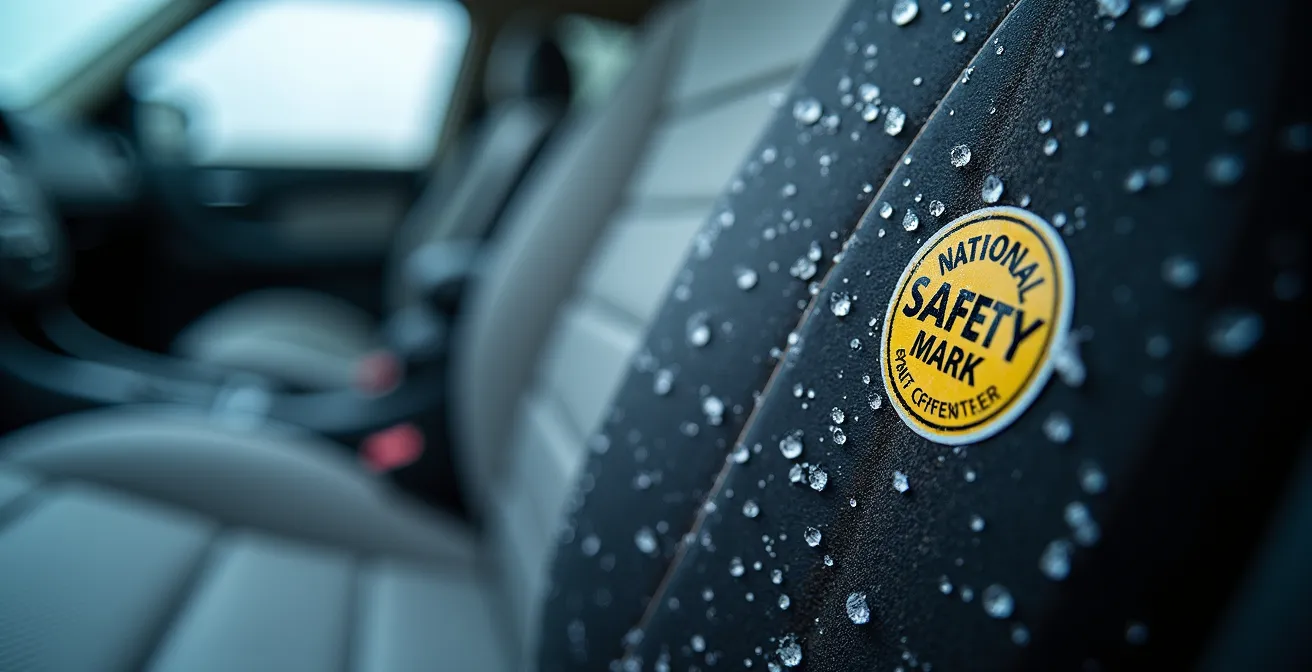
Furthermore, safety standards evolve. A seat from 10 years ago does not meet today’s more rigorous Canadian Motor Vehicle Safety Standards (CMVSS). Manufacturers are constantly improving designs based on new crash data. Using an expired seat means you are using outdated technology. While using an expired seat is not a specific ticketable offense in most of Canada, it is an unacceptable risk. In the event of a crash, its failure could lead to liability issues and, more importantly, the injury of your child. Considering that Transport Canada data shows that up to 80% of car seats are not used properly, ensuring your seat is within its valid life is a fundamental first step you cannot skip.
Is the latch system actually safer than using the seat belt?
The correct answer is: the safest installation method is the one you can perform correctly, every single time, to achieve less than one inch of movement at the belt path. Neither the LATCH (Lower Anchors and Tethers for Children) system—also known as UAS in Canada—nor the vehicle seat belt is inherently safer than the other. When used correctly, they both meet stringent safety standards. The significant difference lies in their application and limits.
The LATCH system was designed to simplify installation, but this simplicity can create a false sense of confidence. A 2015 roadside study by the Child Passenger Safety Association of Canada (CPSAC) found critical errors, including using both LATCH and the seatbelt simultaneously (which is prohibited by most manufacturers), and exceeding the system’s weight limits. It is crucial to understand these differences.
This table from Transport Canada data summarizes the key considerations:
| Installation Method | Weight Limit | Center Seat Availability | Installation Ease | Safety Rating |
|---|---|---|---|---|
| LATCH/UAS System | 65 lbs (child + seat combined) | Rarely available | Easier for most parents | Equally safe when used correctly |
| Vehicle Seat Belt | No weight limit | Always available | Requires proper locking technique | Equally safe when used correctly |
The most critical point is the LATCH weight limit. The lower anchors have a maximum capacity that includes the weight of the child AND the car seat itself. Once this combined weight exceeds 65 lbs (29.5 kg), you MUST switch to a seat belt installation. You must check your car seat and vehicle manuals to confirm the specific limits. Do not guess.
Why a loose tablet becomes a deadly weapon in a rollover?
In a collision or rollover, every unsecured object in your vehicle becomes a projectile. Its effective weight is multiplied by the speed and force of the impact. This is the principle of the kinetic energy multiplier. An object that seems harmless can become a lethal weapon. Consider a standard 1.5 lb tablet. While it feels light in your hands, physics calculations demonstrate that this tablet can exert over 100 lbs of force during a 100 km/h impact. This is more than enough force to cause a fatal head injury to any occupant, including a child perfectly secured in the best car seat.
This applies to everything in your vehicle: a thermos of coffee, an ice scraper on the floor, a bag of road salt on the back seat, or groceries in the cargo area. Your car seat can only protect your child from the initial crash forces; it cannot protect them from secondary impacts from unsecured objects inside the cabin. A clean, organized car is a safe car. Before every single drive, especially in winter when we carry more gear, you must conduct a cabin sweep.
Your 5-Point Winter Projectile Audit
- Points of Contact: Identify all unsecured items in the passenger cabin—electronics, drink containers, emergency supplies, and personal items.
- Collect and Inventory: Gather every loose object. List what must be accessible (e.g., phone) versus what can be stowed (e.g., ice scraper).
- Assess Coherence with Safety: Does this item *need* to be in the cabin? A « no » means it goes in a secured trunk or cargo hold.
- Evaluate Securing Method: For items remaining in the cabin, are they in a closed compartment, a proper cup holder, or a crash-tested holder? An open bin or seat pocket is not secure.
- Implement the Plan: Secure every single item. Make this a non-negotiable pre-drive habit for every passenger.
Why keeping your child rear-facing until age 4 is safer for their spine?
Keeping your child rear-facing for as long as possible is one of the most significant safety decisions you can make. It is not about leg comfort; it is about spinal protection. A young child’s head is disproportionately large and heavy compared to their body, and their vertebrae are still developing (they are connected by soft cartilage, not fused bone). In a frontal collision—the most common and most severe type of crash—the body of a forward-facing child is thrown violently forward, held back only by the harness. Their head, however, is not restrained and snaps forward with incredible force, putting extreme stress on the neck and spinal cord. This can result in spinal separation, paralysis, or death.
A rear-facing car seat works like a catcher’s mitt. It absorbs the crash forces and distributes them evenly across the strong shell of the seat, cradling the child’s head, neck, and spine in perfect alignment. This spinal protection zone is the single best defense for a developing child. While provincial laws provide a legal minimum to turn a child forward-facing, these are not best practice. Safety experts and car seat manufacturers universally recommend keeping your child rear-facing until they reach the maximum height or weight limit of their convertible car seat, often around age 4.
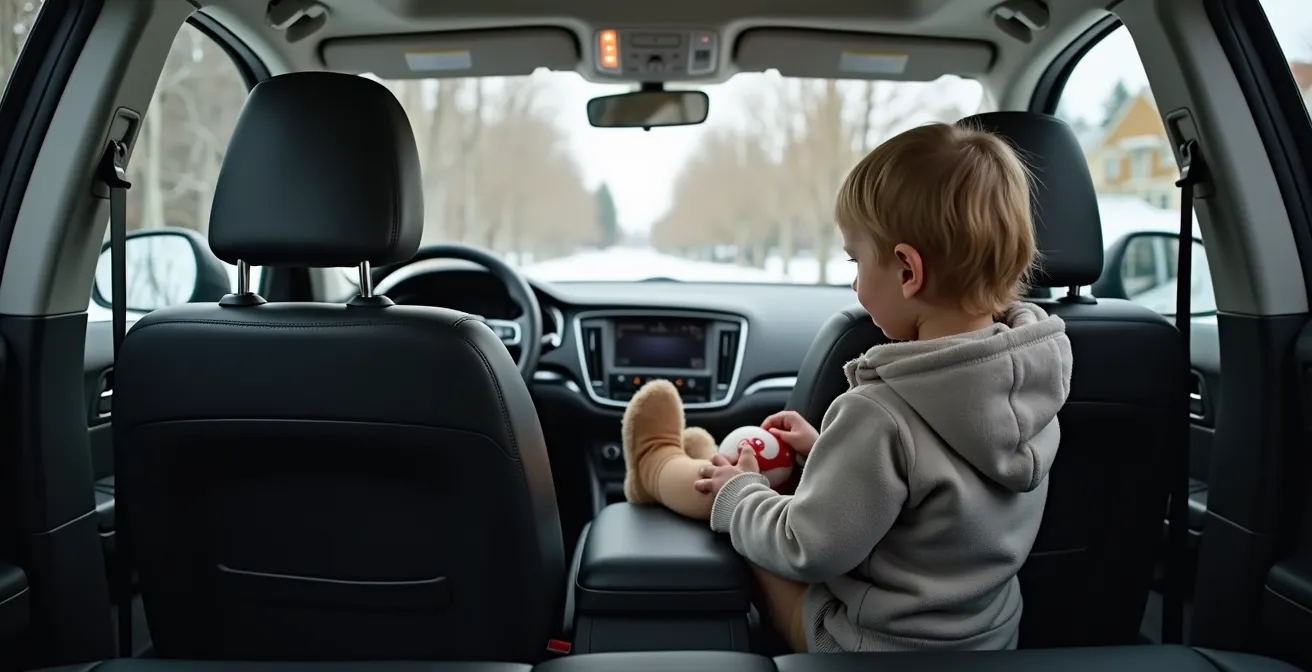
Do not be concerned about your child’s legs touching the back of the vehicle seat. Children are far more flexible than adults and will comfortably find a position. There is no data to support an increase in leg injuries for rear-facing children; it is a life-saving position.
Why does sitting too low cause sciatica during long drives?
While much of our focus is on child restraints, the driver’s condition is a critical component of the vehicle’s overall safety system. An uncomfortable, pained, or fatigued driver is a distracted and less responsive driver. Sciatica—nerve pain radiating down the leg from the lower back—is a common complaint for Canadian drivers on long winter road trips. It is often caused by improper seat ergonomics, specifically sitting too low. When the seat is too low, your hips are positioned below your knees. This posture rotates your pelvis backward, flattens the natural curve of your lumbar spine, and puts direct, sustained pressure on the sciatic nerve.
Proper seat adjustment is not about luxury; it’s about maintaining alertness and control of the vehicle. You must adjust your seat height so that your hips are level with or slightly higher than your knees. Your thighs should be fully supported by the seat cushion without a pressure point behind your knees. This aligns your spine and relieves nerve pressure. The BCAA has found that combining proper seat height with heated seat cushions can significantly reduce back pain on long winter drives. This is because heat keeps muscles pliable, and a proper ergonomic position prevents strain, ensuring the driver remains focused on the road and the safety of their passengers.
Case Study: Ergonomic Solutions for Canadian Winter Driving
A BCAA study on long-haul winter driving between Vancouver and Calgary highlighted a key material science issue for Canadian drivers. They found that common gel-based lumbar cushions can become uncomfortably rigid in sub-zero temperatures. Their recommendation is to use memory foam supports, which retain their properties better in the cold. When combined with proper seat height and the use of heated seat cushions, driver-reported back pain and fatigue were reduced by 60%, directly impacting driver alertness and overall vehicle safety.
Why does the sensor turn off the airbag when a light adult sits there?
The « Passenger Airbag Off » light is a function of the Occupant Classification System (OCS), a safety feature mandated in modern vehicles. Its sole purpose is to prevent the airbag from deploying when a child or a child restraint is in the front seat. An airbag deploys with explosive force—up to 300 km/h—and can be fatal to a child. The system uses weight sensors in the seat cushion to determine the occupant’s size. If the weight is below a certain threshold, the system automatically deactivates the passenger-side frontal airbag.
The critical threshold is determined by federal standards. The Canadian Motor Vehicle Safety Standards mandate that the system must suppress the airbag for any occupant weighing less than approximately 66 lbs (30 kg). Therefore, if a petite adult weighing close to this threshold sits in the passenger seat, the sensor may classify them as a child and turn the airbag off. This is especially common if the person is not sitting properly—for example, slouching, sitting on the edge of the seat, or having their feet on the dashboard. This redistributes their weight and can fool the sensor.
If the light stays on for an adult who you know is well over the weight limit, it indicates either improper posture or a system malfunction that requires immediate service at a dealership. Never place aftermarket seat covers, especially thick or waterproof ones, on the front passenger seat, as they can interfere with the OCS sensor’s accuracy and compromise the safety system.
Key Takeaways
- System Integrity: Your child’s safety depends on a chain of correct choices, where a single mistake like a bulky coat can cause total system failure.
- Material Science Matters: Car seats are made of plastic that degrades with time and temperature extremes; expiry dates are non-negotiable for safety.
- Installation is Everything: The ‘best’ installation method (LATCH vs. seatbelt) is the one you can execute perfectly every time, respecting all weight limits.
Where to mount an emergency cutter so you can actually reach it?
In the terrifying event of a rollover or being trapped in a vehicle after a crash, you may only have seconds to free yourself or your child from a seat belt or car seat harness. An emergency cutter (or « seatbelt cutter ») is a vital piece of equipment, but it is useless if you cannot reach it when you are pinned, injured, or upside down. Placing it in the glove box is a critical error. The glove box is often inaccessible after a frontal collision.
Case Study: Canadian SAR Technician Recommendations
Based on experience from winter accidents on highways like the Coquihalla, Search and Rescue (SAR) technicians and Public Health units across Canada recommend a strategy of redundant placement. A primary cutter should be mounted on the driver’s sun visor, accessible even if pinned against the door. A secondary cutter should be placed in the center console for passenger access. A highly visible third cutter in a rear door pocket can be used by external rescuers if the primary occupants are incapacitated. This system of redundancy is a direct lesson from real-world emergencies where drivers could not reach a single, poorly placed tool.
You must not only place your tools strategically but also test your ability to access them. This is not a theoretical exercise. Put on your bulky winter gloves and perform this drill.
- Sit fully buckled in your driver’s seat.
- Simulate being pinned against the driver’s side door by leaning heavily to your left. Can you still reach and deploy the cutter on your sun visor with your right hand?
- Simulate being pushed forward against the steering wheel. Can you reach the cutter in your center console?
- Ensure your passenger can also access and operate the secondary cutter.
- Apply a small piece of reflective or glow-in-the-dark tape to your cutters to make them visible in the dark.
Your responsibility as a parent extends beyond love and care; it requires you to become a rigorous, knowledgeable guardian against the laws of physics. Implement these practices without compromise. The safety of your child is the direct result of the standards you enforce.
Frequently Asked Questions on Beyond the Seat: Keeping Children Safe in Canadian Winters
Why does the airbag off light stay on for my adult passenger?
The passenger may be sitting improperly (slouching or on seat edge), or the sensor may need recalibration at a dealership.
Is it safe to drive with the passenger airbag off light on?
For adults over 66 lbs sitting properly, this indicates a malfunction requiring immediate service.
Can aftermarket seat covers affect the sensor?
Yes, thick or waterproof seat covers can interfere with weight sensors and should be avoided.