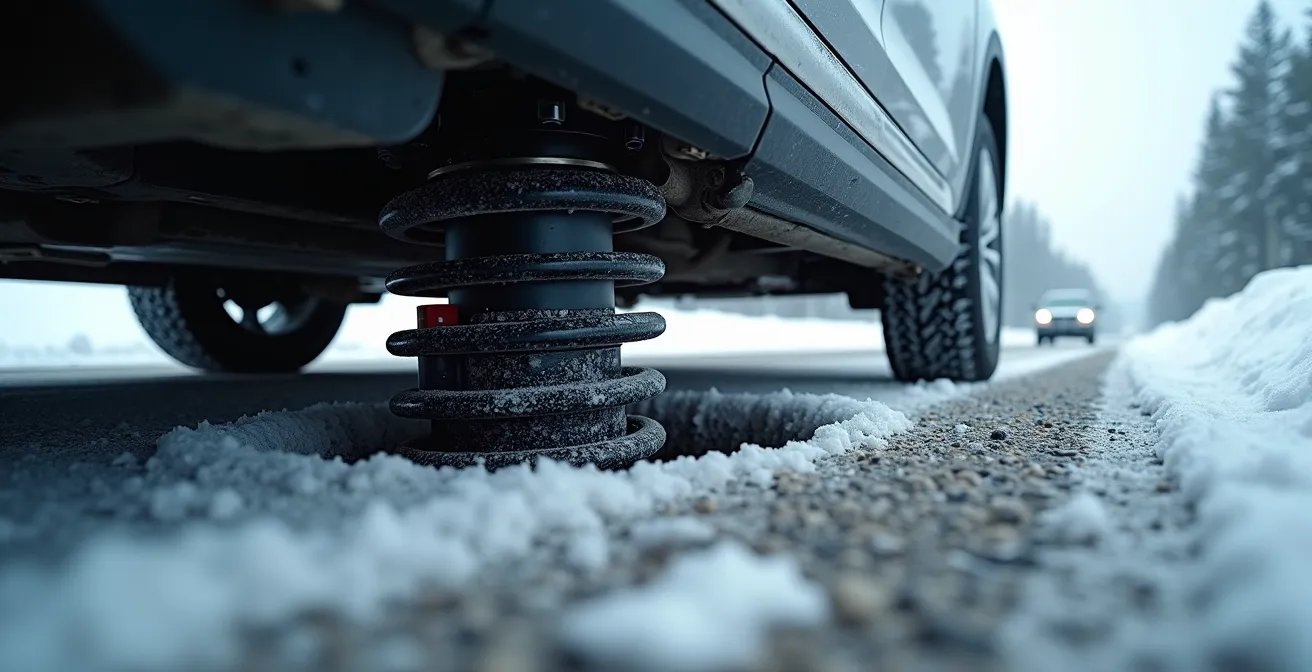
The promise of a smooth ride from adaptive suspensions is a costly illusion on Canada’s harsh, salt-covered roads.
- This complex technology fails prematurely due to corrosion and pothole impacts, a predictable failure rather than a possibility.
- Repair bills for a single magnetic shock can exceed $2,000, quickly negating any perceived comfort benefits.
Recommendation: For most Canadian drivers, a quality standard suspension offers far better long-term value, reliability, and predictable, affordable maintenance.
You feel it before you see it. That jarring crash as your wheel drops into a pothole hidden by a puddle of spring meltwater in Quebec, or the sickening undulation of a frost heave on an Edmonton side street. It’s the Canadian driving experience. At the dealership, the salesperson painted a beautiful picture: an adaptive suspension that offers the « best of both worlds. » A system that reads the road a thousand times a second to give you a cloud-like ride over bumps and taut, sporty handling in the corners. It sounds like the perfect solution for our less-than-perfect roads.
But they never talk about the « salt-and-pothole tax. » As a mechanic who has spent decades under vehicles caked in winter grime, I can tell you the hard truth. These sophisticated systems, with their magnetic fluids, complex sensors, and computer controls, were not designed with a Canadian winter in mind. They are a ticking financial time bomb. The real question isn’t whether you’ll enjoy the ride for the first couple of years. The real question is whether you’re prepared for the crippling, four-figure repair bill when—not if—it fails. The comfort is temporary, but the cost is very, very real.
This isn’t about bashing technology. It’s about a pragmatic, brutally honest cost-benefit analysis. We’re going to break down why these systems fail in our climate, what the real-world comfort difference is, what the repair bill actually looks like, and what your options are when the dashboard warning light comes on. This is the conversation the salesperson won’t have with you.
This guide provides a mechanic’s-eye view of the true cost of owning a vehicle with adaptive suspension in Canada. We’ll examine the components, the failure points, and the financial realities to help you make a truly informed decision.
Summary: A Mechanic’s Guide to Adaptive Suspensions in Canada
- Why do magnetic ride shocks fail faster in road salt conditions?
- Standard vs Adaptive: Is the comfort difference noticeable on frost heaves?
- The $2,500 shock absorber: Preparing for the maintenance bill
- How to delete your air suspension without triggering dashboard errors?
- How to drive over speed bumps to extend your suspension life?
- Stiff vs Soft suspension: What is actually safer for Canadian potholes?
- The $50 bushing that saves your $1000 tires from uneven wear
- OEM vs Aftermarket Parts: Which Should You Choose for Repairs?
Why do magnetic ride shocks fail faster in road salt conditions?
Let’s get straight to the heart of the problem. Magnetic ride systems like MagneRide are technological marvels. The dampers are filled with a special magnetorheological fluid, which is basically synthetic oil filled with tiny iron particles. When an electric current is applied, the particles align, and the fluid stiffens—instantly. This allows the car’s computer to adjust damping on the fly. The issue isn’t the theory; it’s the execution in a harsh environment. The primary failure point is the seals. Road salt, sand, and grime are brutally abrasive. They eat away at the rubber seals designed to keep that precious magnetic fluid inside the shock.
Once a seal is compromised, the failure is catastrophic for the system. Even a small leak means the shock loses its ability to adapt, turning your expensive, high-tech suspension into a sloppy, unresponsive mess. The lifespan of these components is a major concern. While some might last a while in a perfect climate, it’s a different story here. Experience shows that most MagneRide shocks last between 50,000 to 75,000 miles (80,000 to 120,000 km) before they start leaking, a milestone many Canadian vehicles hit just as the factory warranty expires. The constant bombardment of corrosive materials simply accelerates this predictable failure.
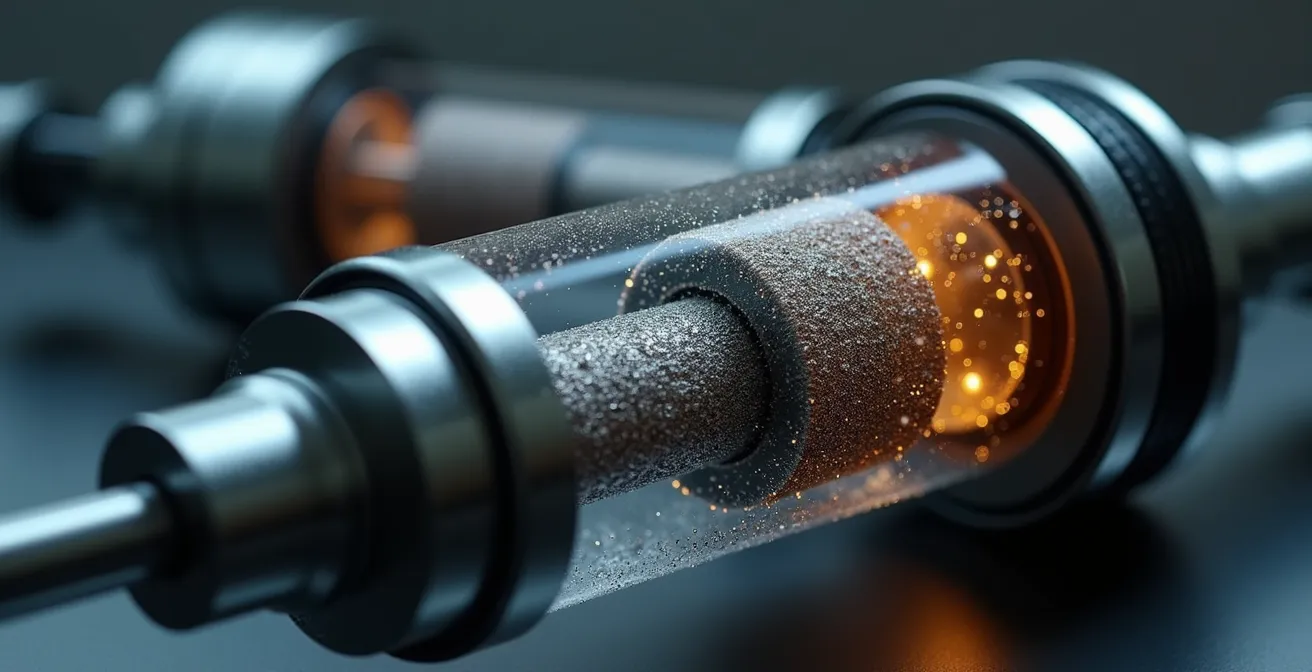
The electronics are another weak point. Each shock has wires and connectors that are exposed to the same salt spray and moisture. Corrosion on these connectors can lead to false readings or a complete loss of signal, triggering error codes and putting the system into a ‘fail-safe’ mode, which is usually uncomfortably stiff. So you have two main enemies: mechanical wear on the seals and electrical corrosion, both made exponentially worse by Canadian road conditions.
This isn’t a random chance of failure; it’s a built-in consequence of using delicate technology in a hostile environment. The system’s complexity is its greatest weakness.
Standard vs Adaptive: Is the comfort difference noticeable on frost heaves?
This is the million-dollar question, or more accurately, the several-thousand-dollar question. Does the adaptive system’s benefit justify its cost and fragility? On a smooth highway or a racetrack, the difference is undeniable. The ability to switch from a comfortable touring mode to a firm sport mode is impressive. But you’re not buying this car for the Nürburgring; you’re buying it for the drive to the cottage past Timmins or navigating the cratered streets of Montreal after a freeze-thaw cycle.
On large, rolling frost heaves, an adaptive suspension does a better job of keeping the tire in contact with the pavement and managing body motion. It reduces the « floaty » feeling you might get with a soft standard suspension. However, for the sharp, jarring impacts of potholes, the benefit is much less pronounced. No suspension can make a 4-inch deep pothole disappear. The adaptive system might take the harshest edge off, but it’s still a violent event for the tire, wheel, and the suspension components themselves.

The perception of comfort is also subjective. Many drivers find a well-tuned premium standard suspension (not the bargain-basement option) offers 90% of the comfort without any of the complexity or future cost. As the Strutmasters Technical Team notes, driving style also plays a huge role: « MagneRide suspensions that are driven hard with lots of hard braking, accelerating, and turning will wear out sooner than those that are driven more gently. » Constant hard use on rough roads accelerates wear, diminishing that comfort advantage over time as the shocks begin to degrade.
Ultimately, the comfort gain is marginal on the very terrain that destroys the system. You’re paying a premium for a small improvement in specific scenarios, a benefit that fades as the parts inevitably wear out.
The $2,500 shock absorber: Preparing for the maintenance bill
Here’s the part that needs to be in bold on the sales brochure. When a standard shock or strut fails, you’re looking at a replacement cost of a few hundred dollars. When a magnetic or air suspension component fails, you are entering a completely different financial league. A single MagneRide shock absorber can cost over $1,200 for the part alone. For high-end air suspension systems, that number can climb even higher. For luxury brands, the bills can be staggering; for instance, some suspension repair costs on a Mercedes-Benz can cost around $2,000 or more, just for one corner of the vehicle.
Because suspension components should always be replaced in pairs to maintain balanced handling and safety, a single leaking shock means you’re on the hook for two. Add in labour, and you are easily looking at a $2,500 to $4,000 repair bill. This isn’t a scare tactic; it’s the standard price of admission for this technology. That single repair can easily wipe out any fuel savings from a more efficient engine or any other « cost-saving » feature the vehicle might have.
This table breaks down the brutal reality of the costs. As shown in a recent comparative analysis, the leap in price is significant.
| Suspension Type | Cost Range (CAD) | Common Vehicles |
|---|---|---|
| Standard Suspension | $200-$1,000 | Toyota Camry, Honda Accord |
| MacPherson Strut | $200-$400 per strut | Most sedans and compact cars |
| Adaptive/MagneRide | $1,200-$2,000 per shock | GMC Yukon Denali, BMW, Audi |
| Air Suspension | $1,500-$2,500 per strut | Mercedes S-Class, Lincoln Navigator |
Your Post-Winter Canadian Suspension Checklist
- Inspect all four shocks/struts for visible fluid leaks or physical damage from salt corrosion.
- Check control arm bushings and sway bar links for cracks and excessive winter wear.
- Examine suspension height sensors and their wiring for signs of salt damage and corrosion.
- Test the ride quality over known road imperfections to detect any changes in stiffness or noise.
- Get a professional diagnostic scan for any stored adaptive suspension error codes, even if the light isn’t on.
Think of it this way: the money you « save » by choosing a lower trim level without the adaptive suspension is money you are effectively pre-paying for its inevitable repair.
How to delete your air suspension without triggering dashboard errors?
So, the worst has happened. Your luxury SUV’s air suspension has failed, the compressor is shot, a strut is leaking, and you’re facing a repair bill that costs more than a decent used car. You don’t have to be held hostage by the dealership’s service department. There is a pragmatic escape route: a coil spring conversion kit, often called a « suspension delete. » This is a popular and smart solution for aging vehicles with failed air or electronic suspensions.
The concept is simple: you remove the complex, failure-prone air springs and electronic struts and replace them with robust, reliable, and traditional steel coil springs and passive shock absorbers. This returns the vehicle to a standard, non-adaptive suspension setup. The biggest challenge with this conversion has always been the vehicle’s computer. If you simply remove the components, the system will detect a fault and illuminate your dashboard with warning lights and error messages, potentially affecting other systems like traction control.
Case Study: The Arnott Coil Spring Conversion Solution
Companies like Arnott Industries have specialized in solving this exact problem. Their coil spring conversion kits are engineered to not only replace the physical air suspension components but also to safely trick the vehicle’s computer. Each kit typically includes an innovative Electronic Bypass Module (EBM). This small electronic device plugs directly into the vehicle’s harness and sends a signal to the suspension control unit that mimics a perfectly functioning system. As a result, no fault codes are triggered, and the dashboard remains clear of warning lights. It’s a clean, permanent solution that gets you off the high-cost repair treadmill.
This conversion provides a predictable, long-term fix. While you lose the on-the-fly adjustability, you gain peace of mind and a suspension that costs a fraction to maintain going forward. For a vehicle that’s out of warranty, this is often the most financially sound decision, transforming a potential money pit into a reliable daily driver once again.
Choosing to convert your suspension isn’t admitting defeat; it’s making a smart, strategic decision to prioritize reliability and cost-effectiveness over a feature that has become a liability.
How to drive over speed bumps to extend your suspension life?
Let’s be clear: no driving technique will make a fragile suspension invincible against Canadian roads. However, you can adopt habits that reduce unnecessary stress and may slightly prolong the life of your shocks, bushings, and ball joints, whether they’re adaptive or standard. It’s about minimizing the violence of impacts. Speed bumps are a perfect training ground for this, as the same principles apply to potholes and other road hazards.
The worst thing you can do is brake hard right up to the speed bump and stay on the brakes as you go over. When you brake, the front of the car dives, compressing the suspension. A compressed suspension has no upward travel left to absorb the bump, so the impact is transmitted harshly through the chassis. The correct technique is to brake early and release the brakes just before your tires make contact. This allows the suspension to rebound to its normal height, giving it the full range of travel to soak up the impact smoothly.
Here are a few other professional tips to minimize suspension wear:
- Approach at an angle: If the road is wide enough, approaching a speed bump at a slight 20-30 degree angle allows one wheel to compress and rebound before the other, reducing body roll and spreading the load.
- Maintain a steady, slow speed: A constant 5-10 km/h is ideal. Don’t try to « jump » it.
- Straddle where possible: For narrow speed humps (not wide tables), you can sometimes position your vehicle so the wheels go around it, avoiding the impact altogether.
- Check tire pressure: Your tires are the first line of defense. Proper inflation is critical, as underinflated tires can’t absorb impacts effectively, transferring more force to the suspension components.
These techniques won’t save a MagneRide shock from salt corrosion, but they will reduce the cumulative damage from daily impacts. Every hard jolt you can avoid is one less bit of stress on seals, bushings, and electronic sensors.
Think of it as mechanical sympathy. The less you abuse the hardware, the longer it will serve you, regardless of how simple or complex it is.
Stiff vs Soft suspension: What is actually safer for Canadian potholes?
There’s a common misconception that a « stiff » or « sporty » suspension is inherently safer because it provides better handling. Conversely, many assume a « soft » suspension is less safe because it feels floaty. The reality, especially on broken pavement, is far more nuanced. Safety in this context comes down to one thing: keeping the tire’s contact patch on the road surface as much as possible. A tire that is skipping in the air over bumps has zero grip for braking or turning.
A very stiff suspension, while great on a smooth track, can be a liability on a pothole-ridden road. It may not have enough compliance to absorb the bump, causing the tire to lose contact with the pavement for a split second. A very soft suspension can also be problematic, as it may wallow and take too long to recover, upsetting the car’s balance. The « best of both worlds » promise of MagneRide is that it can provide the ideal damping for both scenarios. However, this relies on a perfectly functioning system. When the system fails, or if a sensor is damaged, it often defaults to its stiffest setting, which can be the least safe option for a rough road.
Furthermore, the complexity of these systems introduces more points of failure. The Active Suspension System Control Module, the brain of the operation, is another expensive component that can fail. The average cost for an Active Suspension System Control Module Replacement is between $877 to $924, another hidden cost not accounted for in the initial purchase price. A high-quality, well-engineered standard suspension offers a predictable and consistent level of grip. It might not be « optimal » in every single scenario, but its performance doesn’t change, providing a reliable baseline for the driver.
In the real world of Canadian driving, predictable performance is often safer than theoretically optimal performance that relies on fragile, failure-prone technology.
The $50 bushing that saves your $1000 tires from uneven wear
We’ve talked a lot about the big, expensive shocks, but a suspension system is an intricate network of parts. Often, the failure of a very small, inexpensive component can have costly consequences. Case in point: the control arm bushing. A bushing is essentially a rubber or polyurethane cushion that allows for movement in the suspension while absorbing vibration and noise. They are the silent, unsung heroes of your suspension system.
Over time, and accelerated by road salt and extreme temperature swings, these rubber bushings dry out, crack, and fail. When a control arm bushing fails, it allows for excessive, unwanted movement in the suspension. This throws off your vehicle’s alignment. Even a slight deviation in alignment can cause your tires to wear unevenly and rapidly. You might notice the inside or outside edge of a tire going bald while the rest of the tread is fine. That $1,000 set of premium all-season tires can be ruined in less than 20,000 km due to a single, failed $50 bushing.
Other critical but often overlooked components are the ball joints. As the NAPA Auto Care Technical Team explains, « Bushings and ball joints need to remain flexible, while also controlling several tons of car, truck or SUV. » These joints are another pivot point that can wear out. Replacing a worn ball joint is more expensive than a bushing, with costs that can range from $100 to $400 per joint. Ignoring a noisy or loose ball joint is a major safety risk, as a complete failure can cause the wheel to partially detach from the vehicle.
Regularly inspecting these small, cheap parts during your seasonal tire changes is the smartest, most cost-effective maintenance you can perform. It’s about preventing a small problem from becoming a big, expensive one.
Key Takeaways
- Adaptive suspensions are highly susceptible to premature failure from road salt, corrosion, and pothole impacts common in Canada.
- The repair cost for a single adaptive shock often exceeds $1,500, making long-term ownership disproportionately expensive compared to standard systems.
- For aging vehicles, converting a failed air or electronic suspension to a traditional coil spring system is a reliable and cost-effective permanent solution.
OEM vs Aftermarket Parts: Which Should You Choose for Repairs?
When your high-tech suspension finally fails and you’re faced with that four-figure quote, you have a critical decision to make. Do you pay the premium for Original Equipment Manufacturer (OEM) parts from the dealer, or do you explore the world of aftermarket parts? The answer isn’t always simple and depends on your budget, your vehicle’s age, and your long-term plans.
OEM parts are identical to the ones your car was built with. They guarantee a perfect fit and original performance, but they come at the highest cost. For a vehicle still under warranty, this is usually your only option. For an out-of-warranty vehicle, paying top dollar to replace a failed part with an identical, failure-prone part can feel like a fool’s errand. Aftermarket parts are made by third-party companies. The quality can range from excellent (Tier-1 suppliers who may even make the original OEM part) to dangerously poor. High-quality aftermarket parts from reputable brands can offer OEM-level performance for a fraction of the cost.
Then there’s the third option we discussed: conversion kits. This is the most pragmatic choice for a chronically failing system. You sacrifice the adaptive feature but get a brand-new, robust, and simple system for often less than the cost of replacing two OEM shocks. This table gives a clear breakdown of the trade-offs.
| Part Type | OEM | Tier-1 Aftermarket | Conversion Kit |
|---|---|---|---|
| Cost | Highest ($2,000+) | Moderate ($800-1,500) | Lower ($600-1,200) |
| Warranty | 1-2 years | Limited lifetime | 2 years typical |
| Complexity | Maintains all features | Maintains most features | Simplifies system |
| Installation | Direct replacement | Direct replacement | Includes bypass module |
For most drivers of aging vehicles in Canada, a high-quality aftermarket replacement or a full conversion kit offers the most sensible balance of cost, reliability, and peace of mind. Your goal should be to fix the problem permanently, not just reset the timer on the next failure.
Frequently Asked Questions About Suspension Part Selection
Should I replace suspension components in pairs?
Yes, suspension components like shocks and struts should always be replaced in axle pairs (both front or both rear) to maintain balanced performance, handling, and prevent uneven tire wear.
How long do aftermarket suspension parts typically last?
Quality Tier-1 aftermarket parts can last 50,000-100,000 miles (80,000-160,000 km), similar to OEM parts. However, budget or low-quality options may fail in as little as 20,000 miles (32,000 km), so choosing a reputable brand is critical.
Will using aftermarket parts void my vehicle warranty?
In Canada, consumer protection laws are in place similar to the Magnuson-Moss Warranty Act in the U.S. Generally, using aftermarket parts will not void your new vehicle warranty unless the manufacturer can prove that the specific aftermarket part directly caused the failure you are trying to claim under warranty.